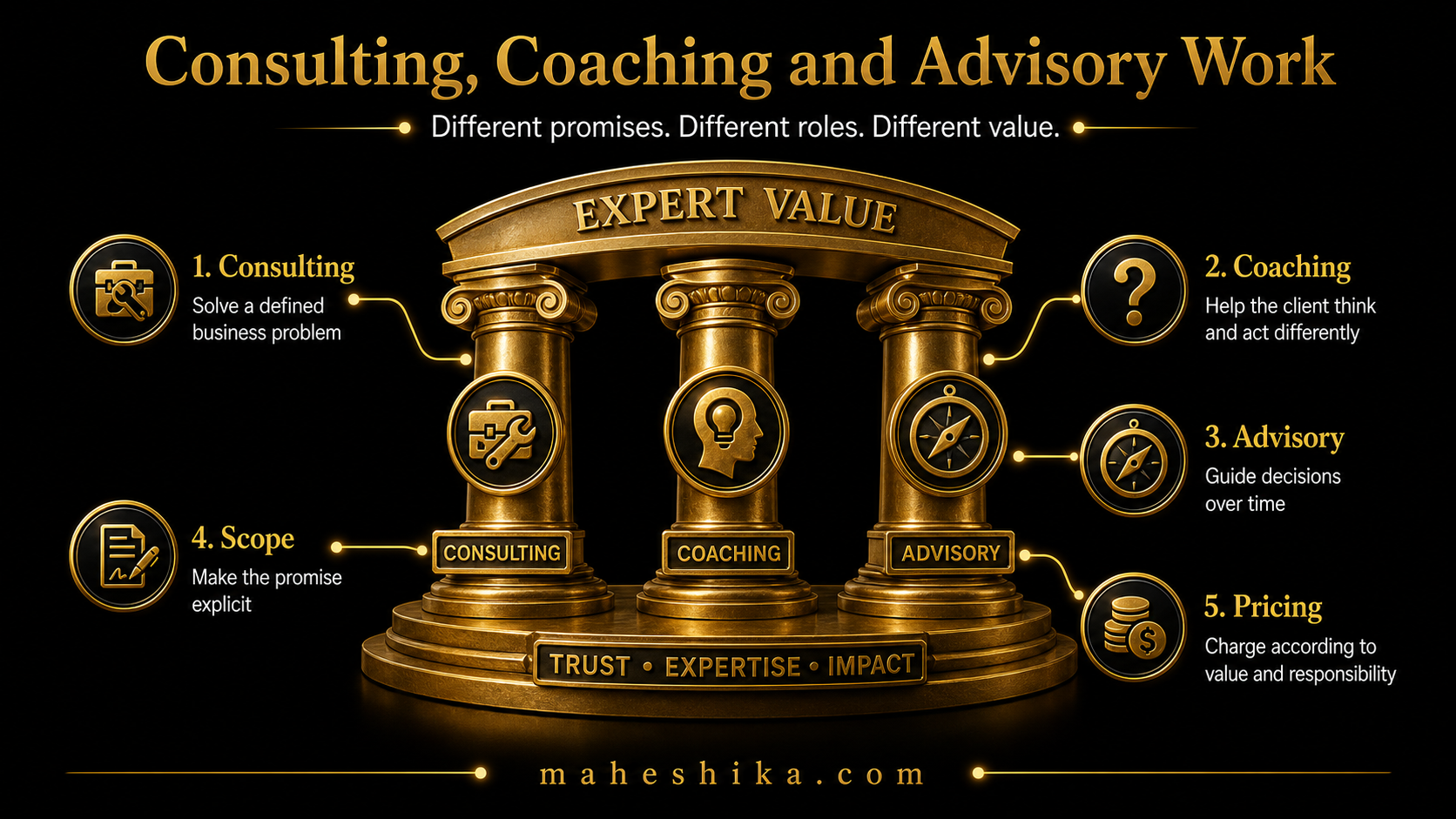
Most independent experts offer some combination of consulting, coaching, and advisory work without being fully clear on the distinction between them. This matters more than it might appear. Each model carries different expectations, different pricing logic, different client relationships, and different requirements in terms of your time and involvement. Conflating them leads to underpriced work, confused clients, and engagements that do not deliver what either party expected.
Consulting: You Solve the Problem
Consulting is engagement-based work where you take responsibility for solving a defined problem or delivering a defined outcome. The client brings you in because they do not have the expertise or the bandwidth to solve the problem themselves. You diagnose, recommend, and often implement. The output is typically a deliverable: a strategy, a plan, a structure, a process, a recommendation backed by analysis.
The defining characteristic of consulting is that you own the answer. You are not facilitating the client to find their own answer. You are applying your expertise to produce the best answer you can reach with the information available. This places the burden of competence squarely on you. If the recommendation is wrong or does not work, that reflects on your expertise. This is why consulting commands the highest rates of the three models: the client is paying for your judgement, your experience, and the risk you absorb in taking ownership of the outcome.
Good consulting is highly specific. The more precisely defined the problem and the outcome, the better the engagement will go. Consulting that sprawls into vague advisory territory is usually underpriced, overscoped, and leaves the client uncertain about what they are actually getting.
Coaching: The Client Finds the Answer
Coaching is a facilitated process where the client develops their own thinking, decisions, and capability. The coach does not provide answers. They ask questions, create structure, provide reflection, and hold the client accountable to the commitments they make. The output is the client's own enhanced capacity: better thinking, better decisions, more consistent execution.
This is a fundamentally different value proposition from consulting. In coaching, the expertise is in the process of facilitating development, not in the content of the domain knowledge. A skilled coach can work with a CEO on leadership challenges without needing to know the specifics of the CEO's industry. The depth of domain knowledge that makes a consultant valuable can actually be a liability in coaching, because it creates the temptation to give answers rather than draw them out.
Senior professionals who have transitioned to independence sometimes offer coaching when they really mean consulting, because coaching sounds less presumptuous. This is a positioning mistake that leads to confused client expectations and underpriced work. If you are bringing your domain expertise to bear and directing the work toward outcomes you have determined are the right ones, you are consulting. Call it that, and price it accordingly.
Related Reading
Advisory Work: You Are a Trusted Resource
Advisory work sits between consulting and coaching in character, but it has its own distinct logic. An advisor is retained for ongoing access to their thinking, judgement, and perspective. The advisor is not brought in to solve a specific defined problem on a project basis. They are retained to be available: to review strategic decisions, to be consulted when relevant challenges arise, to attend key meetings where their perspective adds value, and to provide a sounding board for the leadership of the organisation.
Advisory relationships are typically structured as monthly retainers at a fixed fee. The client is not buying a fixed number of hours. They are buying the certainty of access and the peace of mind that comes from having a trusted expert in their corner. This means the advisor needs to be genuinely available within the parameters of the arrangement, but not constantly busy delivering defined work.
Advisory is excellent for senior professionals with deep domain expertise who prefer ongoing relationships to project-based work. It is also a highly efficient model: a portfolio of four to six advisory clients at appropriate retainer rates can generate a very strong income with a relatively manageable time commitment. The client gets continuity. The advisor gets predictable recurring income. The dynamic rewards genuine expertise and trust far more than it rewards the ability to produce deliverables quickly.
Free Tool
Start free: where do you actually stand?
Two free tools give you an honest answer in minutes. The AI Risk Score shows how exposed your role is. The Expertise Ownership Score shows how findable and owned your expertise is.
AI Risk Score Expertise Ownership ScoreWhich Model Is Right for You
The honest answer is that most expert businesses involve all three at different levels of their offer stack and at different stages of client relationships. A consulting engagement might naturally transition into an ongoing advisory relationship once the defined project is complete. A coaching engagement might be appropriate for the personal development element of a broader consulting engagement with a senior leader.
The question to ask is: what do my ideal clients most need from me, and what does my expertise most naturally support? If your value is in your domain knowledge and your track record of specific outcomes, consulting and advisory are your primary models. If your value is in helping leaders think more clearly and act more decisively, coaching is a genuine fit. Most senior professionals with deep domain expertise are consultants and advisors first.
Be cautious about offering coaching if your real value is in your domain expertise. Clients who need consulting and receive coaching instead often feel underserved, because they came for your knowledge and received a process. Clarity about which service you are providing, and which the client actually needs, is the foundation of a good engagement.
Own the Asset Behind All Three Models
So the answer is not which label sounds best. It is which model your expertise actually supports, and pricing it with the confidence that comes from knowing the difference. Consulting sells your judgement, coaching sells your process, advisory sells your access. Get the match right and the client relationship, the fee, and the outcome all fall into place. The full picture of how to structure this into a business is in the guide at how to turn your expertise into a business.
But whichever model you lead with, all three depend on the same thing underneath: that clients can find you, verify you, and remember you as the person who does this work. A search engine and an AI assistant cannot tell the difference between a consultant, a coach and an advisor from a LinkedIn headline. What they can find is a website under your own name, where the distinction is made plain, where your track record is documented, and where a client can see exactly which of the three they are hiring before they ever speak to you.
Without that, your positioning lives in your head and in the memory of whoever last heard you explain it. With it, the positioning is permanent, searchable, and unmistakably yours. That is the quiet cost of staying without a home online: not that you lose the work outright, but that every prospective client has to take your word for what you do, instead of simply seeing it.
If you know which model fits you and want a website that makes the distinction obvious to every client who finds you, let us talk it through.