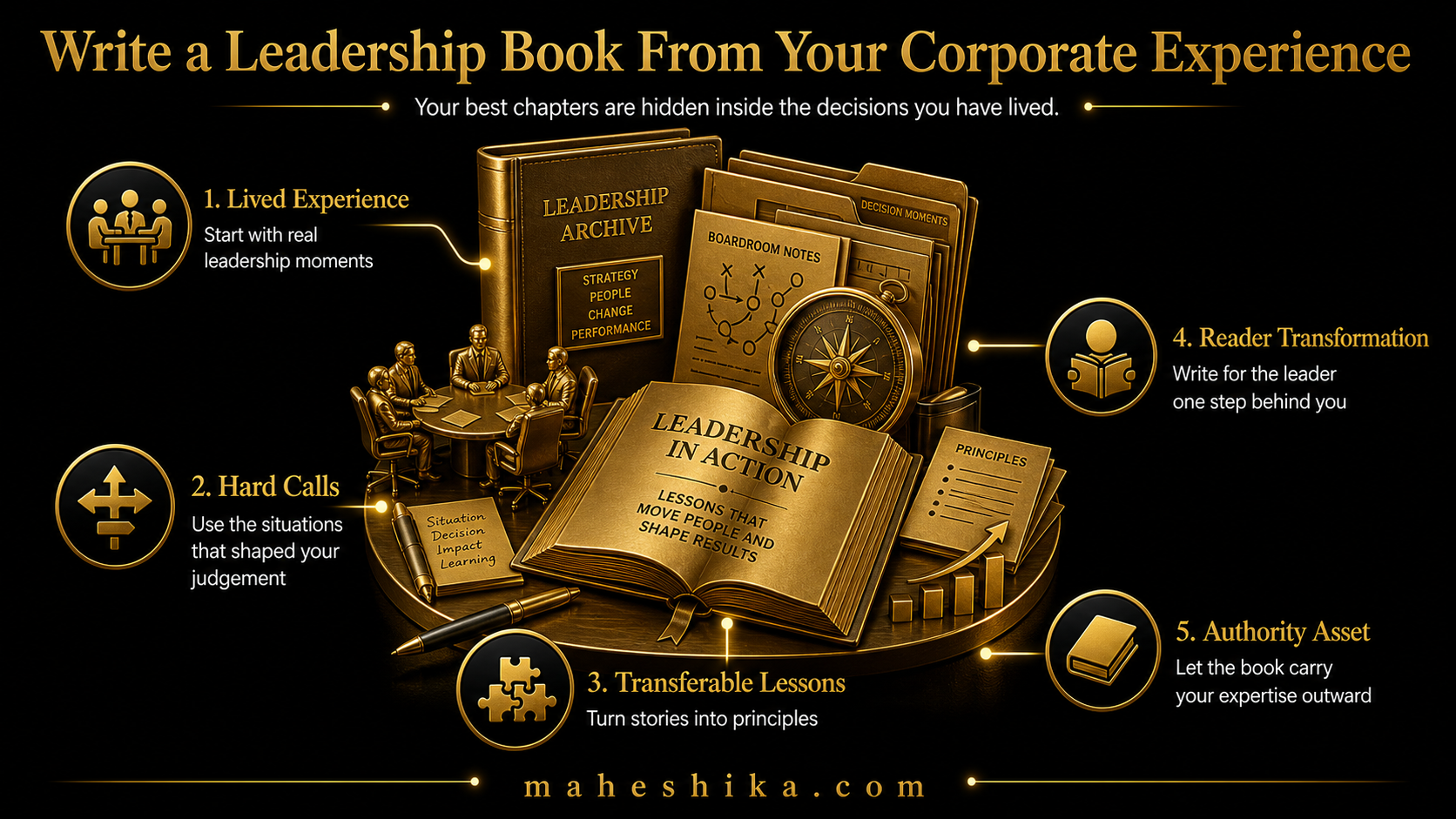
Leadership is one of the most written-about subjects in business publishing and simultaneously one of the most poorly served. The market is saturated with books that offer frameworks without substance, inspiration without application, and theory without the texture of real organisational life. If you have spent 15 or 20 years leading at senior level, you have something most leadership authors do not: actual experience of the complexity that management consultants and academics can only describe from the outside.
That experience is your primary asset as a leadership author. The challenge is learning how to use it effectively rather than simply recounting it.
Choose a leadership problem that your experience uniquely addresses
The leadership book category is broad enough that the most important thing you can do is narrow your focus sharply. "Leadership" is not a book topic. "How leaders in commercial functions build and retain high-performing teams during periods of rapid growth" is a book topic. The more precisely you can define the problem you are solving and the reader you are solving it for, the more useful and distinctive the book becomes.
Look at the specific domains of your leadership experience. Where have you operated at the intersection of complexity, pressure, and meaningful results? What have you learned in those contexts that you have never seen articulated well in other books? That gap is usually where the most valuable leadership books originate.
When I wrote The Job Well Done, the lens was Queen Elizabeth II's 70-year reign as a model of sustained, purposeful leadership. It was not a general book about leadership. It was a specific exploration of what it means to perform a role with consistent excellence across decades. The specificity of that lens made the book distinctive in a crowded market.
Extract the framework from your experience, not the narrative
Corporate memoir and leadership framework are different literary forms. A memoir is a chronological account of what happened to you. A leadership framework book uses selected experiences as evidence for principles that readers can apply in their own contexts. Most strong leadership books are the second type, not the first.
To extract your framework, review your career through a specific lens. Ask: what did I consistently do that worked, even when the context varied? What patterns of behaviour or decision-making produced good outcomes across different teams, different organisations, different market conditions? The consistent patterns are your framework. The specific situations are your evidence.
A simple structure for each chapter: introduce the principle, explain why it matters and what happens when it is absent, illustrate it with a specific story from your experience, draw out the transferable lesson, and give the reader a practical application. This architecture repeats across the book, creating a rhythm that readers find easy to navigate and remember.
Related Reading
Handle confidentiality without sacrificing specificity
One of the most common concerns I hear from senior professionals considering a leadership book is the tension between specificity and confidentiality. Their best stories involve real organisations, real people, and real situations that cannot be disclosed without risk.
There are several ways to navigate this. The most straightforward is to anonymise or composite: change the names, the industry, and enough contextual details to make identification impossible while preserving the instructive essence of the situation. Be transparent with readers that some details have been changed. Another approach is to use publicly documented examples from other organisations alongside your own experience, treating your private examples as background context that informs your analysis of public cases. A third approach is to focus on your own decisions and responses rather than others' behaviour, which reduces the sensitivity of the material considerably.
Free Tool
Start free: where do you actually stand?
Two free tools give you an honest answer in minutes. The AI Risk Score shows how exposed your role is. The Expertise Ownership Score shows how findable and owned your expertise is.
AI Risk Score Expertise Ownership ScoreWrite for the reader who is ten years behind where you are now
One of the most useful calibration tools for a leadership book is this: imagine the senior professional you were at age 35 or 40, dealing with the challenges you faced then. What did you need to know that you only learned later? What would have saved you years of costly trial and error? What did you have to discover through painful experience that someone could have simply explained?
That earlier version of you is your primary reader. This reframe does two things. First, it grounds the book in genuine usefulness rather than retrospective self-congratulation. Second, it surfaces the most valuable material: the hard lessons, the mistakes, the moments of recalibration. These are the chapters readers underline. They are also the chapters that establish you as someone who has lived what they are describing, rather than someone who has studied it.
Let the writing surprise you
Something happens when experienced leaders write seriously about their own practice: they discover things they did not know they knew. The process of articulating a principle, finding the right story to illustrate it, and then working out the transferable lesson forces a depth of reflection that ordinary professional life rarely creates.
Some of the best sections of a leadership book emerge not from what you planned to include but from what the writing itself draws out. Leave room for this. Do not treat the first outline as a fixed contract. Allow the manuscript to develop as you write, and follow the threads that feel most alive. A leadership book that surprises its author tends to be the kind that surprises and challenges its readers too. That is where the value lives.
The Book Is the Proof, Not the Whole Point
So write the book from a narrow problem, a real framework, and the hard-won lessons the earlier version of you needed. Do that and you will have produced something rare: a leadership book with actual authority behind every page, rather than borrowed theory dressed up as experience.
But finish the manuscript and a quieter problem appears. A book on a shelf, or even a bestseller on Amazon, is a moment. It sells, it is read, and then it is behind the next release in the algorithm. Meanwhile the reader who was moved by your chapter on leading through pressure has no way to find you again next month, next year, when they actually need you. Your expertise proved itself for 300 pages and then had nowhere permanent to live.
That is the gap AI has made expensive. Anyone can now generate a plausible paragraph on leadership in seconds, in a voice indistinguishable from a hundred others. What nobody else can generate is you: a named author with a published book, findable under your own name, with your thinking, your framework, and your body of work gathered in one place a search engine can point straight to. A personal website is what turns a book that was read once into an authority that is found again and again.
You do not have to work out how to build that on your own, and you do not have to wait until the book is finished to start. If you would like to talk through what that would look like for your book and your experience, let us talk.