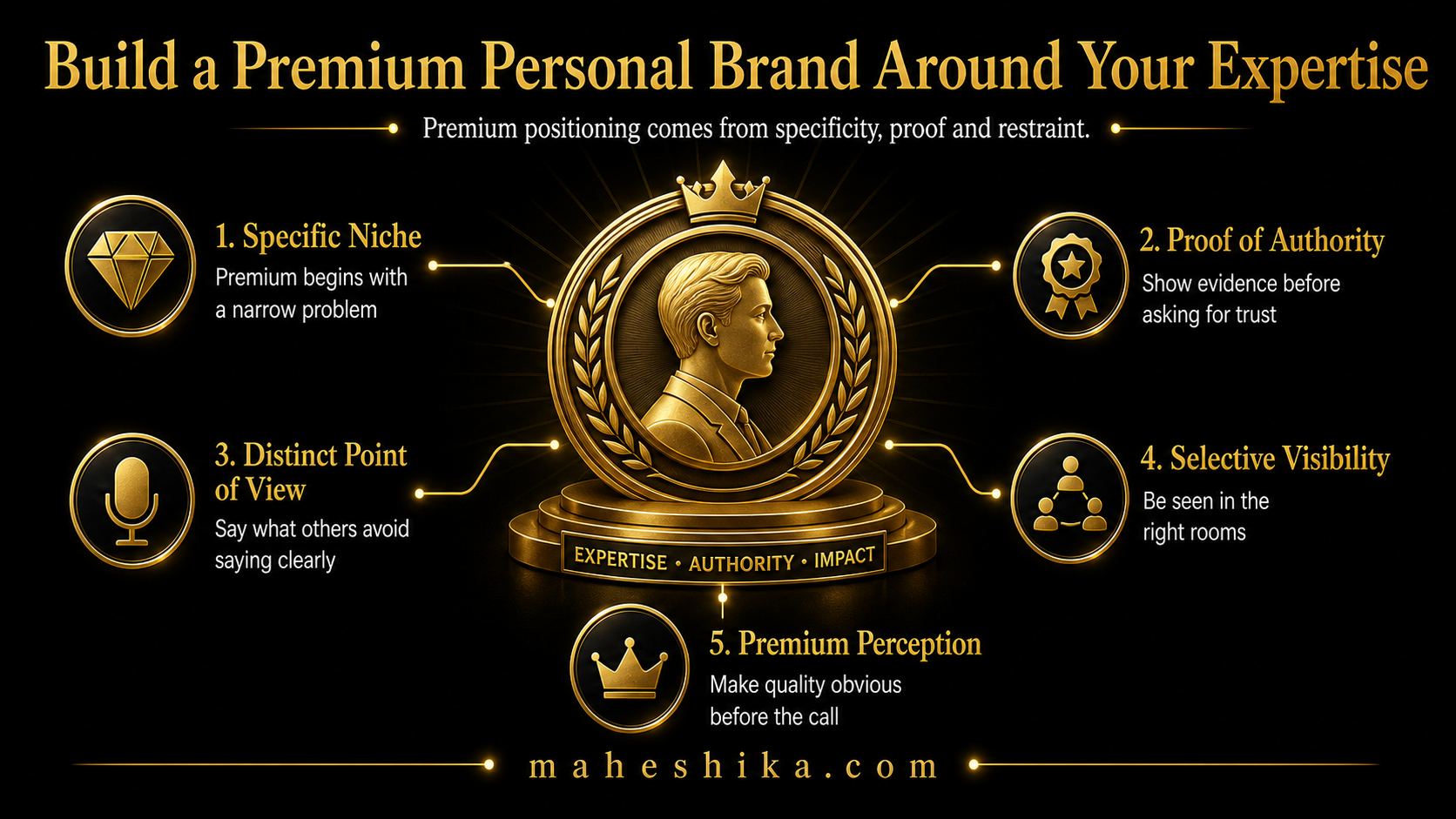
There is a version of personal branding that requires you to perform daily on social media, optimise for engagement metrics, and present a curated version of your life as though your expertise were inseparable from your personality. This works for certain people in certain contexts. It is not the only model, and for many senior professionals, it is exactly the wrong one.
A premium personal brand is built differently. It is built on the quality and distinctiveness of your thinking, the specificity of what you stand for, and the consistency with which you show up in the spaces your ideal clients and partners actually inhabit. It attracts rather than chases. It positions rather than performs. Here is how to build it.
Define your positioning with precision before you build anything
The most common personal branding mistake is beginning with tactics: posting on LinkedIn, redesigning a website, updating a bio. These are useful, but they are only useful once you have clarity on what you are positioning for and who you are positioning to.
Your positioning statement is the foundation. It answers three questions with a single coherent answer: what is the specific problem you solve, who specifically experiences that problem, and what is distinctive about how you solve it compared to everyone else with similar credentials?
"I help senior professionals" is not a positioning statement. It is a category. "I help chief commercial officers in Series B and C technology companies build the sales infrastructure they need to move from founder-led revenue to scalable growth" is a positioning statement. It names the problem, the person, and the context with enough specificity that the right client recognises themselves in it immediately.
Until you have this clarity, any effort you spend on branding is speculative. The clarity comes from examining your strongest work: the clients you helped most significantly, the problems you solved most effectively, the outcomes you can point to with the most confidence. The positioning emerges from that analysis, not from an abstract exercise about values and vision.
Choose depth over breadth in your content strategy
A premium personal brand is not built on volume. It is built on depth. One genuinely insightful article per month, consistently, for 18 months, will build a stronger position than 30 LinkedIn posts per month that say slightly different versions of the same surface-level observation.
The content that builds premium positioning is specific, opinionated, and draws on experience that the reader cannot easily find elsewhere. It names real problems with real precision. It offers frameworks that are original, not recombinations of ideas from other books. It is willing to disagree with conventional wisdom when experience suggests the conventional wisdom is wrong.
This kind of content takes longer to produce, but it creates a fundamentally different impression. It signals that you are someone who has thought deeply about your domain, not someone who has read widely about it. For the clients who hire at premium rates, this distinction matters enormously.
Related Reading
Invest in the infrastructure that signals premium positioning
Premium positioning requires premium execution. This means a personal website that reflects the quality of your work: properly designed, clearly written, with a visual identity that communicates professionalism rather than informality. It means professional photography, not a selfie or a cropped conference photo. It means a LinkedIn profile that reads as a positioning document rather than a chronological CV.
None of this is superficial. In the world of high-value consulting and speaking, your digital presence is often the first and only evidence a prospective client has before deciding whether to engage further. A website that looks like it was built in 2014 tells a story. A LinkedIn profile with a generic headline tells a story. The story should be the one you want told.
The investment in professional visual identity and a well-built website pays for itself in the first engagement it secures or upgrades. Clients who pay premium fees expect to find premium infrastructure when they look you up. The infrastructure signals that you take your positioning seriously, which implies that you will take their problem seriously too.
Free Tool
Start free: where do you actually stand?
Two free tools give you an honest answer in minutes. The AI Risk Score shows how exposed your role is. The Expertise Ownership Score shows how findable and owned your expertise is.
AI Risk Score Expertise Ownership ScoreAcquire third-party credibility markers deliberately
Premium brands are validated by others, not only by themselves. Third-party credibility markers: book awards, speaking credits at respected events, published articles in notable publications, testimonials from named clients at significant organisations, academic credentials deployed in context. These signals do work that self-promotion cannot.
Building third-party credibility is not passive. It requires active pursuit. Submit to relevant award programmes. Pitch speaking proposals to the conferences your target clients attend. Write for the publications they read. These activities take time and involve rejection, but the cumulative effect on positioning is transformative. Each marker shifts the burden of proof in your favour. Instead of having to persuade a prospective client that you are as good as you say you are, you have evidence that others, with no stake in the claim, have already made that assessment.
Build the brand through the work, not around it
The most durable premium personal brands are built by professionals who focus on doing exceptional work and communicating about it clearly, rather than by professionals who focus primarily on their brand as an end in itself. The brand is downstream of the work. When the work is genuinely excellent and is communicated specifically, the brand follows.
This means that the primary investment is in the quality of your thinking, the depth of your frameworks, and the outcomes your clients achieve. The communication strategy makes that quality visible. The infrastructure makes it accessible. But none of it replaces the substance.
The Asset That Makes It Permanent
So a premium personal brand is not a performance. It is positioning, sharpened by depth, made credible by others, and made visible by infrastructure that matches the quality of the work underneath it. For a senior professional with 15 or 20 years of real experience, the substance is already there. What has been missing is the clarity, the consistency, and the place to put it.
And that last piece matters more than it looks. Positioning statements live in a pitch deck. Content lives on platforms you do not own, ranked by algorithms you do not control. Credibility markers get buried in a feed within days of being posted. None of it is truly yours until it has a permanent address, one that does not depend on LinkedIn's mood or a publication's editorial calendar. AI now answers most questions in a flattened, generic voice, and a platform can change its rules overnight. What cannot be flattened or deprioritised is a website under your own name, holding your positioning, your best thinking, and your proof, in one place you control outright.
Without it, everything above stays borrowed. The premium brand you have worked to build sits on land you do not own. Build it on your own ground instead, and it compounds for as long as you keep doing the work, findable, unmistakably yours, impossible to mistake for anyone else's.
You do not have to work out the infrastructure alone. If you want the premium brand you have just read about built properly, under your own name, let us talk.