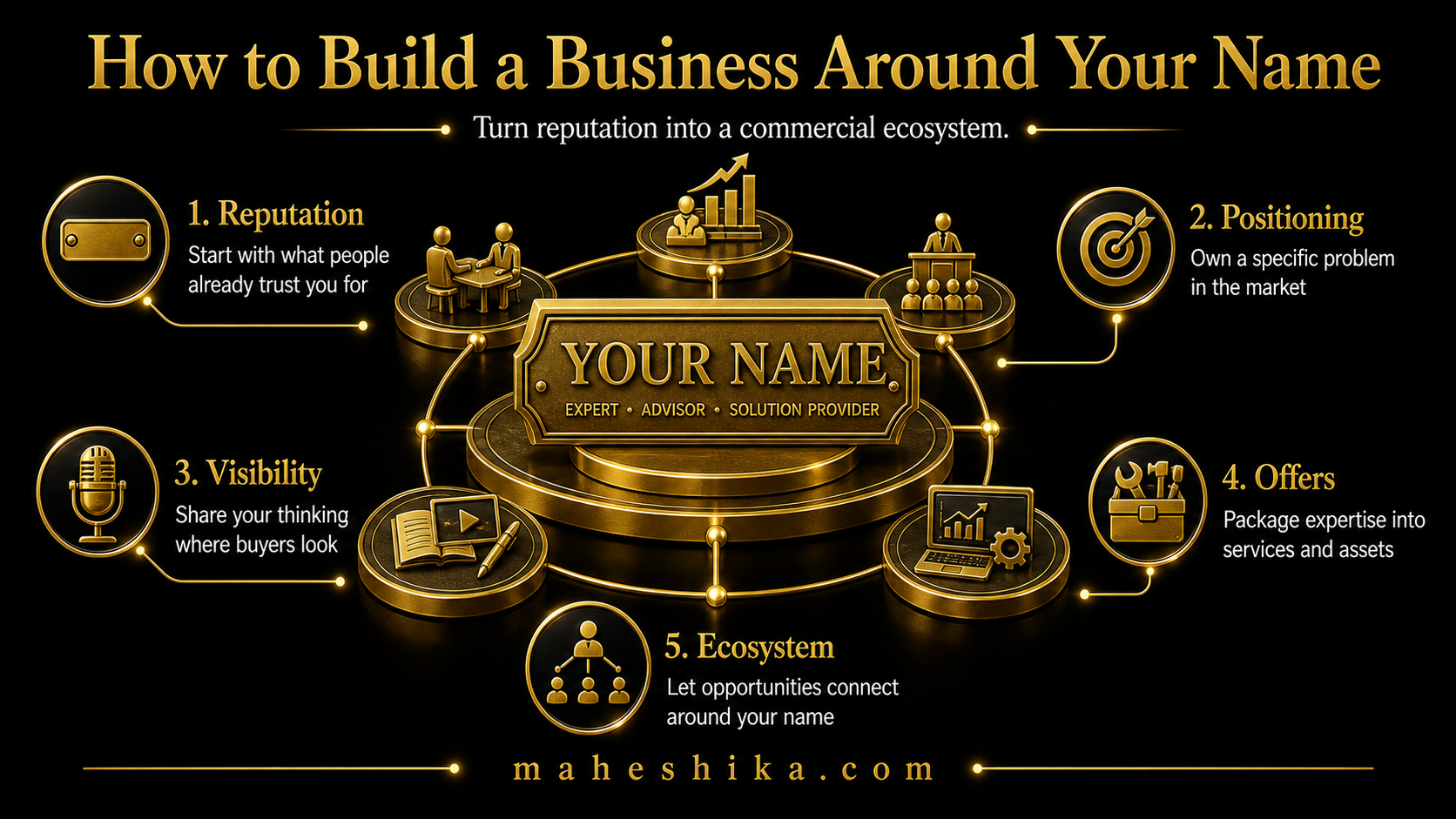
When I made the decision to build this platform under my own name, maheshika.com, I had already spent years hiding behind corporate brands. I was the "head of commercial" at X, the "EMEA lead" at Y. The organisation was the brand and I was a function within it. Going independent changed that equation entirely. Now I am the brand.
For senior professionals with genuine expertise and a credible track record, building a business around your name is not a vanity exercise. It is the highest-leverage commercial decision you can make. This article explains why, and exactly how to do it well.
Why Your Name Outperforms a Generic Business Name
When clients commission senior consultants, they are not buying a brand. They are buying a specific person's judgement, network, and track record. The person is the asset. A generic business name, "Strategic Advisors Limited" or "Peak Performance Consulting", creates a layer of abstraction between the client and the thing they are actually buying, which is you.
An eponymous business removes that abstraction. Clients know exactly what they are getting. They can research you directly. They can read your thinking, watch you speak, understand your professional history. The trust builds faster because there is no brand veneer to see through first.
There is also a compounding effect. Every piece of content you publish, every speaking engagement you do, every book you write, every article you publish, all of it accretes to your name. It cannot be separated from you. Over time, your name becomes searchable, recognisable, and associated with a specific domain of expertise. That is the foundation of a consulting business that generates inbound enquiries rather than one that hunts perpetually for outbound leads.
The Three Pillars of a Name-Based Business
An eponymous expert business is built on three interconnected pillars. Each supports the others, and all three need to be present for the model to work at its full potential.
A clear point of view. You cannot build a business around your name without having a distinctive way of thinking about your domain. Your name needs to stand for something specific. Not just "I do commercial strategy" but "I believe commercial strategy fails because it is disconnected from human behaviour at the front line, and here is how I solve that". A point of view is what gives people a reason to follow you, read your writing, and recommend you to others. Without it, a name-based business is just a name.
A content and visibility strategy. Your name-based business grows through the visibility you create over time. Writing, speaking, and publishing are the primary mechanisms. They do not need to be constant or voluminous. They need to be consistent and genuinely useful. One well-considered article per month, published publicly and distributed to your network, compounds significantly over three to five years.
A central online home. Your website, at your own domain, is the home of your name-based business. It is where your work, your thinking, your credentials, and your contact details live. It is where people are sent when someone recommends you. It needs to be clear, professional, and fast. It does not need to be complex. The most effective expert websites are clean, credible, and specific: who you are, what you do, for whom, and how to engage.
Related Reading
The Authority Assets That Make Your Name Mean Something
A name without evidence is just a name. The authority assets that make an eponymous expert business commercially compelling are specific and intentional.
A published book is the most powerful authority asset available to a senior professional. It is permanent, it travels independently of you, and it signals a level of intellectual commitment and seriousness that no website or LinkedIn profile can replicate. When I published The Job Well Done, it changed how people perceived my expertise in a way that years of accumulated experience alone had not. Not because the book was necessary to validate that experience, but because it made the expertise visible and tangible in a form that clients could hold.
Speaking engagements are the second most powerful authority asset. A keynote at a relevant industry event or a corporate leadership forum puts you in front of exactly the people who need what you offer. It demonstrates your ability to think in public, to hold a room, and to translate expertise into actionable insight. The content you deliver in speaking engagements should be consistent with your written point of view. It is all the same intellectual territory, expressed in different formats.
Case studies and testimonials are the third pillar of authority, and arguably the most directly connected to conversion. Clients hire consultants based on evidence that those consultants have solved similar problems for similar organisations. A small number of specific, detailed case studies, with named clients where possible, is more persuasive than any amount of credentials or general positioning.
Free Tool
Start free: where do you actually stand?
Two free tools give you an honest answer in minutes. The AI Risk Score shows how exposed your role is. The Expertise Ownership Score shows how findable and owned your expertise is.
AI Risk Score Expertise Ownership ScoreThe Compound Effect of Consistency
The most important characteristic of a successful name-based business is not brilliance in any single moment. It is consistency over time. The people who build recognisable, authoritative, commercially productive expert platforms are almost always people who showed up consistently for years: writing, speaking, engaging, contributing to the conversation in their domain.
The early stages feel slow. You publish articles that get modest readership. You speak at events where you are not yet the headline. You build a website that no one has discovered yet. This is not failure. It is the necessary accumulation that precedes any kind of traction. The professionals who give up in year one are exactly the ones who would have had a significant platform in year three.
The practical implications: commit to a sustainable output level and sustain it. Two articles a month, sustained for two years, produces a body of work that demonstrates both expertise and reliability. One article a week for six weeks and then nothing is worse than nothing, because it signals inconsistency.
Your Name Is the One Asset Nobody Can Take Off the Market
So the answer to building a business around your name is not a rebrand or a clever tagline. It is a point of view stated plainly, visibility built in public, and consistency held for years past the point where it feels rewarding. Do those three things and your name stops being a job title. It becomes the asset itself.
Here is the part that makes this urgent rather than optional. AI can now answer almost any question in a competent, well-structured voice, and that voice sounds like everyone. It has read every strategy framework, every leadership model, every case study you have. What it cannot do is be you: it cannot hold your specific judgement, your track record, your name people already trust. But that advantage only counts if your name lives somewhere the world can find it. An employer can disappear overnight. A title can be reorganised out of existence in a single memo. What survives both is the one space you actually own.
A personal website under your own name. Somewhere your point of view lives permanently, your work is shown in full, and your signature is unmistakable, owned outright, findable in a search, impossible to flatten into a generic answer. That is not a marketing extra bolted onto the business. It is the business, the one asset that keeps compounding whether or not you published this week.
You do not have to design and build that home alone, and you do not have to wait until you feel ready. If you want it done properly, let us talk.