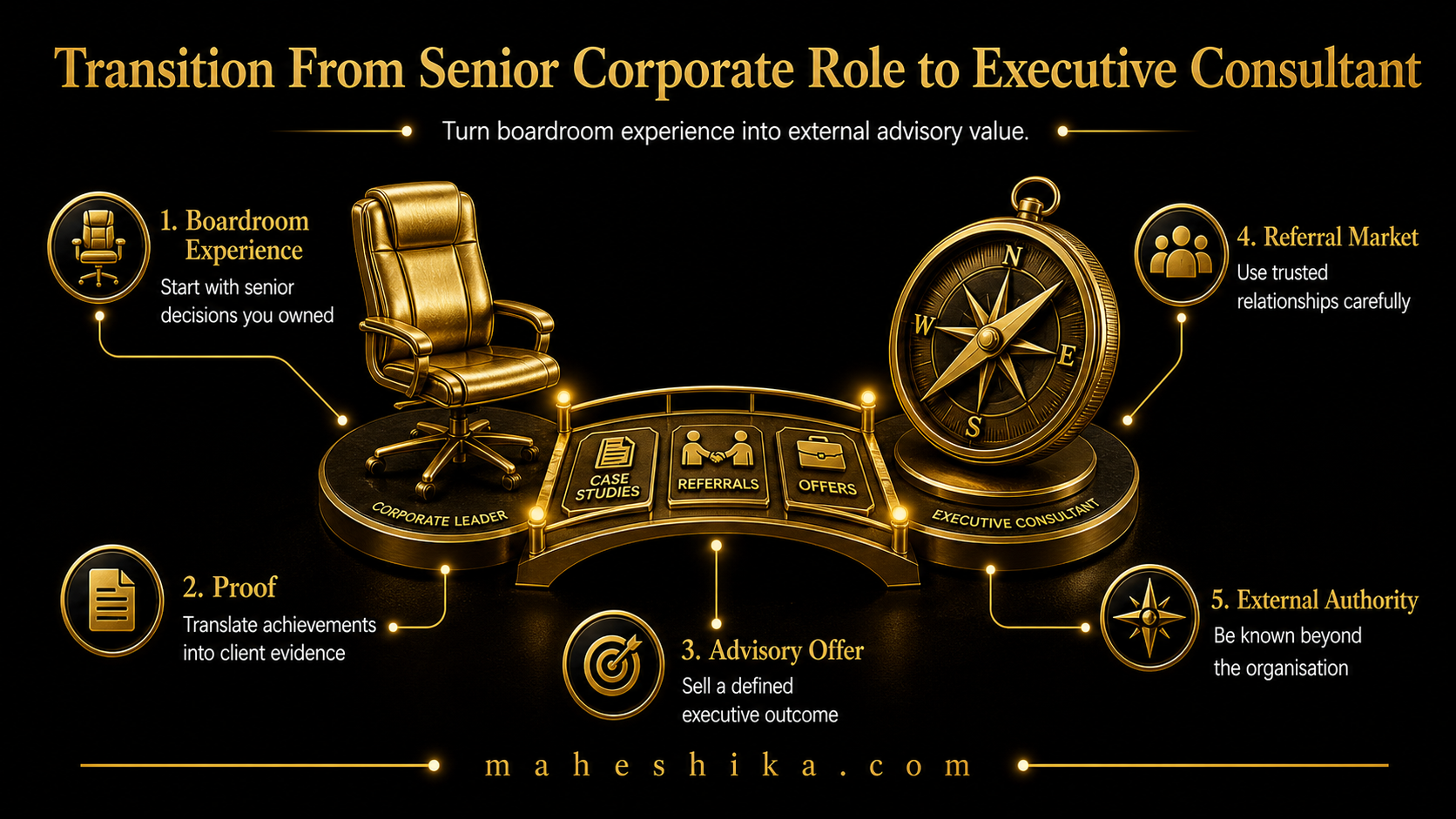
The transition from a senior corporate role to an independent consulting practice is one of the most significant professional moves a person can make, and one of the most underestimated in its complexity. It is not a career change in the ordinary sense. It is a complete reinvention of the relationship between your expertise and the market that wants it.
I know this from having made it. And I know it from working with other senior professionals who are navigating the same transition, some smoothly, some with more difficulty than they expected. The ones who struggle have usually made one of the same predictable mistakes. The ones who succeed have done the work that most people skip. Here is what that work looks like.
The Biggest Mindset Shift: From Employed Expert to Business Owner
Inside a large organisation, your expertise creates value and the organisation commercialises it. You do not have to find clients, articulate your proposition, set your fees, or convince anyone to pay for your time. The structure around you handles all of that. When you step out, every one of those functions becomes your responsibility. That is not a small change. For many senior professionals, it is genuinely disorienting.
The shift that needs to happen is from thinking of yourself as a very senior employee available for hire to thinking of yourself as a business that owns a strategic asset: your expertise, your relationships, your reputation, and now your AI capability. Those assets can be deployed in multiple ways, for multiple clients, at a price point that reflects their genuine scarcity. That is not arrogance. That is accurate valuation. The difficulty is that most senior professionals have never been asked to value themselves that way, and the instinct is to undercharge rather than to set fees that reflect the real market value of what they deliver.
Define Your Specific Offer Before You Launch
The most common early mistake independent consultants make is being too broad in what they offer. The logic is understandable: after 15 or 20 years of enterprise experience, you genuinely can help clients with many different things. The problem is that being available for everything makes it very hard for the right clients to understand why you are the specific person they need. Generalism, at launch, is commercially expensive.
The most effective independent practices I have seen launched with a specific, clearly articulated offer: a defined client type, a defined problem or challenge, and a defined outcome the consultant delivers. That specificity does not limit your eventual scope. It creates the clarity that makes you findable, memorable, and referable. You can expand later from a position of established credibility. Launching broad and hoping to narrow later almost never works as well.
For senior professionals coming out of enterprise commercial roles, the specific offer is usually at the intersection of their deepest expertise and the problem they have seen their ideal clients struggle with most. That intersection is already known to you. The work is articulating it with enough precision that a potential client can immediately see whether it is relevant to their situation.
Your Network Is Your Launch Strategy
The first clients for an executive consulting practice almost always come from the professional network built during the corporate career. Not from cold outreach, not from marketing campaigns, not from a website. From people who already know the quality of your thinking, who have watched you work, who trust your judgement in their specific domain.
This means two things. First, the transition planning should start before you leave your corporate role, with a deliberate investment in reconnecting with and deepening the relationships that will matter most in an independent practice. Not in a transactional way, but in the genuine way that good professional relationships are built. Second, the first conversations about your consulting offer should be framed as information-gathering and thought partnership, not as sales pitches. The best early client relationships come from conversations where a former colleague says: this is a problem we are trying to solve, what would you do with it? Those conversations, handled well, often become engagements.
Related Reading
Price Differently Than You Think You Should
The fee conversations are where many senior professionals lose more ground than anywhere else in the transition. The instinct is to convert your annual salary into a day rate, to benchmark against what other consultants seem to charge, and to worry about pricing yourself out of the market. The result is fees that are too low for the value delivered, which creates a practical problem and a positioning problem simultaneously.
The practical problem is economic: your cost base as an independent is higher than your salary cost to an employer, because you are now covering all the overhead that the organisation previously absorbed. The positioning problem is that in consulting, price communicates positioning. A senior executive consultant charging day rates comparable to a junior analyst is sending a confusing signal about the nature of what they offer.
The correct approach is to price on value delivered, not time spent. What is the commercial problem you are solving worth to the client? A six-figure strategic decision made better is worth more than a hundred hours of time. When you can articulate your value in those terms, the fee conversation changes entirely. This requires confidence in your own expertise and clarity about the specific outcome you deliver. Both are things that develop with practice and the right feedback from advisers who have navigated the same transition.
Use AI to Operate at Corporate Scale Without Corporate Overhead
The most significant practical advantage available to executive consultants in 2026 is AI. A senior professional who combines their deep domain expertise with genuine AI fluency can produce the research, analysis, content, and client deliverables that previously required a team. This changes the economics of independent practice fundamentally. It also changes the quality ceiling for what a single expert can produce for a client.
The consultants who are building the most compelling practices are those who use AI not just to work faster but to work differently: to build tools and frameworks for clients, to produce IP that scales beyond the time they can personally invest, and to maintain a visible intellectual presence that would previously have required a marketing team. That combination of deep expertise, AI capability, and strategic visibility is what creates a consulting practice that is genuinely difficult to compete with.
Free Tool
Start free: where do you actually stand?
Two free tools give you an honest answer in minutes. The AI Risk Score shows how exposed your role is. The Expertise Ownership Score shows how findable and owned your expertise is.
AI Risk Score Expertise Ownership ScoreThe Asset the Organisation Never Gave You
So the transition from senior corporate professional to executive consultant is not a leap of faith. It is a rigorous piece of business building: a specific offer, a network activated with intention, fees priced on value, and AI used to work at a scale no individual consultant could reach before. Do that work properly and the transition is not just survivable, it is the making of the strongest chapter of your career.
But underneath all of it sits the one thing the organisation never gave you and never let you keep. Inside the corporate structure, your expertise was found through the company: its brand, its client list, its introduction. Step outside it and that visibility goes with it. Twenty years of judgement, relationships and results, and nowhere of your own for a prospective client to go and see it for themselves.
That gap is the real risk in this transition, and it is quietly getting worse. AI now answers most questions in a voice that sounds like everyone else's, drawing from generic sources that were never yours. The consultants who hold their ground are the ones with a place the market can find and trust as unmistakably theirs: a personal website under their own name, where the thinking, the results and the offer live together. Owned outright, not rented from an employer or a platform, not one search result among a thousand identical ones.
You do not have to work that out alone or leave it until the practice is already struggling to be seen. If you want it built properly, by someone who has made this exact transition herself, let us talk.