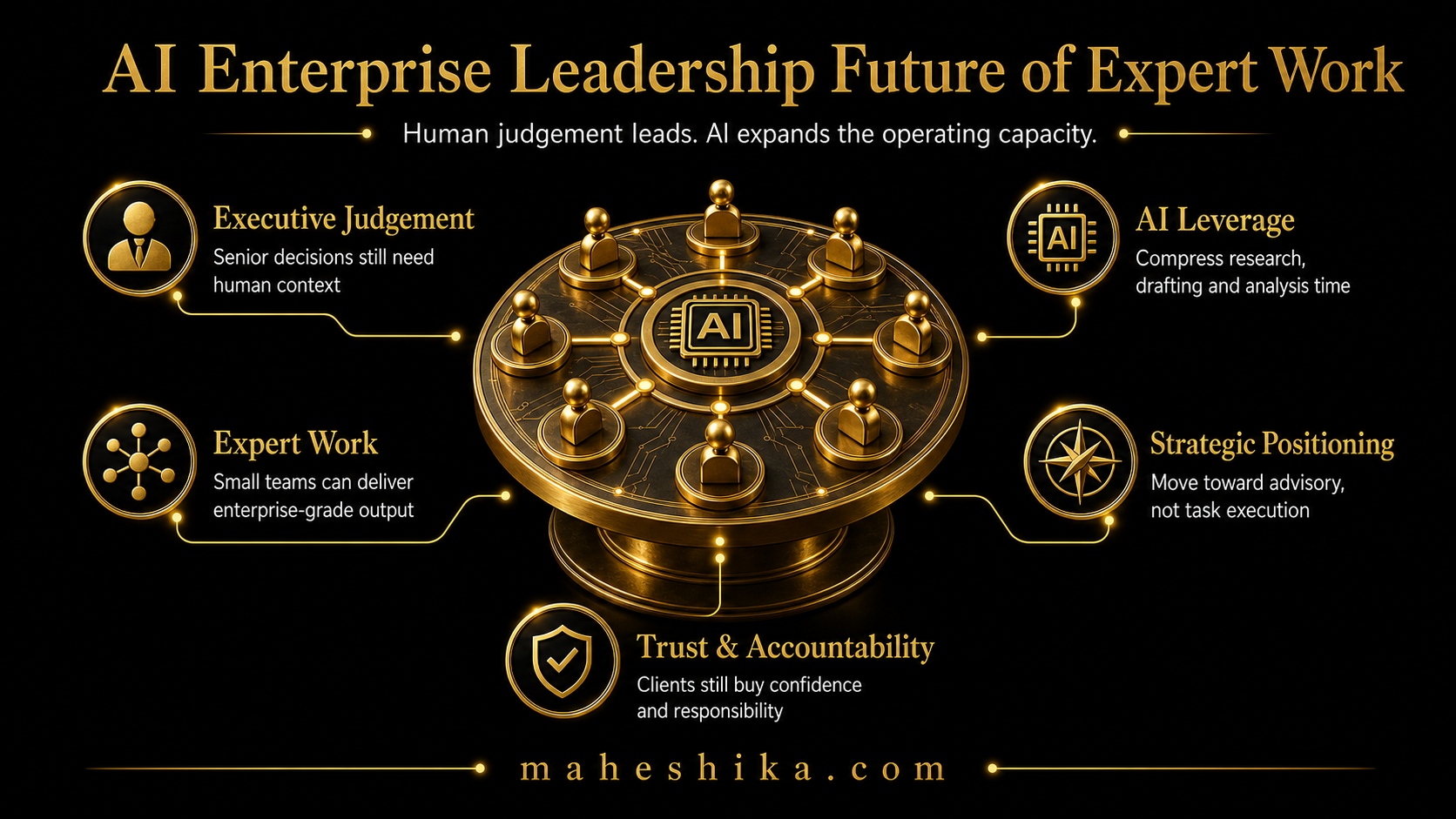
Eighteen years. Four continents. Hundreds of commercial deals, partnership negotiations, board-level conversations about growth, and team-building exercises in markets where nothing worked the way the playbook said it would. That is the context from which I am writing this guide.
I am not writing it from the outside looking in. I am writing it as someone who has led enterprise commercial ecosystems, navigated the politics and complexity of large organisations, and who now builds AI-powered platforms daily. What I see is a profound shift, and I want to be precise about what it means for senior professionals.
This is not a guide about which AI tools to use. It is a guide about what AI changes at the level of enterprise strategy, leadership, and the value of deep professional expertise. It covers the mistakes I see organisations making, the decisions leaders are getting wrong, and the genuine opportunity that exists for those who position themselves correctly.
In This Guide
- 01What Senior Leaders Need to Know About AI Before It Disrupts Their Industry
- 02How to Lead an AI Transformation in a Large Organisation
- 03The Change Management Playbook for Enterprise AI Adoption
- 04Why Most AI Implementations Fail and the Leadership Mistakes Behind Them
- 05How to Build a Commercial Ecosystem in a New Market From Scratch
- 06What Is Strategic Partnership Management and Why It Matters in 2026
- 07How to Lead High-Performing Teams Across Multiple Countries
- 08The Future of Enterprise Sales in an AI-Driven World
- 09How Senior Professionals Can Stay Relevant in the Age of AI
- 10How to Transition From a Senior Corporate Role to an Executive Consultant
- 11What Does It Take to Build a High-Performing Commercial Team?
- 12The Skills Gap in Enterprise AI: Why Human Leadership Still Matters
- 13How to Use AI to Scale Your Consulting Business Without Hiring
- 14The AI Tech Stack Every Independent Consultant Needs in 2026
- 15How AI Is Changing the Consulting Industry and What to Do About It
- 16How to Build AI Tools for Your Clients as a Non-Technical Consultant
- 17How to Use AI to Create Content, Courses and Resources From Your Expertise
- 18The Solopreneur AI Stack: Tools That Replace an Entire Team
- 19How to Position Your Consulting Business Around AI Adoption
- 20Why Consultants Who Ignore AI Will Lose Clients to Those Who Use It
- 21How to Use AI to Research, Write and Publish Blog Content That Ranks on Google
- 22How One Person With AI Can Outperform a Traditional Agency
The AI Inflection Point Senior Leaders Must Understand Now
The most dangerous misconception I hear from senior leaders is that AI is primarily a technology question. It is not. It is a strategy and leadership question with a technology component. The organisations that are getting it wrong are getting it wrong at the top, not at the implementation level.
What has changed is the pace at which AI is compressing decision cycles, reducing the cost of analysis, and eliminating the informational advantage that middling layers of management once provided. When AI can synthesise market data, generate scenario analysis, and produce a first-cut commercial proposal in minutes, the competitive advantage shifts entirely to the quality of the strategic judgement applied to that output. That judgement comes from experience. It comes from having been in the room when a deal nearly collapsed, from understanding the cultural dynamics of a negotiation that no model can fully replicate, from the pattern recognition that only genuine seniority produces.
Senior leaders who understand this are not threatened by AI. They become more valuable because of it. Those who do not are being outflanked, quietly and quickly, by those who do.
The inflection point is this: for the first time, a single experienced professional with the right AI capability can do what previously required a team. That has profound implications for how enterprise organisations are structured, how consultants compete, and how expertise is valued and monetised.
Why Enterprise AI Fails at the Human Level
I have watched AI initiatives stall or collapse in large organisations, and the pattern is remarkably consistent. The technology works. The failure happens at the human layer. Specifically, it happens because of three recurring leadership mistakes.
The first is the delegation trap. Senior leaders approve the AI initiative, assign it to a technology or digital team, and then step back. The result is a technically competent implementation that has no connection to commercial reality, no championship from the people who actually run P&L, and no adoption from the teams whose daily work it was supposed to improve.
The second is the ROI illusion. Organisations invest in AI tools and then immediately ask for a return on investment calculation. The problem is that the most significant returns from AI come from compounding effects over time, from the cumulative improvement in how decisions are made, not from a single productivity metric. Leaders who measure AI the way they measure a software licence renewal will always be disappointed.
The third is the culture mismatch. AI changes how work is done. It changes what skills are valued. It changes who has influence. If the leadership team has not done the work of understanding those shifts and communicating clearly about them, the organisation will resist at every level. Not because people are obstinate, but because change without meaning creates anxiety.
Human leadership, applied with genuine understanding of the technology, is what bridges these gaps. That is not a soft skill. That is a core strategic capability.
How Senior Professionals Become the Most Valuable Asset in an AI-Driven World
The counterintuitive truth is that AI, deployed well, increases the premium on genuine expertise. Here is why.
AI flattens the curve of competence. Tasks that previously required training, time, and specialist knowledge can now be performed adequately by someone with a good prompt and a capable model. This sounds like it devalues expertise. It does not. It devalues average competence. The distance between average and exceptional grows wider as AI raises the floor. The professionals who combine deep domain expertise with AI fluency become disproportionately more valuable than their peers who have one without the other.
In enterprise commercial work, this means that an experienced leader who can synthesise AI-generated market intelligence with their own pattern recognition, cultural judgement, and relationship capital is operating at a level no junior team can replicate, regardless of their AI tools. The expertise is the context. The AI is the leverage.
I see this in my own practice daily. The ability to build functional AI platforms, to run complex research and analysis, to produce commercial content at scale, all amplifies the value of the underlying knowledge, not the other way around. Senior professionals who recognise this and invest in their AI fluency are not hedging against obsolescence. They are compounding their advantage.
Free
Start free: what might your organisation not be seeing?
The Business X-Ray is an outside-in look at your business: what is visible, what may be happening underneath, and what cannot be known from the outside at all. Reviewed personally before it goes out.
Get the free Business X-RayLeading AI Transformation vs Managing It
There is a distinction that matters enormously here, and I want to be direct about it. Managing an AI transformation means overseeing the procurement, the implementation, the training, the rollout. Leading it means something different. It means having a point of view on where the organisation needs to be in three years, and working backwards from that to make decisions today that most of your peers are not yet making.
Leading AI transformation requires the leader to engage personally with the technology. Not to become an engineer, but to understand, from first-hand experience, what AI can and cannot do, where the boundaries are, and where the leverage points are for your specific commercial context. Leaders who manage from a distance, who rely entirely on briefings from their technology teams, are making strategy from incomplete information. And the gaps in that information are consequential.
The best enterprise AI leaders I have encountered share three characteristics. They are curious without being evangelical. They are decisive about investment without being reckless. And they hold the human change management question as seriously as they hold the technical one. All three are learnable. None of them require a computer science degree.
From Enterprise Leader to Independent AI Consultant
A growing number of senior professionals are making a different kind of move. They are not retiring or stepping down. They are stepping out, taking their deep enterprise expertise into independent consulting, and using AI to operate at a scale and quality that was previously impossible for a solo practice.
This is the model I have built, and it is the model I help others build. The combination of genuine enterprise credentials, deep domain knowledge, and AI capability creates a competitive position that the traditional consulting market has not yet fully priced. Organisations that previously could only access this level of expertise through large consulting firms are discovering they can engage directly with independent experts who deliver more personalised, faster, and often better work at a fraction of the cost.
For senior professionals considering this path, the AI component is not optional. It is what makes the economics work. It is what allows one person to do the research, analysis, content production, and client delivery that previously required a team. And it is what makes the offering compelling, because organisations are increasingly aware that they need AI expertise combined with commercial wisdom, and that combination is rare.
The articles in this guide cover every dimension of this landscape: the leadership challenges inside large organisations, the commercial skills that transfer directly to an independent practice, the AI tools and strategies that make it scalable, and the positioning decisions that determine whether you build something that lasts.
How to Use This Guide
Each article in this cluster stands alone. You can read them in any order depending on where you are in your own journey. If you are still inside a large organisation and navigating an AI initiative, start with articles 1 through 4. If you are building a commercial capability in a new market, articles 5 through 8 speak directly to that. If you are thinking about the transition from corporate to independent, articles 9 and 10 are where to start.
The articles on AI consulting and solopreneur strategy (articles 13 through 22) are for those who are already building or seriously considering an independent practice. They are practical, specific, and based on what I have built and what I see working for the professionals I work with.
Everything here is grounded in real enterprise experience. I have held P&L responsibility. I have led commercial teams across multiple countries. I have built partnerships from nothing in markets where no one knew who we were. And I now build AI platforms and run a consulting practice with a fraction of the overhead of a traditional firm. The perspective I bring is not theoretical. Use it accordingly.
The One Asset AI Cannot Compete With
So here is the answer. AI does not shrink the future of expert work, it raises the premium on it. It flattens average competence and widens the gap between that and genuine expertise, which means the leaders and consultants who pair deep experience with real AI fluency are entering the most valuable period of their careers, not the most threatened one. The organisations and clients who understand this are already paying for it.
But there is a quieter shift underneath that answer, and it is the one most senior leaders have not reckoned with. Inside a large organisation, your title, your logo, and your seat at the table did the work of making you visible. Step outside that structure, or simply watch AI answer every commercial question in a voice that sounds like everyone else's, and the thing that kept you findable is gone. Twenty years of P&L ownership, market-building, and hard-won judgement can end up living nowhere anyone can search for it.
What secures your place is not another credential or another AI tool. It is a space of your own: a personal website under your own name, where your thinking is published, your track record is shown, and your point of view is unmistakably yours. Owned outright. Found in a search. Impossible to flatten into a generic answer. That is not a marketing nicety. In an AI-driven market, it is the one asset that keeps making the case for you when you are not in the room.
You do not have to work that out alone, and you do not have to leave it for later. If you want it built properly, by someone who has led exactly this transition, let us talk.