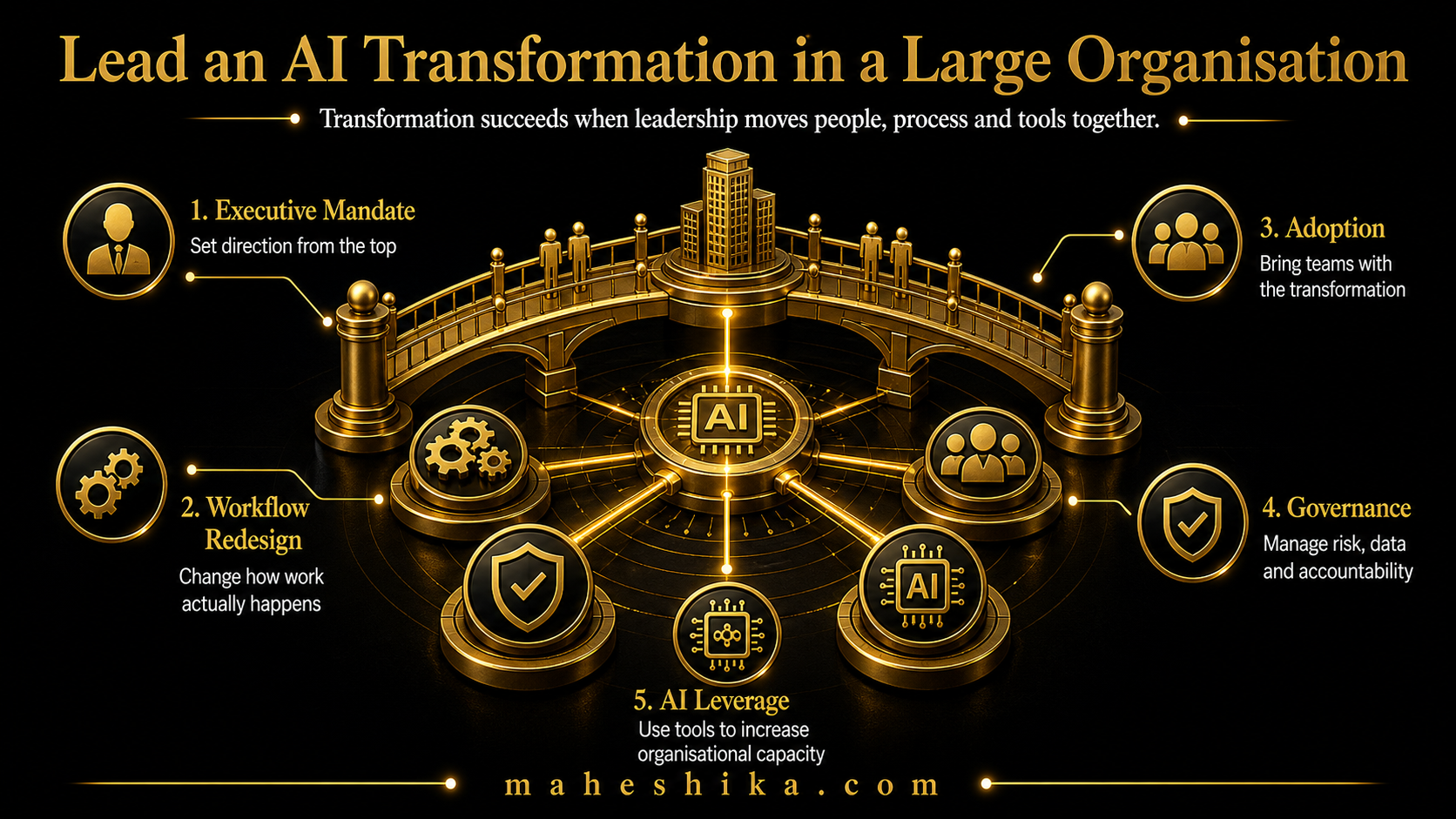
Every large organisation I have worked with or consulted to has at some point declared that it is embarking on an AI transformation. Very few of them have led it. Most have managed it. The distinction is consequential, and it shows up directly in the commercial outcomes they achieve.
AI transformation led well looks like an organisation that is making better decisions faster, deploying its best people on highest-value work, and building commercial capabilities that compound over time. AI transformation managed from a distance looks like a portfolio of tools that nobody is using consistently, a technology team that cannot get business buy-in, and a board that is asking why the investment has not yet shown up in results.
Here is what the leading version requires.
Define the Commercial Outcome First, the Technology Second
The most common mistake is starting with the AI tool and working backwards to a use case. The correct sequence is the inverse: identify the commercial outcome you want to achieve, then determine whether and how AI can accelerate it. This sounds obvious. In practice, organisations reverse it constantly, because the technology vendors are visible and persuasive, and the strategic clarity about what the business actually needs is harder work.
Before any AI investment decision, the leadership team should be able to answer three questions with precision. Where in our commercial model does speed or quality of analysis most directly affect revenue? Where are our most experienced people spending time on work that does not require their full expertise? Where are we losing competitive ground because we cannot produce high-quality outputs at the scale our market now expects? The answers to those three questions are your prioritisation framework. They determine where to start, where to invest, and how to measure success.
Build the Leadership Coalition Before the Technology Stack
AI transformation fails when it is owned by one function and contested by others. In large organisations, the commercial, operations, finance, and people functions all have direct stakes in how AI reshapes work. If the transformation is championed only by the technology or digital team, the other functions will either ignore it or actively resist it, because the decisions about their work are being made without them.
The leadership coalition needs to include the people with P&L responsibility. In my experience, nothing accelerates enterprise adoption faster than a commercially respected leader who is visibly using AI in their own practice and speaking concretely about what it produces. That kind of peer-level credibility does more for adoption than any training programme or internal communications campaign. Find those people early, give them space and resource to experiment, and make sure their findings circulate widely.
Start With Pilot Depth, Not Pilot Breadth
One of the most reliable ways to waste an AI transformation budget is to spread early pilots across too many teams, functions, and use cases simultaneously. The result is thin implementation everywhere, no team reaches the depth where genuine value is created, and the review six months in shows marginal gains that do not justify continued investment.
The alternative is to choose two or three high-value use cases, embed them deeply in the teams that will benefit most, and measure relentlessly. What constitutes deep implementation? The team understands how to use the tool in their actual workflow. They have iterated on how they use it based on experience, not just training. They can articulate specifically what has changed in their output or their time. And critically, they can identify what the tool does not do well, which is where the human expertise remains essential and irreplaceable.
When you have genuine depth in two or three places, you have case studies, you have confident advocates, and you have a replicable implementation model. That is the foundation for scaling with integrity.
Related Reading
The Governance Question Most Leaders Avoid
What decisions can AI make, recommend, or inform autonomously, and what decisions require human sign-off? This question needs explicit answers before you scale. Organisations that avoid it end up with inconsistent practices, compliance exposure, and occasional high-profile errors that set the entire transformation back by twelve months or more.
Governance here does not mean bureaucracy. It means clarity. It means your teams know what they are authorised to do with AI, what outputs require human review before acting on them, and who is accountable when AI-assisted decisions go wrong. The commercial and legal functions need to be part of this conversation from the start, not brought in after the fact to approve a policy that the technology team has already written.
Measure Commercial Outcomes, Not AI Activity
One of the most telling signs of a poorly led AI transformation is when the progress metrics are about AI adoption rather than commercial performance. Percentage of employees who have completed AI training. Number of use cases identified. Hours of AI tool usage per week. These metrics measure activity. They tell you almost nothing about whether the transformation is producing value.
The metrics that matter are the ones that connect directly to commercial performance: speed of deal cycle, quality of commercial proposals, customer response rates, time from insight to decision, revenue per head in teams where AI is embedded versus teams where it is not. These are harder to attribute precisely, but the effort of measuring them forces the organisation to think clearly about what it is actually trying to achieve, which is the more valuable outcome.
Free
Start free: what might your organisation not be seeing?
The Business X-Ray is an outside-in look at your business: what is visible, what may be happening underneath, and what cannot be known from the outside at all. Reviewed personally before it goes out.
Get the free Business X-RayThe Leader's Personal Role in Transformation
There is a version of leading an AI transformation where the senior leader attends the strategy session, approves the budget, and then hands it off. That version rarely produces commercial outcomes. The version that works requires the leader to remain personally engaged: asking specific questions about what the AI-assisted work produces versus what it produced before, attending at least some of the operational reviews, and being willing to make visible decisions based on AI-generated intelligence in front of their teams.
Visibility matters enormously in large organisations. When people see their most senior leaders using AI seriously, treating it as a genuine capability rather than a novelty or a compliance exercise, the cultural signal it sends is worth more than any internal communications campaign. The transformation takes on a different quality. It becomes something the organisation is doing together, rather than something being done to it.
The One Move That Secures Your Place
So leading an AI transformation well is not a technology decision, it is a leadership discipline: define the commercial outcome first, build the coalition before the stack, go deep on two or three use cases before you go wide, govern deliberately, measure commercial results rather than activity, and stay personally, visibly engaged throughout. Do that and the organisation moves faster, with its best people doing its highest-value work. Skip it and you get an expensive portfolio of tools nobody quite trusts.
But here is what most leaders driving this work never turn back on themselves. Every week of the transformation, you are making the organisation's expertise faster to access, more scalable, more visible, an AI trained to summarise your industry, your function, your playbook, in seconds, in a voice that sounds like everyone. Meanwhile your own two decades of judgement are still sitting inside a job title on somebody else's org chart, one restructuring or one retirement announcement away from having nowhere to live.
The leaders who come through this decade well are the ones who do for themselves what they are doing for the business: give their expertise a place that survives beyond the role. A personal website under your own name, where your thinking, your frameworks, and your results are shown in full. Owned outright, findable in a search, impossible to flatten into a generic AI answer. That is not vanity. It is the same strategic move you are making for your organisation, applied to yourself.
You do not have to build it after the transformation is over, and you do not have to work it out alone. If you want it done properly, by someone who has led exactly this kind of change from the inside, let us talk.