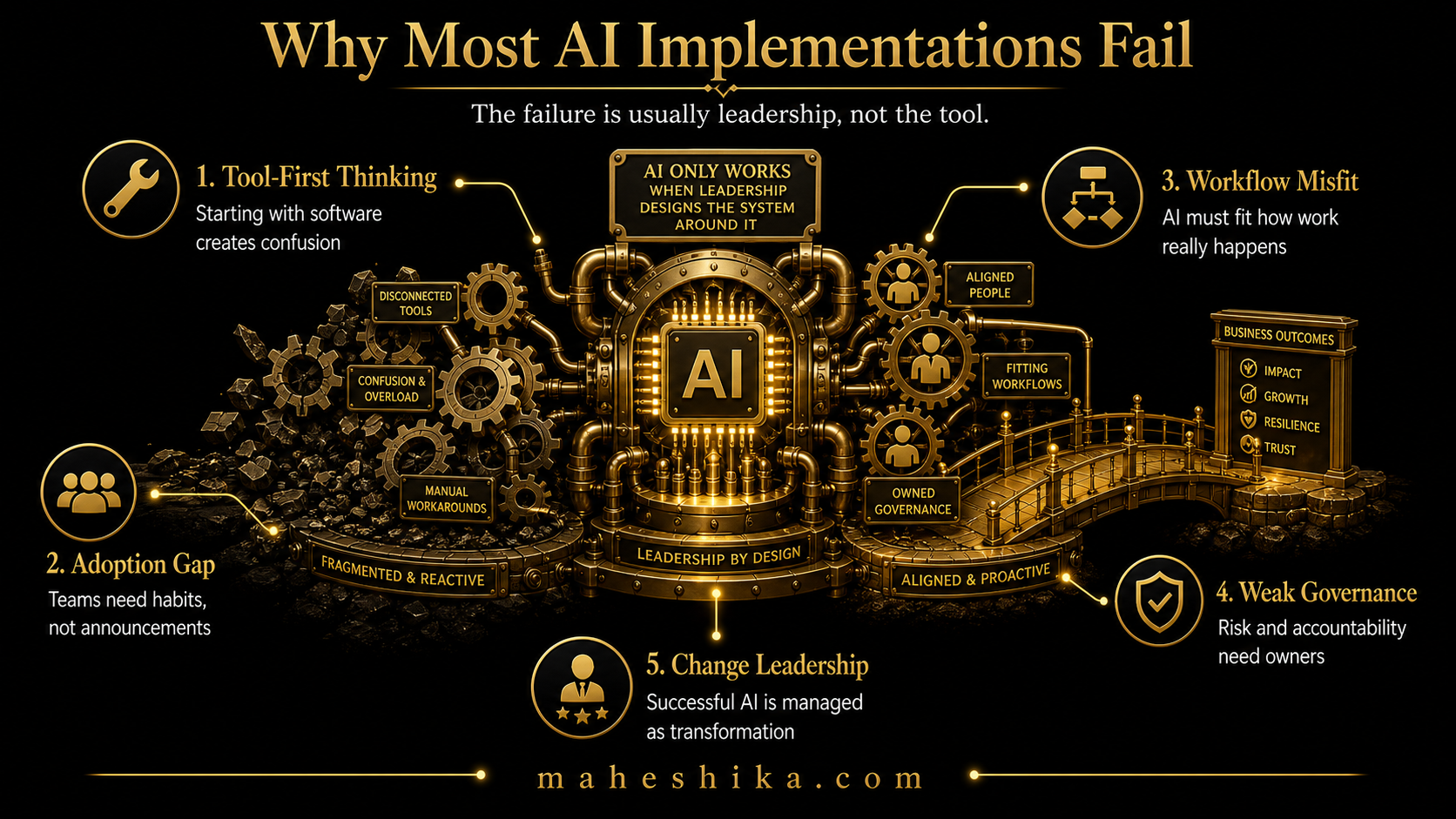
There is a pattern I keep encountering across industries and geographies. An organisation announces an AI initiative with genuine intent. A budget is approved. A technology partner is selected. Training is rolled out. And then, quietly, nothing much changes. The tools exist. The adoption data is thin. The commercial outcomes are not there. The initiative either disappears or gets relaunched under a different name six months later.
This is not a technology problem. The technology, in most cases, is capable. The failure happens at the leadership level, in decisions made before a single tool is deployed. Here are the six mistakes I see most consistently, and what to do instead.
Mistake One: Buying the Tool Before Defining the Problem
This is the most common and most expensive mistake. An organisation selects an AI platform because of a compelling vendor demonstration, a competitor's announcement, or a board mandate to do something with AI. The tool is procured. Then the implementation team is asked to find use cases for it.
The result is a solution looking for a problem. Use cases are identified based on what the tool can do rather than what the business actually needs, and they rarely generate the commercial outcomes that would justify the investment. The correct sequence is to start with a clear-eyed analysis of where your biggest commercial constraints are: where is speed limiting your ability to capture revenue, where is quality of output losing you deals, where are your best people spending time on work below their level? Then determine whether AI addresses those constraints directly. If it does not, the tool is wrong. If it does, you have a genuine use case with a measurable commercial outcome attached.
Mistake Two: Treating AI as an IT Project
When AI implementation is owned entirely by the technology function, without senior commercial ownership, the outcomes are almost always underwhelming. Technology teams are excellent at implementation. They are not positioned to make the strategic judgements about commercial workflow, about which decisions should be AI-informed versus AI-assisted versus human-only, about the cultural and behavioural changes that determine whether adoption sticks. Those judgements require commercial and operational leadership to be in the room, with genuine ownership, from the beginning.
The organisations where AI implementation delivers real commercial value are those where the commercial leadership team owns the outcome and the technology team owns the execution. That distinction in ownership changes every decision downstream.
Mistake Three: Underestimating the Human Resistance
Senior professionals who have invested years developing expertise in a particular domain will feel genuine discomfort when AI begins to perform parts of that domain competently. This is not irrational or petty. It is a legitimate human response to an identity threat. Organisations that dismiss this response, or that frame AI purely as efficiency gain without acknowledging the displacement anxiety it creates, encounter resistance that undermines adoption at every level.
Addressing this requires honesty and specificity. Be clear about which tasks AI will change, which it will not, and what the organisation is asking each person to develop in response. Vague reassurances that AI will not replace anyone are not believed and not credible. Specific conversations about how AI changes the nature of the work, and how the human expertise that remains is more valuable as a result, land very differently.
Related Reading
Mistake Four: Measuring the Wrong Things
Implementation teams under pressure to show progress default to activity metrics. How many people have been trained. How many use cases have been identified. How frequently the tools are being accessed. These metrics are easy to collect and easy to report. They are almost entirely useless as indicators of whether the implementation is delivering commercial value.
The metrics that matter are the ones that connect to commercial outcomes. Time from opportunity identification to proposal submission. Quality scores on external-facing communications. Revenue generated per commercial team member in AI-enabled versus non-AI-enabled segments. Decision speed on key commercial choices. If you cannot connect your AI implementation to a measurable change in at least one commercial metric within six months, either the use case is wrong or the implementation is not deep enough to produce real change. Both are fixable, but only if you are measuring the right things.
Mistake Five: Expecting Immediate Return
AI's most significant commercial returns come from compounding effects: teams that get progressively better at using it, workflows that are iteratively refined, institutional knowledge about what works and what does not that accumulates over time. Organisations that evaluate AI investment on a six-month ROI timeline, against metrics designed for capital expenditure decisions, will almost always conclude the investment was disappointing.
This is a planning and expectation-setting failure that sits at the board level. The leadership team needs to agree upfront on a realistic timeline for different types of return: early efficiency gains visible within three months, workflow transformation visible within twelve months, and strategic competitive advantage visible at eighteen months and beyond. Without that shared understanding, the pressure for short-term returns kills initiatives that would have been genuinely transformative with more runway.
Mistake Six: No Senior Leader Champion Who Is Actually Using the Technology
Every successful enterprise AI implementation I have observed has one thing in common: a senior leader who is personally, genuinely using AI in their own work and who speaks from that experience. Not endorsing the initiative at a distance. Not citing the business case. Speaking specifically about what AI changed in how they work, what surprised them, what they got wrong initially, and what they do differently as a result.
This kind of personal credibility cannot be manufactured. It has to be real. And it has an outsized effect on culture and adoption because it makes AI normal at the senior level, which is the most powerful signal a large organisation can receive.
Free
Start free: what might your organisation not be seeing?
The Business X-Ray is an outside-in look at your business: what is visible, what may be happening underneath, and what cannot be known from the outside at all. Reviewed personally before it goes out.
Get the free Business X-RayThe Leadership Question That Comes After This One
So the answer to why most AI implementations fail is not the technology. It is a leadership sequence: define the commercial problem before you buy the tool, put commercial owners in charge of the outcome, name the human resistance instead of dismissing it, measure what actually moves revenue, and give it the runway a compounding return needs. Get that sequence right and AI becomes a genuine advantage. Get it wrong and you relaunch the same initiative under a new name in six months.
But notice what sits underneath every one of those six mistakes. In each case, the leader who spoke with real authority, on the tool, on the workflow, on the resistance in the room, was believed. The leader who spoke from a slide deck was not. As AI gets better at producing competent, generic answers in a voice that sounds like everyone, the credibility that used to come from a title or a seat at the table starts to thin out. The org chart cannot vouch for your judgement the way it once could.
What still vouches for it is a record the market can actually find: your own thinking, under your own name, in a place you own outright. Not a LinkedIn post that disappears in the feed, not a company bio that vanishes the day you leave. A personal website that shows exactly how you think about problems like the six above, searchable, unmistakably yours, and impossible to mistake for a generic answer. The leaders who will still be sought out for their judgement in five years are the ones building that record now, quietly, while everyone else is still measuring training completion rates.
You do not have to build that record alone. If you want to talk through what yours would look like, let us have a conversation.