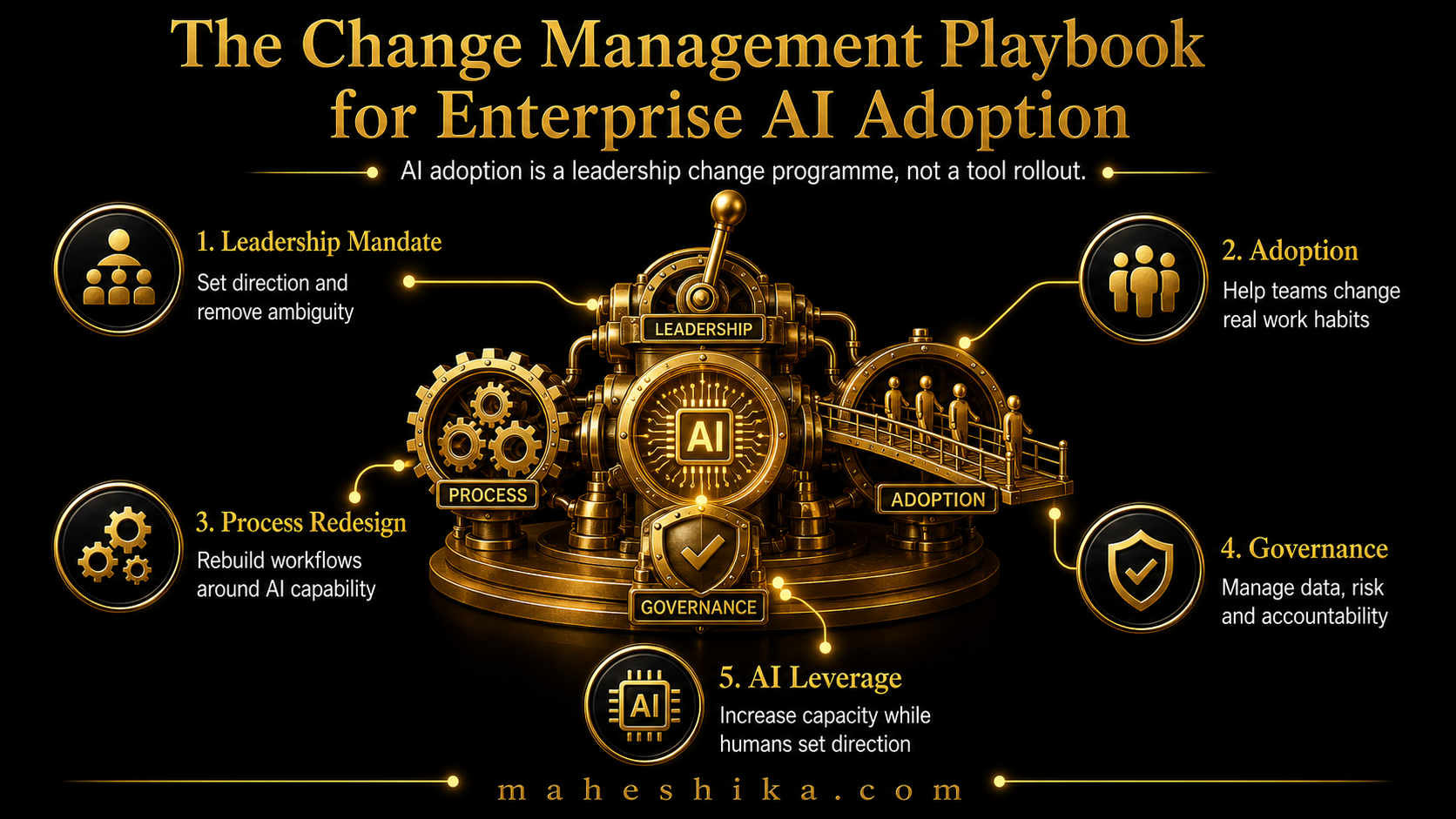
The most technically sound AI deployments I have seen fail quietly in large organisations. Not because the technology did not work, but because the change management around it was thin or absent. The rollout happened. The training happened. The tools were made available. And then the organisation collectively found ways to continue doing what it had always done, while the AI tools gathered digital dust in the background.
Change management for AI adoption is not the same as change management for a new ERP or CRM system. The resistance dynamics are different, the skill gaps are different, and the emotional stakes are different. People are not just adapting to a new tool. They are navigating a genuine shift in how their expertise is valued and what their role means. That requires a different approach.
Understand What You Are Actually Asking People to Do
When you introduce AI into a team's workflow, you are asking them to do something that is genuinely difficult. You are asking experienced professionals to accept that some of the work they have built their identity around, the research, the drafting, the analysis, can now be done differently. For high performers who have invested years in developing those skills, this is not a neutral ask. It carries real emotional weight, even when the rational case is clear.
Effective change management starts with acknowledging this directly. Not as a pastoral concern, but as a commercial one. If your best people are silently resistant because they feel their expertise is being devalued, that resistance will show up in your adoption metrics whether you name it or not. A direct conversation about what AI changes and what it does not, specifically about how it amplifies rather than replaces experienced judgement, addresses the anxiety at the source rather than hoping it resolves itself.
Sequence Differently for Different People
Not everyone in a large organisation is at the same point in their relationship with AI. In most teams you will find three groups. The first group is already using AI independently and has formed strong opinions about what works. The second group is curious but uncertain, they want to engage but do not know where to start. The third group is actively sceptical, they have decided AI is overhyped, unnecessary, or threatening, and they need a different kind of engagement.
The mistake is running the same training programme for all three groups. Group one needs challenge and community, not introductory training. Group two needs guided practical experience with something relevant to their actual work. Group three needs evidence, specifically peer evidence from people they respect, not executive mandates or vendor presentations.
Mapping your team against these three profiles before you design your adoption programme takes perhaps an hour. It will save you months of wasted effort and genuinely improve the outcomes you achieve.
Make the First Experience Genuinely Useful
The single most powerful thing you can do to accelerate AI adoption in a team is ensure that the first meaningful experience each person has with the tool is directly relevant to a real problem they are trying to solve right now. Generic training scenarios, borrowed use cases from other industries, or demonstrations of impressive but irrelevant capabilities all produce the same outcome: mild interest followed by no behaviour change.
Real usefulness produces a different reaction. When someone uses an AI tool to do something they actually needed to do, faster and better than they expected, the adoption question answers itself. They come back. They experiment. They tell colleagues. The change management challenge shifts from persuasion to support.
This means your change leads, your internal champions, need enough proximity to the actual work of each team to know what that genuinely useful first experience should be. It cannot be designed centrally and applied uniformly. It requires someone who understands the work.
Related Reading
Build Psychological Safety Around Failure
AI tools produce imperfect outputs. They hallucinate. They miss nuance. They get the tone wrong. They produce impressive-looking work that is subtly incorrect. Teams that understand this and know how to catch and correct AI errors are dramatically more effective than teams who either trust everything uncritically or avoid the tools because they fear being associated with a mistake.
The psychological safety component of change management here is specifically about building a culture where people feel comfortable saying: the AI got this wrong and here is how I fixed it. That story needs to be as welcomed as the story of AI saving three hours of work. When it is, people engage with the tools more honestly and develop better judgement about when and how to rely on them. When it is not, you get one of two failure modes: people hide AI errors, or people avoid using AI at all because the reputational risk feels too high.
Sustain Momentum Beyond the Launch
Most enterprise AI adoption programmes peak at launch. There is energy, there is communication, there is a training wave. Then the programme moves into maintenance mode and six months later the usage data tells a disappointing story. What sustains momentum is not more campaigns. It is a continuous learning infrastructure: a place where people share what is working, where they ask questions without embarrassment, and where new capabilities are introduced in the context of existing workflows rather than announced separately.
In practice, this often looks like a regular short-format peer learning session, thirty minutes, specific use case, real output shared. It looks like a shared repository of useful prompts and templates that teams have built for their own work. It looks like a leader who mentions AI in their weekly update not because it is a transformation initiative but because it is now how they work. These are not expensive or complex interventions. They are consistent ones.
Free
Start free: what might your organisation not be seeing?
The Business X-Ray is an outside-in look at your business: what is visible, what may be happening underneath, and what cannot be known from the outside at all. Reviewed personally before it goes out.
Get the free Business X-RayThe Role of Senior Leaders in Sustaining Change
Change management is not the responsibility of the change management team alone. Senior leaders who are personally visible in their AI engagement sustain momentum in ways that no programme or communication can replicate. This does not require performing enthusiasm you do not feel. It requires honesty about the learning process, willingness to share what surprised you, and the discipline to embed AI into the way you actually lead, rather than treating it as a separate initiative you champion from a distance.
The organisations that have navigated this well are those where the senior team treated AI adoption as something they were part of, not something they sponsored. That participation, even at a modest and genuine level, changes the cultural signal entirely. It communicates that this is the new way of working, that the people at the top are in it too, and that the organisation is moving together rather than in separate lanes.
The Leadership Move Underneath the Playbook
So the answer to enterprise AI adoption is not a bigger launch or a cleverer campaign. It is a leader who understands what people are actually being asked to give up, who sequences the work for where each person genuinely stands, and who stays visibly in the change rather than sponsoring it from a distance. Get that right and the technology takes care of itself.
But there is a second question sitting underneath the first one, and it is the one most senior leaders never ask about themselves. You spend this playbook helping your people prove their judgement still matters when AI can do the drafting. Fair enough. Now ask who is doing that for you. A title on an org chart is not a body of evidence. It disappears the moment the structure changes, and AI can now produce a plausible answer to almost any question in a voice that sounds like every other leader's.
What does not disappear is a place that is yours. A personal website under your own name, where the frameworks you have built, the transformations you have led, and the judgement you bring are on record and findable, independent of whichever organisation you happen to be inside this year. That is not a leadership indulgence. It is the same protection you are asking your teams to build for themselves, applied to you.
You do not have to work this out alone or leave it for later. If you want your own record built properly, let us talk.