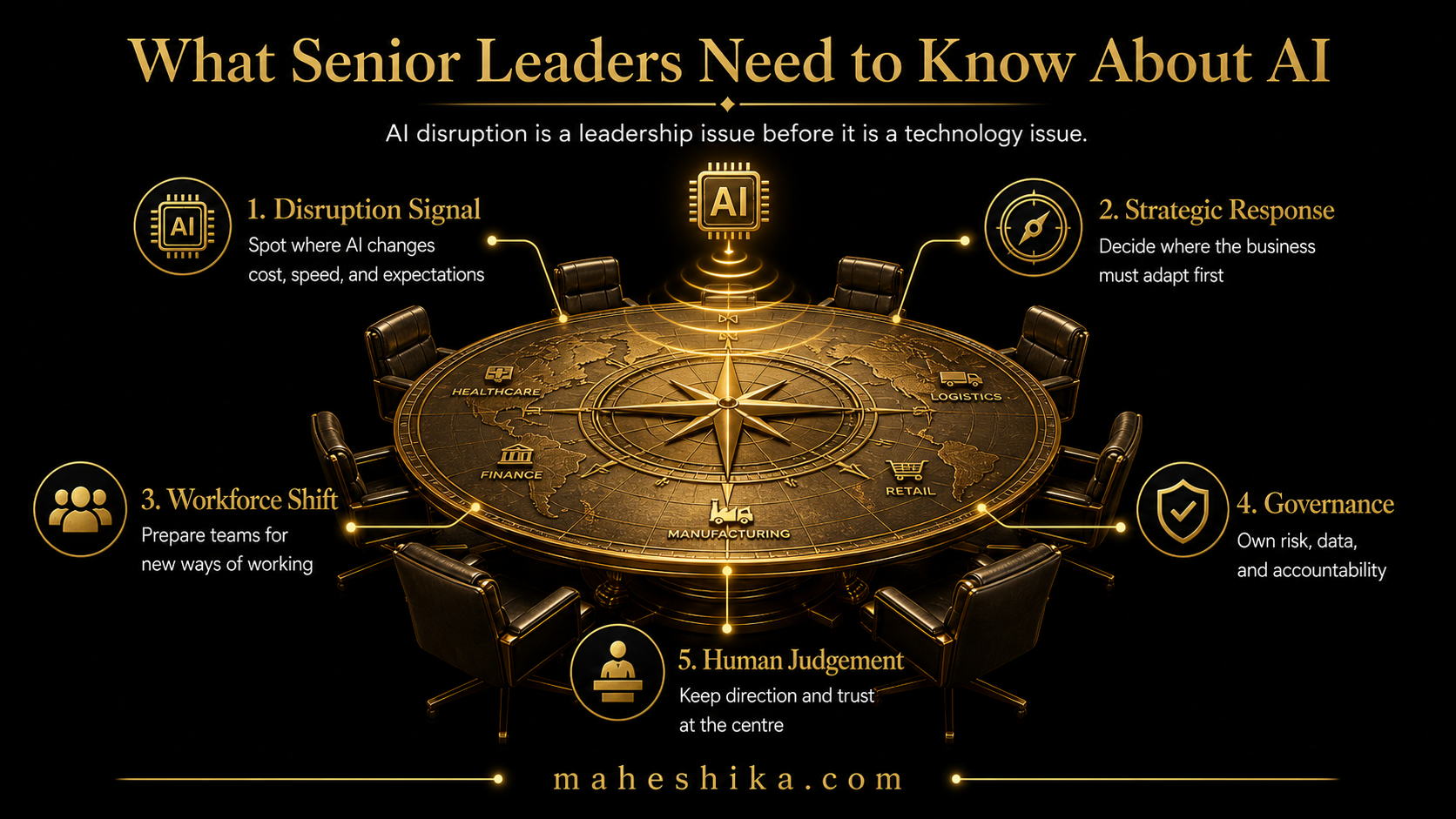
Most senior leaders I meet have a version of the same private anxiety about AI: they know it is important, they are not sure exactly what they need to know, and they are surrounded by people who either oversell it or dismiss it. Neither camp is useful. What you need is a clear-eyed assessment of what AI actually changes at the strategic and commercial level, and what it does not.
I want to give you that here, based on 18 years in enterprise commercial leadership and two years of daily, hands-on AI practice across strategy, content, research, and platform building.
AI Is Not Your Industry's Future. It Is Your Industry's Present.
The first thing to recalibrate is timing. The disruption conversation tends to get framed as something coming, a threat on the horizon that will arrive at some unspecified future date. The more accurate framing is that it is already inside your organisation, your supply chain, your competitor's decision-making process, and your customers' expectations. The question is not whether to prepare. It is whether you have the information to see clearly where you already are.
In most large organisations, AI adoption is happening bottom-up and sideways, led by individuals who have integrated it into their daily work with or without official sanction. This is not a risk to dismiss. It is signal. The places where it is already embedded quietly are the places where the competitive dynamic has already shifted. Your job as a senior leader is to bring that signal to the surface and respond to it deliberately, rather than waiting for it to appear in a board report.
The Three Shifts That Affect Every Industry Without Exception
Regardless of your sector, three changes are already reshaping the competitive landscape.
The compression of analysis cycles. Tasks that previously took a team of analysts weeks now take hours. Market analysis, competitor intelligence, scenario modelling, first-draft commercial proposals: all of these are being compressed. This means that the organisations with the best strategic thinking, applied to AI-generated intelligence, move faster than those relying on traditional research timelines. The premium shifts from information-gathering to interpretation and judgement.
The commoditisation of average output. Content, analysis, communication, and process documentation that sit at the average level of quality are increasingly producible by AI. This affects pricing power, team structures, and the value proposition of any professional who has historically competed on volume or speed alone. If what you deliver can be replicated adequately by a capable model and a competent prompt, the commercial case for your involvement changes.
The personalisation expectation. AI has raised the floor for personalised communication, customer experience, and tailored proposals in commercial relationships. Customers and clients now receive AI-personalised outreach, recommendations, and content from competitors. Organisations that have not adapted their commercial approach to this new baseline are appearing impersonal and slow by comparison, even when they are technically delivering more.
What You Do Not Need to Know (and What You Do)
You do not need to understand how large language models are trained. You do not need to know the technical architecture of the AI tools your teams are using. You do not need to become a prompt engineer. These are important for execution teams, not for board-level strategy.
What you do need to know: the categories of work that AI performs well versus poorly, the types of decision it can assist versus the types it cannot replace, and the human and organisational conditions that determine whether AI deployment creates value or creates expensive chaos.
AI performs exceptionally well at synthesis, pattern recognition across large data sets, drafting and iteration, translation and summarisation, and structured analysis. It performs poorly at genuine commercial judgement in novel situations, relationship-based influence, ethical reasoning in ambiguous contexts, and any task where the answer depends on information it has not been given. Senior leaders live primarily in that second category. That is their moat. The risk is not that AI will replace them. The risk is that they fail to use it to amplify their effectiveness in the first category, and their competitors do.
Related Reading
The Competitive Intelligence Question Every Leader Should Ask Now
Here is a practical starting point. Identify the three to five areas in your industry where speed of analysis or quality of output has historically been a competitive differentiator. Then ask: if a competitor could compress that work by 70 percent and improve its quality simultaneously, where would that change the power dynamics in your market?
That is the disruption to track. Not the broad, abstract threat of AI, but the specific operational and commercial leverage points where AI-fluent competitors will outmanoeuvre those who are not. In my work across enterprise commercial strategy across EMEA, the leverage points were consistently in three places: speed and quality of new market entry analysis, quality of commercial proposals at scale, and the richness of partnership intelligence. All three are now AI-accelerable. The organisations that know this are already moving.
The Leadership Decision That Determines Everything Else
Every significant AI decision in a large organisation comes back to a single leadership choice: whether AI is treated as a technology project or as a strategic transformation. Technology projects get assigned to technology teams, measured by implementation timelines, and evaluated against feature lists. Strategic transformations get personal ownership from the senior leadership team, are measured against commercial outcomes, and are revisited as learning accumulates.
The organisations that are getting genuine commercial value from AI are those where senior leaders are personally engaged with it, not as technical operators, but as strategic owners. They have a point of view on what AI means for their business model. They have made deliberate decisions about where to invest first. They are asking better questions of their teams because they have enough personal familiarity with the technology to know what is possible.
This is the single most important thing you can do before your industry reaches peak disruption: develop your own working knowledge of AI well enough to lead strategy from a position of genuine understanding. Everything downstream of that decision is easier.
Free
Start free: what might your organisation not be seeing?
The Business X-Ray is an outside-in look at your business: what is visible, what may be happening underneath, and what cannot be known from the outside at all. Reviewed personally before it goes out.
Get the free Business X-RayWhat to Do This Quarter
Three concrete actions that will move you from passive awareness to strategic readiness. First, spend two hours with an advanced AI model, not briefed by your team but directly, with a real problem from your commercial agenda. See what it produces. Identify where you would need to override or redirect its output, and why. That gap between what it generates and what your judgement adds is your most important data point.
Second, identify one person in your organisation who has been using AI extensively in their work without being asked to. Have a genuine conversation with them about what they have found, what surprised them, and what they think the leadership team is missing. This is your fastest route to ground truth.
Third, make one deliberate investment decision about AI this quarter. Not a committee recommendation. Not a delegation to your technology team. A direct strategic decision that reflects your own assessment of where the highest-leverage opportunity is in your business. The practice of making those decisions, even imperfect ones, is how leaders develop AI strategic fluency faster than those who wait for consensus.
The Advantage AI Cannot Compress
So the answer to what you need to know before AI reaches your industry is not a technical briefing. It is a leadership decision: treat AI as a strategic transformation you own personally, build enough working knowledge to ask sharper questions, and make direct investment calls before you have full certainty. The leaders who do this consistently are the ones who compound an advantage quarter after quarter, while their competitors are still waiting for a report to tell them where they stand.
There is a second risk sitting underneath that one, and it rarely gets named in board conversations. AI is compressing average analysis into something instant, adequate, and delivered in a voice that sounds like everyone else's. At the same time, the platform most senior leaders rely on to be seen and heard, their title, their seat on the leadership team, their employer's name beside their own, is not permanent. Restructures happen. Roles get absorbed. Industries consolidate. The moment that platform changes, the visibility built over twenty years of judgement can disappear with it.
What does not disappear is a space you own outright. A personal website under your own name, where your thinking on exactly the kind of question this article raises lives permanently, where your track record is shown in full, and where your point of view carries your signature, not your employer's logo. Findable in a search, impossible for an AI summary to flatten into a generic answer, and yours regardless of what happens to the title on your business card. That is what keeps a senior leader's expertise unmistakably theirs while the average gets automated around them.
Building that is not a project for someday. If you want your judgement to have a home that outlasts any one role, I would like to help you build it properly. Let us talk.