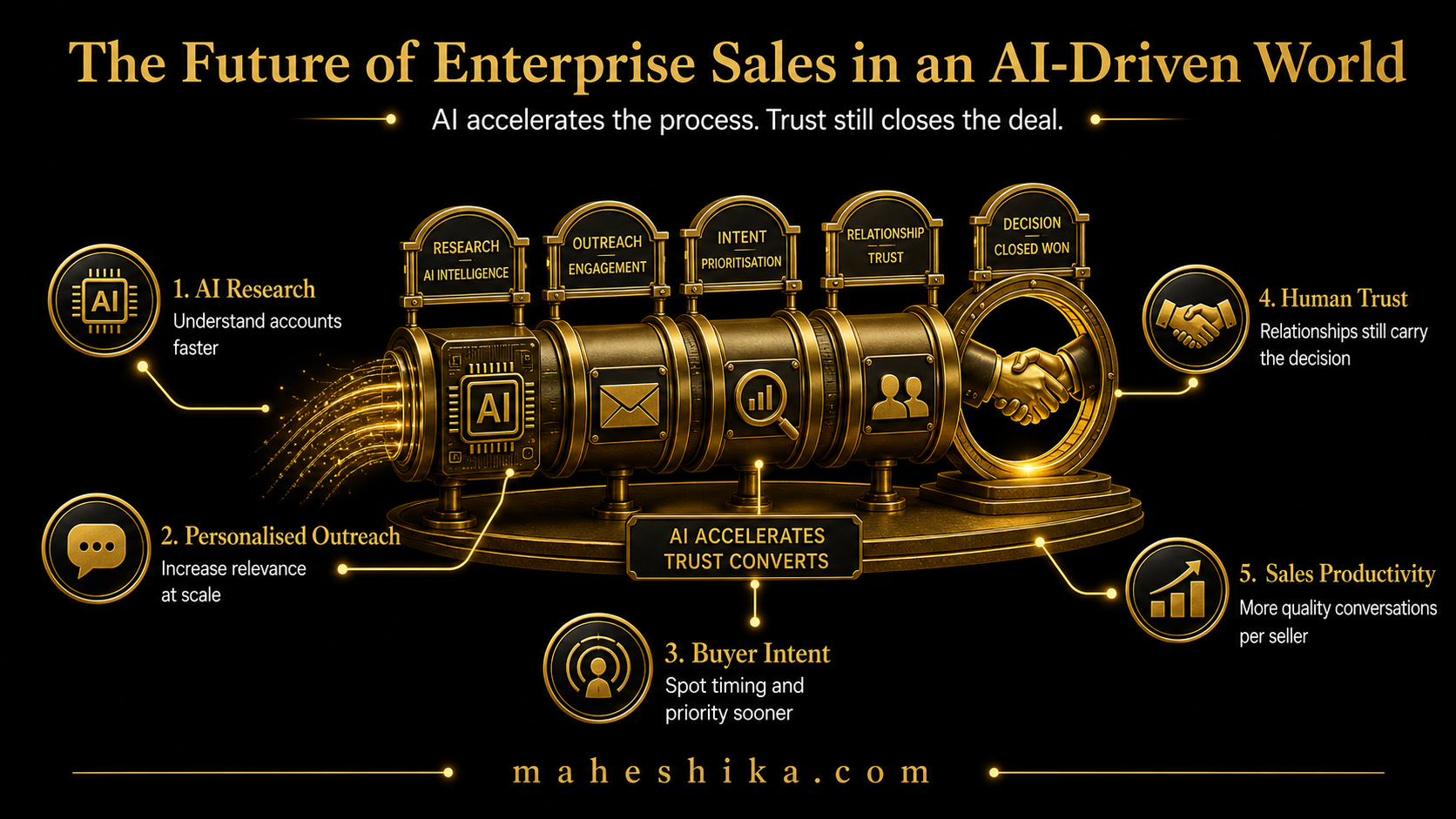
Enterprise sales has always been a discipline where deep human judgement is the core differentiator. The deal cycles are long. The buying committees are complex. The relationships that determine access and credibility take years to build. None of that has changed. What has changed is the informational and operational context in which that judgement operates.
AI is transforming enterprise sales in ways that are less dramatic than some predict and more consequential than others acknowledge. The transformation is not about replacing sales professionals. It is about creating an enormous performance gap between those who use AI intelligently in their commercial practice and those who do not.
What AI Actually Changes in Enterprise Sales
The most significant change AI brings to enterprise sales is the compression of research and preparation cycles. Account intelligence, competitive positioning, stakeholder mapping, industry context for a particular prospect's situation: all of this previously required hours of research. AI compresses that to minutes and improves the quality of the output when the human using it knows what questions to ask and how to validate the answers.
This matters because preparation quality is one of the most consistent differentiators between senior commercial professionals who win at a high rate and those who do not. The best commercial leaders I have worked with have always invested more in preparation than their peers. AI makes that investment dramatically more efficient, which means the gap between the best-prepared and the average-prepared widens further. The floor of acceptable preparation rises. The ceiling of what is possible in a given time expands.
The Buyer Has Changed. The Seller Must Too.
Enterprise buyers in 2026 are significantly better informed before they engage with a vendor than they were five years ago. AI tools give procurement teams, technical evaluators, and commercial decision-makers the ability to do comprehensive market scans, generate comparison analyses, and stress-test vendor claims at a level that previously required specialist knowledge or external consultants. By the time a buyer has a substantive conversation with a vendor, they often know as much about the competitive landscape as the vendor's own sales team.
This changes what a sales conversation needs to deliver. Informational presentations, product overviews, and feature demonstrations are largely wasted effort on a well-informed modern enterprise buyer. What they want is commercial intelligence: a point of view on their specific situation that they could not easily generate themselves, scenario analysis that reveals the implications of different choices, and the kind of pattern recognition that comes from seeing similar problems across many organisations. That is genuinely valuable. A deck full of features and benefits is not.
The Skills That Become More Valuable, Not Less
Commercial judgement in complex, ambiguous situations is becoming more valuable, not less, as AI handles more of the information-processing work. The ability to read a room, to understand the political dynamics in a buying committee, to know when to push and when to wait, to build genuine trust with senior decision-makers, none of this is automatable. It is the residue of years of practice and the thing that distinguishes excellent enterprise sales professionals from competent ones.
Proposal quality and commercial writing are also becoming more important, precisely because AI makes average proposal quality easier to achieve. When every competitor can produce a well-structured, adequately written proposal, the differentiator becomes the insight, the specificity, and the commercial intelligence embedded in the content. Writing a proposal that feels genuinely tailored to the buyer's situation, that demonstrates real understanding of their commercial context, requires the kind of expert judgement that AI cannot manufacture without a human directing it with deep knowledge of the account.
Related Reading
What Sales Leaders Need to Do Differently Right Now
Sales leaders managing enterprise teams need to make two specific investments that most are not yet making seriously. The first is equipping their teams with AI capability specifically in the commercial preparation and proposal workflows, where the time saving and quality improvement is most immediately visible and most directly tied to commercial outcomes. This is not a general AI training programme. It is targeted skill development in the specific AI-assisted tasks that directly affect win rate and deal quality.
The second is raising the bar on commercial thinking across the team. If AI is handling more of the information-processing work, the human contribution needs to shift towards the analysis and judgement layer. That means investing in the commercial thinking capability of the team, through coaching, through review conversations that focus on the quality of commercial reasoning rather than just the activity metrics, and through exposure to the kind of senior thinking that patterns recognition across multiple complex deals.
Free
Start free: what might your organisation not be seeing?
The Business X-Ray is an outside-in look at your business: what is visible, what may be happening underneath, and what cannot be known from the outside at all. Reviewed personally before it goes out.
Get the free Business X-RayThe One Advantage AI Cannot Automate
So here is the real answer: enterprise sales is not being replaced by AI, it is being sorted by it. The professionals who invest seriously in AI-assisted preparation, who raise the quality of their commercial thinking, and who keep building genuine trust with the people who sign, pull further ahead every quarter. The ones who treat AI as a shortcut instead of a force multiplier fall further behind. That gap is now the whole game.
But there is a second shift happening underneath the sales conversation, and it changes something more personal than win rate. For years, your credibility lived inside a company: a title on a slide, a logo on your email signature, a track record filed away in someone else's CRM. AI now generates competent-sounding commercial content in seconds, in a voice that sounds like everyone else in your market. When the content is commoditised and the employer can change tomorrow, the thing that keeps a senior commercial professional visible and trusted is no longer the company behind them. It is what they own outright.
A personal website under your own name, where your commercial track record, your point of view, and the results you have actually delivered live in one place, findable in a search, unmistakably yours, not filed under a company that can restructure without asking you. That is not a side project. It is the one asset that keeps working for you no matter which enterprise you are selling for this year, or whether you are still selling for one at all.
You do not have to build that alone, and you do not have to wait until you need it to start. If you want to talk through what yours should look like, let us talk.