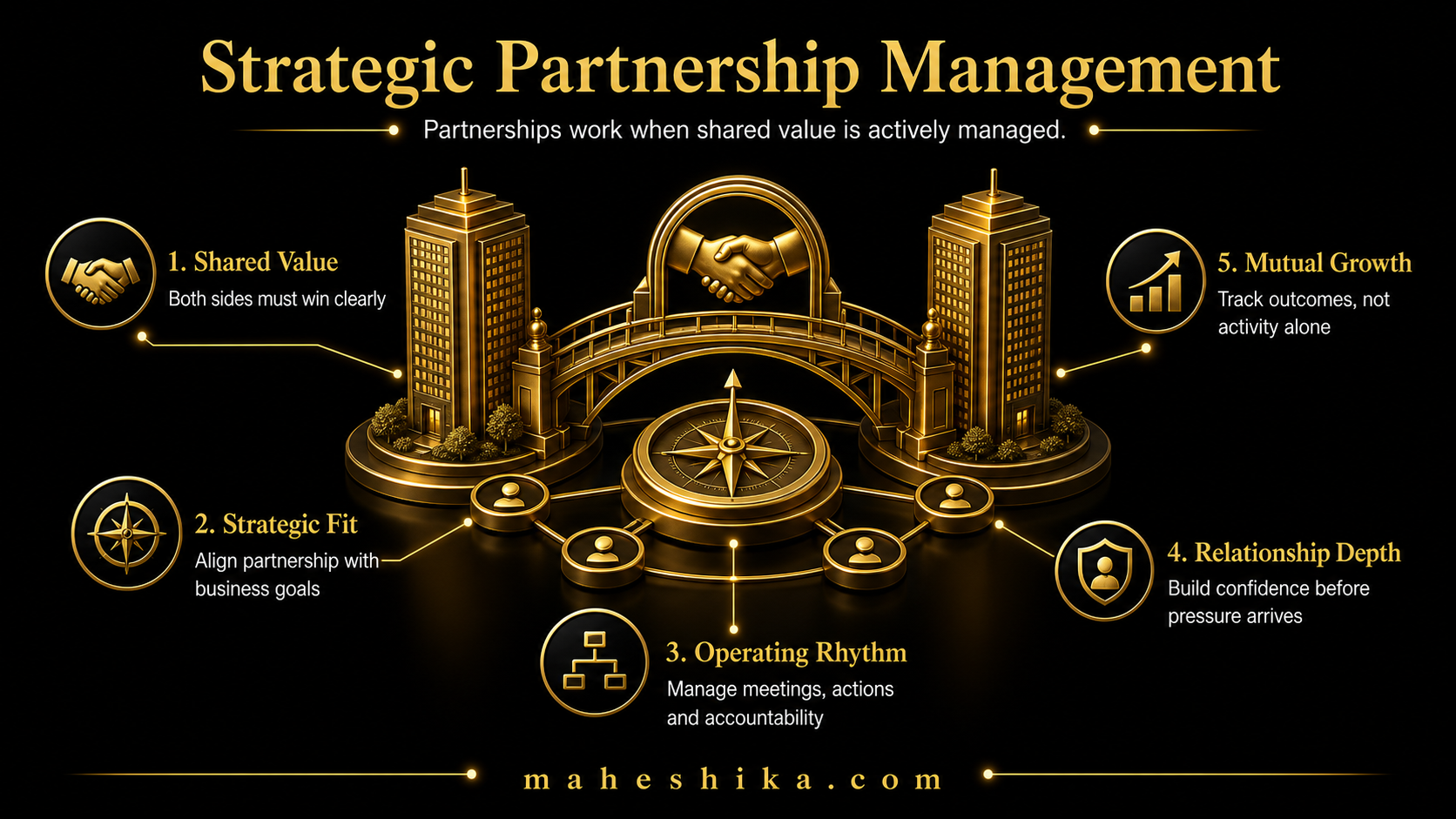
Strategic partnership management is one of the most commercially powerful capabilities in enterprise, and one of the most consistently underinvested in. Most organisations treat partnerships as either sales channels or vendor relationships. The ones that treat them as genuine strategic assets build commercial positions that are significantly more durable, more scalable, and more defensible than those built through direct sales alone.
Having spent 18 years managing partnerships across EMEA, I want to be precise about what strategic partnership management actually means, how it differs from account management or channel management, and why it matters particularly in the current commercial environment.
What Strategic Partnership Management Actually Is
A strategic partnership is a relationship between two organisations that creates commercial value for both that neither could create independently. The "strategic" qualifier matters. Most commercial relationships called partnerships are actually vendor-customer relationships, channel arrangements, or referral agreements. They have a transactional core dressed in the language of partnership. They are not wrong. They are just not strategic.
A genuinely strategic partnership changes what is possible for both parties. It opens markets or customer segments that were previously inaccessible. It creates a combined capability or offering that is more compelling than either party's individual proposition. It builds a shared commercial interest that makes both organisations more invested in each other's success than they would be in a purely transactional arrangement. Managing that kind of relationship requires a different skill set, a different cadence, and a different kind of organisational investment than managing a supplier contract or a reseller agreement.
The Difference Between Partnership Management and Account Management
Account management focuses on protecting and growing revenue from an existing customer relationship. The primary orientation is towards the customer's needs and how to serve them more completely. The success metric is retention and expansion of a commercial relationship where the power dynamic is clear: one organisation is buying, the other is selling.
Partnership management is fundamentally different in orientation. The question is not what does the partner need from us, but what can we build together that neither of us can build alone? This requires understanding the partner's commercial strategy as deeply as your own, identifying the genuine overlap points where combined effort creates disproportionate value, and structuring the relationship in a way that sustains both parties' commitment over time. It requires a leader who can hold both organisations' interests simultaneously, who can navigate the inevitable tensions that arise in any genuine partnership, and who can make decisions that optimise for the long-term value of the relationship rather than the short-term convenience of either party.
Why It Matters More in 2026 Than It Did Five Years Ago
Three shifts in the commercial environment have elevated the importance of strategic partnership management. The first is the increasing complexity of enterprise purchasing decisions. Large organisations buy less from single vendors and more from ecosystems of providers who work together. Getting into and staying central to those ecosystems requires genuine partnership relationships, not just good products.
The second is the acceleration of AI capability across industries. AI creates new categories of partnership opportunity: technology providers who need domain expertise to make their models commercially relevant, domain experts who need technology capability to deliver at scale, and organisations that can combine both to create offerings that neither could build independently. The strategic partnership opportunities created by AI are significant and largely uncaptured, because most organisations are still figuring out their own AI strategy before thinking about what it enables in their partner ecosystem.
The third is the shift towards outcome-based commercial models. As more enterprise relationships move from transactional to outcome-based, the commercial relationships that sustain them become necessarily more collaborative and more strategically interdependent. That is the natural habitat of genuine partnership management.
Related Reading
The Practical Skills of Effective Partnership Management
At its core, strategic partnership management requires five capabilities that are distinct from general commercial competence. The first is the ability to identify genuine strategic fit, as opposed to superficial complementarity. Not every organisation that operates in an adjacent space is a genuine strategic partner. Identifying the ones where the overlap is deep enough, and the mutual benefit clear enough, to justify the investment of genuine partnership is a skill that requires both market understanding and commercial judgement.
The second is structuring capability: the ability to design partnership agreements that align incentives correctly and sustain commitment over time. Most partnership agreements are underspecified on the things that matter most: what happens when the partner's strategy shifts, how joint opportunities are identified and owned, what constitutes success at the twelve-month and three-year marks. Getting the structure right at the beginning prevents most of the conflicts that erode partnership value later.
The third is executive relationship management, specifically the ability to maintain genuine relationships at multiple levels in the partner organisation simultaneously, so that the partnership is not dependent on any single contact. The fourth is conflict navigation: all genuine partnerships produce tensions, and the ability to surface and resolve them constructively rather than allowing them to fester is what separates partnerships that compound over time from those that gradually degrade. The fifth is value articulation: the ongoing ability to communicate clearly to both organisations' leadership what the partnership is producing and why it is worth sustaining.
Free
Start free: what might your organisation not be seeing?
The Business X-Ray is an outside-in look at your business: what is visible, what may be happening underneath, and what cannot be known from the outside at all. Reviewed personally before it goes out.
Get the free Business X-RayThe One Partnership That Is Yours Alone
That is the real answer to what strategic partnership management is and why it matters in 2026: it is the discipline of building commercial relationships that make two organisations stronger together than either could be alone, and the enterprises that master it are pulling steadily ahead of the ones still treating every partner as a vendor. The skill set is rare, deliberate, and genuinely scarce inside most organisations. That scarcity is exactly why it is valuable.
Here is the realisation that sits underneath everything in this article. The professionals who become genuinely excellent at partnership management, the ones who can hold two organisations' interests at once and make the relationship compound for years, do not stay visible on the strength of a job title. That expertise has a shelf life measured in org charts, not in the years it took to build. The moment the title changes or the company restructures, the market has no way of knowing that this particular person built the ecosystem, structured the deal, and made it hold.
That is the quiet cost most senior partnership leaders never account for. In a market where AI can answer almost any question about partnership strategy in a voice that sounds like everyone else's, the thing that keeps your name attached to your own expertise is not another year of good work inside someone else's company. It is a place of your own: a personal website under your own name, where the partnerships you have built, the frameworks you use, and the judgement you bring are shown and owned outright. Findable in a search. Impossible to reduce to a generic answer.
If you have spent years building the kind of commercial relationships this article describes, the next strategic move is a straightforward one: build the asset that makes that expertise visible and yours, permanently. Let us talk about what that looks like for you.