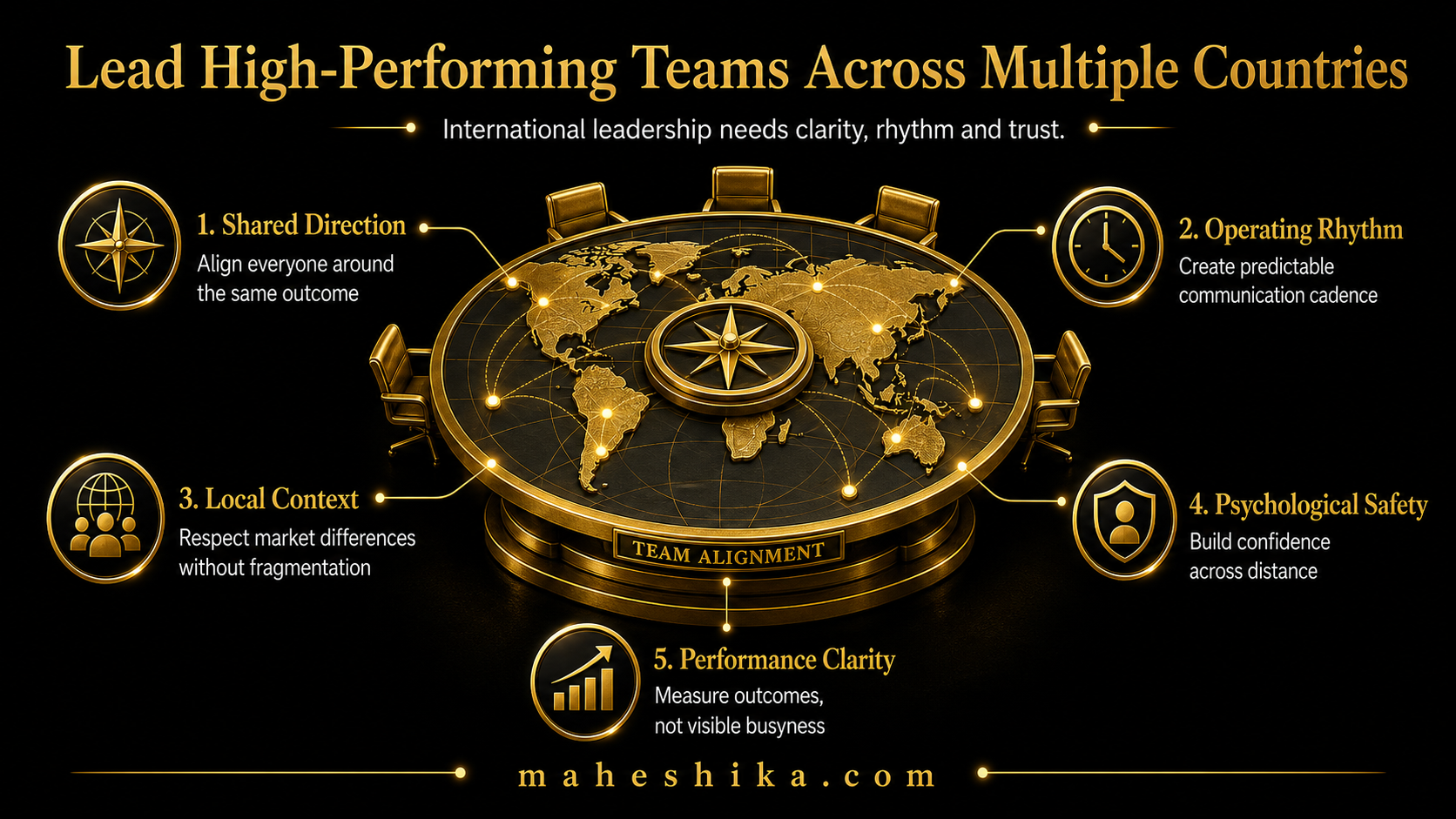
I have led teams across four continents. Teams where the time zone spread made a synchronous all-hands meeting genuinely challenging. Teams where the cultural norms around authority, feedback, and disagreement were different enough to require a genuinely different leadership approach in each location. Teams where the organisational context, the incentive structures, the local commercial dynamics, varied considerably from what headquarters assumed they were.
What creates high performance in that environment is not a management system or a framework. It is a set of leadership commitments that, when held consistently, make geography a manageable challenge rather than an insurmountable one. Here is what I have found to be genuinely decisive.
Clarity of Purpose Is Non-Negotiable at Distance
In a co-located team, ambiguity about direction gets resolved through informal conversation, corridor discussions, a quick check-in at the coffee machine. In a dispersed international team, that ambiguity compounds. It sits unaddressed for days or weeks, quietly producing misaligned effort, duplicated work, and decisions that contradict each other across geographies.
The most important thing I do with any dispersed team is invest disproportionately in clarity: clarity about the strategic priorities, about what success looks like for the quarter and the year, about which decisions can be made locally and which need central alignment, and about the non-negotiables that apply regardless of location. This clarity does not happen in a single communication. It requires consistent repetition, in different formats, with regular opportunities for the team to test their understanding against the reality they are navigating.
Invest in the Relationship Before You Need It for Performance
Managing performance in a multi-country team requires a level of trust that cannot be created in the moment of performance management. If the first substantive conversation a remote team member has with a senior leader is about why their results are below expectation, the conversation is already damaged before it starts. There is no foundation of relationship to draw on, and the distance makes the interaction colder and more threatening than it would be in person.
The investment in relationships needs to happen before it is needed, during periods when performance is fine, when the only reason to spend time with someone is because you are genuinely interested in their perspective, their challenges, and what they need to do their best work. When that foundation exists, performance conversations are a continuation of an ongoing dialogue, not an event. They land differently. They produce better outcomes.
Adapt Your Communication Style, Not Your Standards
This is a distinction that matters a great deal in cross-cultural leadership. Adapting your communication style means understanding that directness, formality, the appropriate way to give feedback, the conventions around disagreement, and the signals of respect vary significantly across cultures. Leading effectively across those differences requires genuine curiosity about and fluency in those norms, not a superficial familiarity with them.
What it does not mean is having different standards in different locations. The commercial expectations, the quality standards, the ethical commitments, and the performance requirements should be consistent. The way those expectations are communicated, reinforced, and supported may need to be calibrated to the cultural context. Conflating these two things, applying different standards because of cultural sensitivity, produces a dysfunctional team where people in different locations have fundamentally different experiences of what is expected of them. That is not inclusive leadership. It is its opposite.
Related Reading
Create Visibility Without Surveillance
One of the consistent tensions in managing dispersed teams is the instinct to compensate for physical distance with monitoring: more frequent reporting, more detailed updates, more check-in calls. This instinct is understandable and counterproductive. It signals distrust, creates bureaucratic overhead that reduces the time available for actual work, and trains people to manage upward rather than manage results.
The alternative is to create visibility through rhythm rather than surveillance. A clear cadence of reporting that is proportionate to the strategic importance of the information. Regular brief connections that are conversational rather than interrogative. A shared view of performance data that everyone on the team can see and interpret without it being mediated through a reporting relationship. When visibility is structural and mutual rather than managerial and asymmetric, the team maintains the autonomy it needs to perform while the leader has the information they need to support and intervene appropriately.
The Question Every Remote Leader Should Ask More Often
In my experience, the single most underused question in multi-country leadership is: what is making it harder for you to do your best work right now, that I might not be aware of? The things that constrain performance in remote locations are often structural or contextual, specific to that market, that organisation, that team dynamic, and invisible from the centre. The leader who asks this question consistently, and acts on the answers, removes friction that compounds silently into significant underperformance over time.
It also builds a very specific kind of trust: the sense that the leader sees the local context as real and relevant, rather than treating local variation as deviation from a central ideal. That trust produces the candour that makes multi-country leadership genuinely work: people who tell you what is actually happening rather than what they think you want to hear.
Free
Start free: what might your organisation not be seeing?
The Business X-Ray is an outside-in look at your business: what is visible, what may be happening underneath, and what cannot be known from the outside at all. Reviewed personally before it goes out.
Get the free Business X-RayThe Authority That Travels With You
So high-performing multi-country teams are not an accident. They are built deliberately, through sustained leadership investment in clarity, relationship, and the discipline to hold both consistency and local sensitivity simultaneously. Master those commitments and geography stops being the obstacle. It becomes the proof of what you can lead.
But here is what nobody tells you about that capability: it lives inside the org chart that gave you the mandate to lead across four continents in the first place. Take away the title, the badge, the platform, and the evidence of what you built goes quiet with it. Nobody searching for a leader who can run a dispersed, cross-cultural team finds you, because there is nowhere for them to find you at all.
That is the real risk in a market where AI can answer almost any question in a voice that sounds like everyone else's. The professionals who stay visible are the ones with a place of their own: a personal website under their own name, where the judgement, the frameworks, and the track record live in public. Owned outright, findable in a search, unmistakably yours, whether or not you are still inside the structure that first gave you the room to build it.
You do not have to build that alone, and you do not have to wait until you need it. If you want it done properly, let us talk.