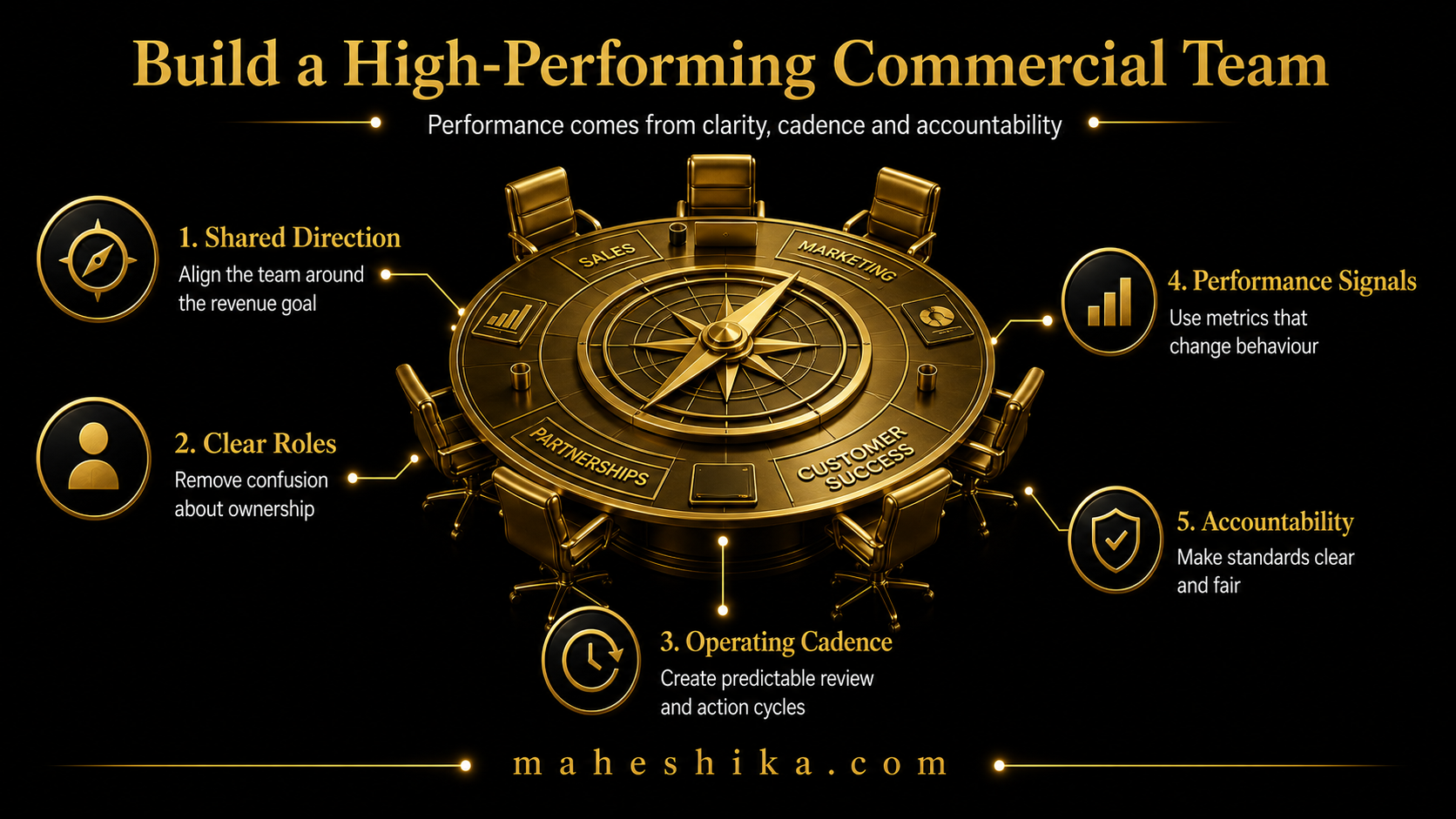
I have built commercial teams in environments where almost nothing was working: new markets with no brand recognition, products that needed explanation, competitors with deep local roots, and organisational pressure to show results faster than the market would allow. And I have built commercial teams where the conditions were favourable and the question was how to turn good results into exceptional ones.
The factors that determine whether a commercial team performs at a high level are the same in both environments. What differs is the timeline and the urgency. Here is what I have found to be genuinely decisive, based on 18 years of building these teams across EMEA and four continents.
Hire for Commercial Thinking, Not Just Commercial Activity
The most consistent mistake in commercial team building is optimising for energy and activity over judgement. High-activity salespeople are easy to identify in an interview process: they are confident, articulate, quick, and appear driven. What is harder to identify, and more predictive of sustained high performance, is the quality of commercial thinking. Does this person understand what drives a buying decision at the level of the buyer's actual business problem? Can they hold complexity and ambiguity without defaulting to the nearest script? Do they know when to advance and when to pause?
These qualities are harder to assess in a standard interview but they are assessable. Give candidates a real commercial scenario, something genuinely complex from your business, and ask them to walk through their thinking. The gap between candidates who have real commercial judgement and those who have good commercial habits is visible within twenty minutes, if you are asking the right questions and listening carefully to the quality of reasoning rather than just the confidence of delivery.
Create Clarity on What Winning Looks Like
Commercial teams underperform when the definition of success is ambiguous or when the metrics used to evaluate performance do not accurately reflect commercial value created. Revenue is the obvious metric, but it is a lagging indicator and it can be gamed in ways that damage the long-term health of the business: pulling forward deals, discounting to hit quarterly targets, winning business that is not a good fit and then struggling with delivery or retention.
The best commercial leaders I have worked with define success at multiple levels: leading indicators that predict performance, such as quality of the pipeline and quality of customer conversations, and lagging indicators that confirm it, such as revenue, deal size, and customer retention. They make those definitions explicit and stable, so the team knows what it is actually optimising for and is not constantly reinterpreting targets based on what is most convenient in the moment.
Invest in the Quality of Commercial Thinking Continuously
High-performing commercial teams do not stay high performing without continuous investment in the quality of commercial thinking. Markets change. Buyers become more sophisticated. The competitive landscape shifts. The techniques that worked eighteen months ago need to be evaluated and updated. Teams that stop developing their commercial capability start declining, often without noticing until the results are already reflecting it.
The investment I have found most valuable is not formal training programmes. It is the regular cadence of serious commercial conversation: deal reviews that go deep on the quality of the commercial approach rather than just the status of the pipeline, peer learning sessions where the team shares what is working and what is not, and the leader's own willingness to engage directly with the most complex commercial situations rather than delegating them entirely to individual contributors.
Related Reading
Address Underperformance Early and Directly
In my experience, the single most damaging thing a commercial leader can do for team performance is tolerate sustained underperformance without addressing it directly. The damage is not primarily to the output of the underperformer, though that is real. It is to the rest of the team, who can see what is happening and who are watching to understand what the standards actually are, as opposed to what is claimed they are.
Early, direct, honest conversations about underperformance, accompanied by specific support and clear expectations, save a great deal of damage later. Most underperformance in commercial teams has identifiable causes: skill gaps, motivation issues, a role that is not the right fit for the individual, or structural problems in the territory or product that the individual cannot solve alone. Addressing it early creates the possibility of genuine resolution. Leaving it too long usually produces an outcome that is bad for everyone.
Build the Culture That Sustains Performance Over Time
High performance in commercial teams is not sustainable on pressure alone. I have seen teams that were driven to high numbers through intense pressure, with no investment in the culture that sustains intrinsic motivation, and the attrition that followed was consistently costly. The best performers, the ones with options, are the first to leave when the culture is extractive rather than developmental.
The culture that sustains high performance over multiple years has specific characteristics. It is honest about commercial reality, even when that reality is uncomfortable. It celebrates learning from failure as openly as it celebrates success. It creates genuine opportunity for the best performers to grow in ways that are meaningful to them, not just in ways that are convenient for the organisation. And it is led by someone who treats commercial excellence as a serious discipline worth investing in, rather than a function to be managed at arm's length and pressured for results.
That last point is where everything starts. The leader's own relationship with commercial excellence, their genuine interest in understanding what makes the difference between good and exceptional commercial performance, determines more about the team's culture than any process or policy. It is the part that cannot be delegated.
Free
Start free: what might your organisation not be seeing?
The Business X-Ray is an outside-in look at your business: what is visible, what may be happening underneath, and what cannot be known from the outside at all. Reviewed personally before it goes out.
Get the free Business X-RayThe Asset That Outlasts the Org Chart
So what does it take? Not a checklist. It takes hiring for judgement over activity, defining winning honestly rather than conveniently, treating commercial thinking as a discipline you invest in continuously, addressing underperformance while it is still fixable, and a leader who treats commercial excellence as something worth their own attention rather than something to delegate and monitor from a distance. That last part cannot be handed off. It is also the part that quietly builds your reputation, deal by deal, market by market, for years.
Here is what strikes me writing this down: everything I have just described, the judgement, the pattern recognition, eighteen years of reading rooms and reading markets, lived entirely inside other people's organisations. It built enormous value for those businesses. It built almost nothing that was visibly, searchably mine. If the title disappeared tomorrow, so would most of the evidence that I had ever done any of it.
That is the quiet risk every senior commercial leader is carrying, whether they have named it yet or not. AI can now produce a competent answer to "what makes a high-performing commercial team" in seconds, in a voice that sounds like everyone else's. What it cannot produce is your specific track record: the actual teams you built, the actual markets you turned around. That record only protects you if it lives somewhere you own, a personal website under your own name, where your thinking and your work are on record, findable, unmistakably yours, not filed away inside a company that can end its relationship with you on a Tuesday.
If you have spent years building this kind of value for someone else's business, it might be time to build the piece of it that is permanently yours. Let us talk about what that would look like for you.