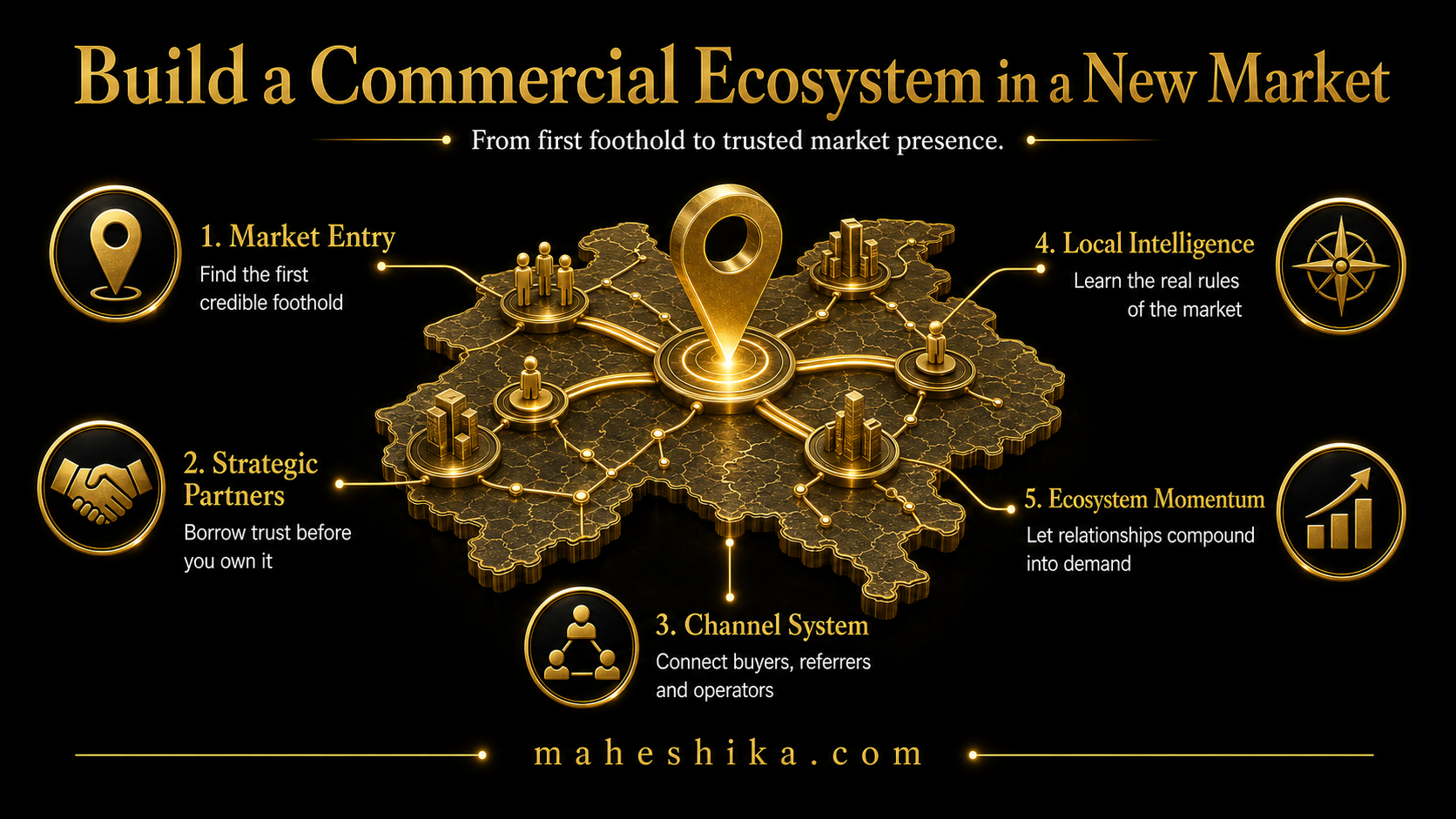
I have done this more times than I can easily count. Arrived in a market where nobody knew the company, where the product was unfamiliar, where the competitive landscape was dominated by long-established local players, and where the remit was to build commercial traction from nothing. Across EMEA, across very different regulatory and cultural environments, across sectors where the buying cycles could run to eighteen months or more.
What I learned is that building a commercial ecosystem in a new market is never primarily about the product. It is about the relationships, the positioning, and the sequencing. Get those three right, and the product finds its audience. Get them wrong, and even an excellent product stalls at the edges of the market and never gets to the centre.
Understand the Ecosystem Before You Try to Enter It
The first and most important investment in a new market is intelligence, not activity. Before any commercial outreach, before any partnership conversations, before any marketing spend, you need to understand precisely who the key players are in the commercial ecosystem you are entering. Not just the direct buyers, but the influencers, the gatekeepers, the existing incumbents, the industry associations, the regulatory bodies that shape the context in which buying decisions are made.
In every market I have entered across EMEA, this mapping exercise revealed dynamics that were not visible from the outside and that would have produced very expensive mistakes had I not found them early. A distributor who appeared to be the logical entry point but who had a deeply conflicted relationship with the category we were entering. A regulatory relationship that, if handled correctly, would open access to the entire public sector. A local competitor who looked formidable but whose customer relationships were actually fragile and vulnerable to a credible alternative.
This intelligence does not come from desk research alone. It comes from conversations: with industry contacts, with potential customers who are willing to speak candidly before a formal sales process begins, with advisers who know the market from the inside. Investing six to eight weeks in this intelligence-gathering phase, before committing commercial resources, pays back consistently.
Find Your Anchor Partner First
Every successful commercial ecosystem I have built started with one anchor relationship: a partner, customer, or distributor who gave the organisation credibility and reach it could not have acquired alone. The anchor partner is not necessarily the largest or most prestigious player in the market. They are the one whose endorsement or association changes how the rest of the market perceives you.
Finding this partner requires being clear about what you bring to them, not just what they bring to you. The mistake is approaching potential anchor partners with a pitch about your product and your market entry goals. That is irrelevant to them. The conversation that opens doors is the one where you can articulate specifically what commercial opportunity your partnership creates for them: access to a customer segment they currently cannot reach, a capability that complements their existing offering, or a commercial arrangement that structurally improves their margins. When those conversations happen at the right level, with people who have the authority to say yes, the anchor relationship becomes the foundation everything else is built on.
Sequence Your Market Entry Deliberately
One of the most common and most damaging mistakes in new market entry is trying to be everywhere at once. The logic is understandable: you want to generate revenue quickly, every segment looks like an opportunity, and the pressure from leadership to show traction creates an incentive to spread effort broadly. The result is a thin commercial presence across too many accounts and segments, none of which have received sufficient attention to convert, and a team that is exhausted and demoralised because nothing seems to be working.
The alternative is to choose one segment, or even one geography within a segment, and go deep. Win there first. Build reference customers who will speak credibly to your capabilities. Use those references to open the next segment. The sequenced approach is slower in the first six months and dramatically faster in months seven through twenty-four, because you are building momentum rather than dissipating effort.
Related Reading
Build the Local Team With Cultural Intelligence, Not Just Commercial Competence
In cross-border market entry, the instinct is often to hire the person with the best commercial track record, the strongest existing network, or the most impressive CV. These are necessary criteria, but they are not sufficient. The person who builds a commercial ecosystem in a new market needs to navigate cultural dynamics that are often opaque to outsiders, and sometimes to the organisation's leadership team who are directing the effort from a different market.
I have seen exceptional salespeople fail in new markets because they applied the commercial style that worked at home, without adjusting for the relationship-building norms, the decision-making structures, or the communication conventions of the new environment. I have also seen people with more modest track records build extraordinary commercial positions because they understood instinctively how trust is established in that market and invested in it accordingly. Cultural intelligence, in commercial contexts, is as valuable as sector knowledge. Often more so.
Think in Ecosystems, Not Just Accounts
The distinction between a sales strategy and an ecosystem strategy is the difference between winning individual accounts and building a self-reinforcing commercial position. An ecosystem strategy asks: if we win this customer, who else in the market does that open a door to? If we form this partnership, what downstream relationships does it create? If we establish this capability locally, what other commercial opportunities does it enable?
Ecosystem thinking requires a longer time horizon than account-level selling, but it produces commercial positions that are more durable and more defensible. Competitors can match your product features. They cannot easily replicate the web of relationships, references, and partnerships that a well-built commercial ecosystem creates over two to three years of sustained, intelligent effort.
Free
Start free: what might your organisation not be seeing?
The Business X-Ray is an outside-in look at your business: what is visible, what may be happening underneath, and what cannot be known from the outside at all. Reviewed personally before it goes out.
Get the free Business X-RayThe Ecosystem You Build Last Is Your Own
So building a commercial ecosystem in a new market from nothing comes down to intelligence before activity, one anchor relationship before broad reach, and deliberate sequencing over trying to be everywhere at once. Do those three things properly and the market opens. Skip them and even a strong product stalls at the edges, never reaching the centre.
Here is the part I did not fully understand until I stopped being introduced by a company name. Every ecosystem I built in eighteen years across EMEA was anchored to an employer's credibility, not mine. The moment that badge was gone, so was the shortcut. My judgement, my track record, my relationships were still real, but there was nowhere anyone could go to see them for themselves. That is the position most senior professionals are quietly sitting in right now, and AI is about to make it sharper: it can answer almost any question in a voice that sounds like everyone, and a title or an employer can vanish overnight.
The one thing that does not vanish is a space you own outright. A personal website under your own name, where your thinking lives, your work is shown, and your signature on how you built ecosystems, closed markets, and made judgement calls under pressure is unmistakable. Findable in a search. Impossible to flatten into a generic answer. It is the anchor relationship you build with the market itself, and unlike every other one, it never depends on someone else's introduction.
That is worth building properly, and you do not have to work out how alone. Let us talk.