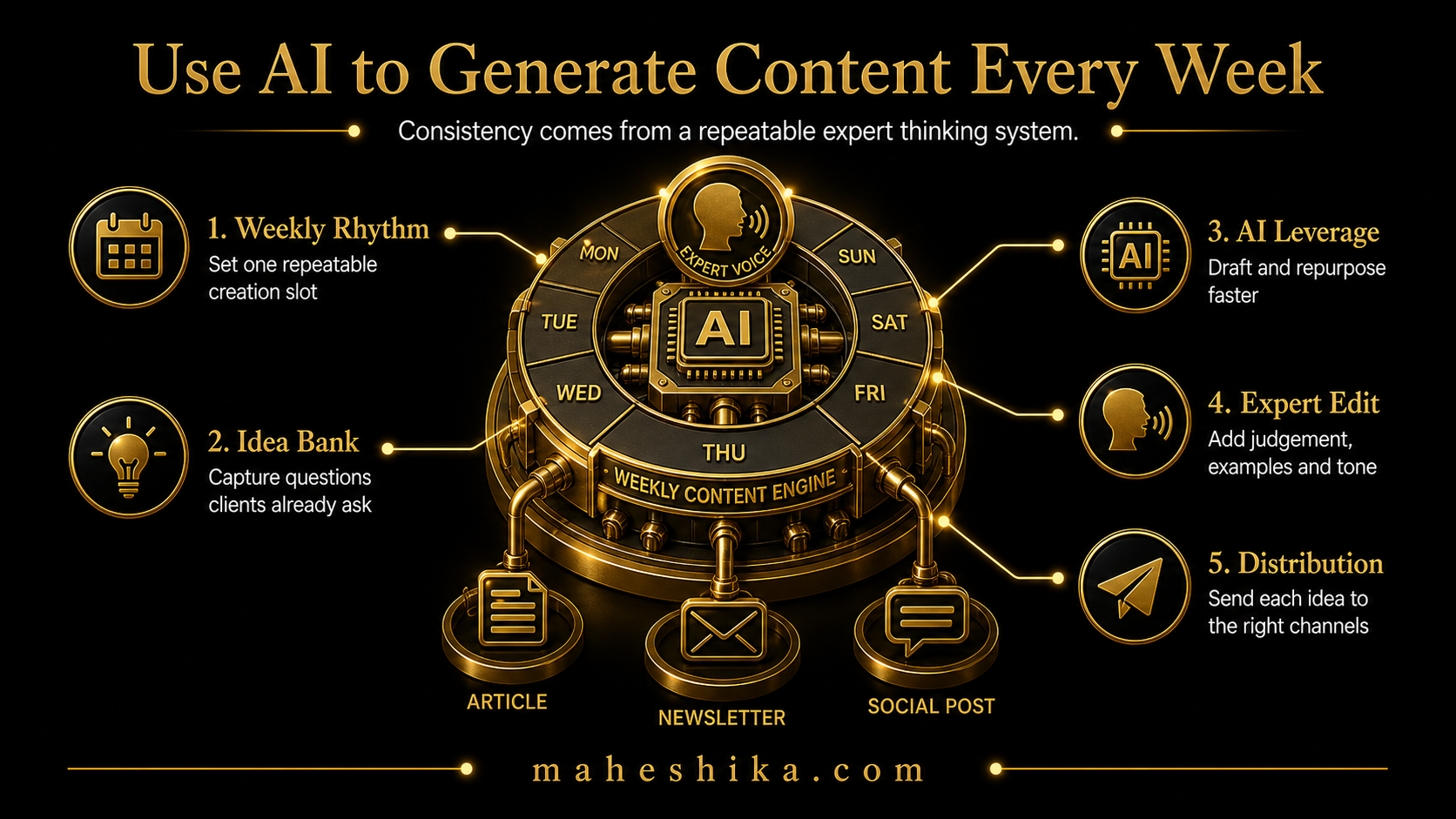
Most small business owners know they should be producing content. They know it builds credibility, attracts clients, and keeps them visible in their market. The problem is not understanding why content matters. It is finding three hours on a Thursday afternoon to sit down and write something good when seven other things are also urgent.
AI does not replace your ideas or your voice. What it does is eliminate the blank page problem, compress the time from idea to draft, and make it genuinely possible to publish consistently even when you are running a business with everything else that entails. Here is a system that works.
Build an Idea Bank First
The biggest bottleneck in content production is not writing speed. It is deciding what to write about. Solve this separately from writing, when you are not under pressure to produce.
Once a month, spend 30 minutes with an AI tool doing a content brainstorming session. Give it context: your business, your audience, the problems they face, the questions you hear most often, and the topics you know well. Ask for 20 article ideas. You will not use all of them, but you will find five or six that are genuinely worth writing. Add those to a simple list. Now you always have topics ready when it is time to write.
The best article ideas come from real conversations: questions clients ask you, objections that come up in sales calls, problems you have solved recently. Keep a running note on your phone for these as they happen. These are always better than generic topic ideas because they reflect what your specific audience actually wants to know.
The Content Production System
With a topic chosen, the process has four steps.
Step one: brief the AI. Do not just say "write an article about X." Give it real context. Your audience, the specific angle you want to take, the key points you want to make, and any personal experience or opinion you want to include. The more specific your brief, the more useful the draft. Think of this as briefing a skilled writer who does not know your business.
Step two: review the outline. Ask for an outline before the full article. This takes 30 seconds and saves significant editing time. If the structure is wrong, redirect it now rather than after 1,000 words have been written in the wrong direction.
Step three: generate and edit. With a good outline confirmed, ask for the full draft. Expect to spend 15 to 20 minutes editing. Your job is to add your specific examples and opinions, remove anything that sounds generic, adjust the tone to match your voice, and verify any facts that matter. The output should sound like you after editing, not like AI.
Step four: repurpose. Once the article is final, ask AI to produce three social media posts from it, a short email newsletter introduction, and a LinkedIn post. Four pieces of content from one piece of thinking. This is where the time savings compound.
Related Reading
Protecting Your Voice
The risk with AI content is that everything starts to sound the same. There is a recognisable AI tone: slightly formal, prone to lists, fond of phrases like "it is worth noting" and "navigating the landscape." If you do not actively edit it out, your content will carry that tone, and sophisticated readers will notice.
The solution is to give AI a style guide. Write two or three paragraphs that represent how you actually write at your best. Tell AI explicitly: write in this voice, use this level of formality, avoid these phrases. Most tools allow you to save a system prompt or custom instructions that apply to every conversation. Set this up once and it changes the baseline quality of every output immediately.
Also: the best piece of your content should always be something AI cannot produce, a specific example from your own experience, an opinion grounded in what you have actually seen, a story that only you can tell. Build that in deliberately. It is what makes your content worth reading rather than just worth skimming.
Free
Start free: what might your organisation not be seeing?
The Business X-Ray is an outside-in look at your business: what is visible, what may be happening underneath, and what cannot be known from the outside at all. Reviewed personally before it goes out.
Get the free Business X-RayA Realistic Weekly Content Schedule
One article per week, properly researched and edited, is a genuinely ambitious content schedule for a business owner. One article per fortnight is more realistic and still creates significant compounding value over a year. Do not let the perfect schedule be the enemy of a consistent one.
A workable schedule looks like this: Monday, select the week's topic from your idea bank and spend ten minutes writing a rough brief for AI. Tuesday, generate the draft and edit it in one sitting of 20 to 30 minutes. Wednesday, generate the social and email repurposing assets in 15 minutes. Thursday, schedule everything for publication.
Total content production time per week: under 90 minutes. That is achievable for most business owners, and it produces a body of work that compounds. Fifty articles in a year. A blog that demonstrates your expertise to every prospective client who looks you up.
Content is one of the highest-return investments a small business can make in its own visibility. AI makes it possible to maintain that investment consistently even when the business is busy. That consistency, more than any individual piece of content, is what builds an audience and a reputation over time.
This article is part of the AI for Small Business: The Complete Guide. The full series covers everything from tools to strategy to team training.
Where All This Weekly Effort Should Actually Live
So that is the system: an idea bank filled before you need it, a four-step process of brief, outline, draft and repurpose, a style guide that keeps the output sounding like you, and a schedule you can actually sustain. Fifty articles a year, produced in under ninety minutes a week. That is not a stretch goal. It is a realistic habit, and it is the difference between a business that talks about being visible and one that actually is.
But here is what that consistency is really building towards, and it is worth naming plainly. Every business owner reading this now has the same tools you do. The idea bank, the four-step process, the style guide, none of it is a secret any more. Which means the advantage was never going to be who could produce content fastest. It was always going to be who had somewhere permanent to put it.
Most of that weekly output ends up scattered across platforms you do not own: a feed an algorithm decides who sees, a list that lives inside someone else's software, posts that are unfindable within a month of publishing. Fifty articles a year for five years is two hundred and fifty pieces of thinking, and if none of them live somewhere under your own name, you have built an audience for the platform, not an asset for yourself. The one place that keeps compounding, that a search engine finds, that no algorithm change can take from you, is a website with your name on it.
That is the real return on everything you write each week: a home for it that is unmistakably yours. If you want help building that home properly, done for you, by someone who has done this work herself, let us talk.