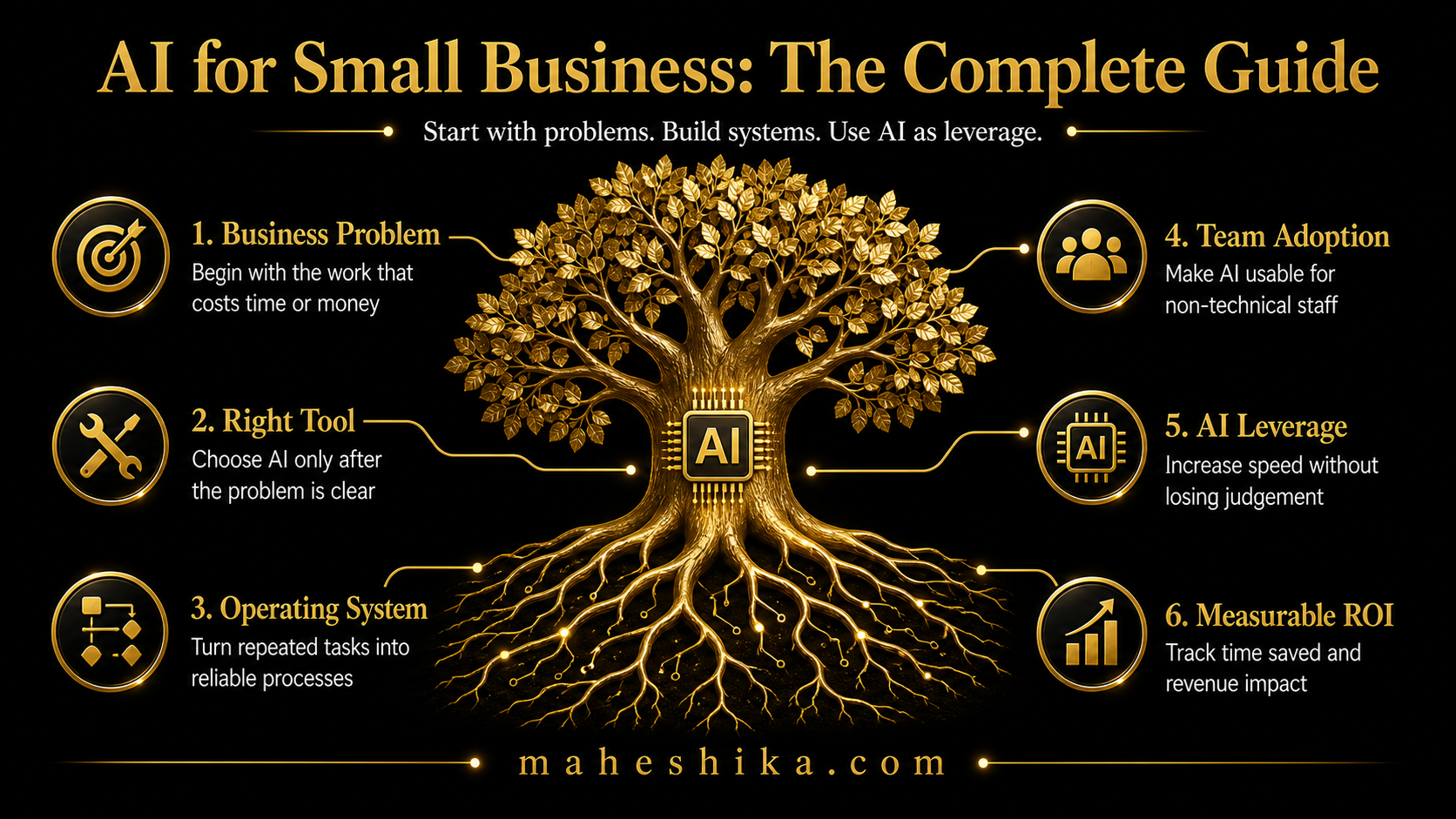
Most small business owners I speak with fall into one of two camps. Either they have tried one or two AI tools, found them underwhelming, and concluded that AI is overhyped. Or they are overwhelmed by the sheer volume of tools, advice, and conflicting opinions, and have not started at all. Both responses are understandable. Neither is going to serve you well in 2026.
AI is not magic. It will not replace your judgement, your relationships, or the expertise you have spent years building. But it is now genuinely capable of replacing the repetitive, time-consuming, low-leverage work that keeps small business owners stuck in their businesses rather than growing them. Content drafting, customer enquiry handling, proposal writing, data summarisation: these are real hours you can reclaim this month, without hiring, without a technical team, and without a significant budget.
This guide covers everything you need to know to implement AI in your business practically and without wasting time on the wrong things. I have organised it into the core questions that matter, with dedicated articles going deeper on each one.
What AI Actually Is for a Small Business
Forget the science fiction framing. For a small business owner, AI is software that can understand natural language, generate text, analyse data, answer questions, and carry out tasks based on instructions you give it in plain English. You do not need to write code. You do not need to understand how it works. You need to know what it can do for you and how to give it clear instructions.
The tools available now fall into several practical categories: writing and content assistants, customer service automation, sales support, administrative automation, and analytics. Within each of those categories, there are free tools, freemium tools, and paid tools. Most small businesses can generate meaningful results starting with free tiers alone.
What AI cannot do is equally important to understand. It cannot replace genuine expertise. It does not know your specific clients, your market history, or your business context unless you provide that information. It makes mistakes, particularly with facts and numbers. Any output that will go to a client needs a human review. These are not reasons to avoid AI; they are parameters for using it well.
The Four Areas Where AI Delivers Fastest Return
If you are just starting, do not try to automate everything at once. Start where the time cost is highest and the output quality threshold is achievable. In my experience working with small business owners and SMB leaders, four areas consistently deliver the fastest return on the time you invest in learning.
Content and communications. Writing takes a disproportionate amount of time relative to the thinking it actually requires. Blog posts, social media updates, email newsletters, client communications: AI can produce solid first drafts in seconds. Your job becomes editing and directing rather than writing from scratch. A business that was publishing one article a month can realistically publish four or eight with the same effort.
Customer service and enquiry handling. A well-configured AI assistant can handle the majority of routine customer questions without your involvement, around the clock. This is not about replacing the human moments that matter. It is about making sure someone always gets a useful response to a basic question, even when you are not available.
Proposals, documents, and client deliverables. The time between winning a client conversation and sending them something of value is often where momentum dies. AI significantly compresses that gap. You can go from a brief conversation to a structured proposal draft in under an hour, where it previously took a day.
Administrative work and research. Summarising documents, researching a sector before a client call, building a first draft of a process or policy, creating templates: these tasks no longer need to consume your afternoons. AI handles them in minutes with clear instructions.
How to Start Without a Budget
The most common reason small business owners delay implementing AI is the assumption that meaningful capability requires significant spend. It does not. Several of the most capable general-purpose AI tools have free tiers that are genuinely useful for business tasks, not limited trial versions designed to frustrate you into upgrading.
A free-tier AI writing assistant can handle content drafting, email writing, and proposal structuring. A free-tier AI chat tool can be embedded on your website to handle customer questions. Free automation tools can connect your existing software, so that a completed form automatically creates a task, sends an email, or updates a spreadsheet. You can build a meaningful AI foundation without spending a pound.
The right time to spend money on AI tools is when you have identified a specific use case where the paid capability clearly justifies the cost, or when the free tier creates a constraint that is limiting your results. Start free, prove the use case, then decide on investment.
All Articles in This Guide
- How to Implement AI Without a Technical Team
- The 10 Best AI Tools for Small Business Owners in 2026
- How to Automate Your Business With AI
- What AI Can and Cannot Do for Your Business in 2026
- How to Use AI to Generate Content Every Week
- AI for Sales: Winning More Clients With AI
- How to Build an AI-Powered Customer Service System
- The ROI of AI for Small Business
- How to Train Your Team to Use AI Without Resistance
- How to Create an AI Strategy in 90 Days
- How to Use AI to Write Better Proposals and Client Documents
- What Is an AI Audit and Does Your Business Need One?
- How to Start Using AI This Week With No Budget
Building an AI Strategy That Actually Fits Your Business
A strategy does not need to be a lengthy document. For a small business, an AI strategy is a clear answer to three questions: where in the business is time being lost to tasks AI could handle, which of those tasks should I address first, and how will I measure whether it is working.
The 90-day framework I recommend starts with an audit of your own working week. Track for one week where your hours actually go. You will almost certainly find that a significant portion goes to tasks that are repetitive, process-based, and do not require your unique judgement. Those are your AI targets.
In the first 30 days, focus on implementing one tool in one area. Content is the easiest starting point for most business owners because the feedback loop is immediate. You write a prompt, you get a draft, you edit it, you publish it. You can see within a week whether it is working. In the second 30 days, add a second use case, ideally customer service or administrative automation. By day 90, you should have three to five AI processes running in your business and a clear view of which ones are saving the most time.
The businesses that fail with AI are almost always the ones that either try to implement too many tools at once, or treat AI as a one-time setup rather than an ongoing practice. AI tools improve. Your prompting skills improve. The results compound over time if you stay with it.
Free
Start free: what might your organisation not be seeing?
The Business X-Ray is an outside-in look at your business: what is visible, what may be happening underneath, and what cannot be known from the outside at all. Reviewed personally before it goes out.
Get the free Business X-RayManaging Your Team Through the Change
If you have a team, even a small one, AI implementation is as much a people challenge as a technology challenge. The most common failure mode is not choosing the wrong tools. It is introducing AI in a way that generates anxiety, resistance, or passive non-adoption.
People worry about job security when AI is mentioned. That worry is not irrational, and dismissing it with reassurances tends to make it worse. A more effective approach is to involve your team in identifying where AI would genuinely help them, rather than presenting it as a decision already made. When people feel that AI is something being done with them rather than to them, adoption is significantly higher.
Training matters too, but not in the way most businesses approach it. A two-hour workshop on AI tools will be forgotten within a week. What works is a structured practice: weekly prompting challenges, shared wins in team meetings, a simple internal guide to how AI is being used in each role. The goal is to make AI a normal part of how the team works, not a special project.
Set clear expectations about quality control from the start. Every team member using AI to produce work that goes to clients should understand that they are responsible for reviewing and approving that output. AI assists; humans are accountable. That principle, stated clearly and enforced consistently, prevents the quality problems that give AI a bad name in small businesses.
The Common Mistakes Worth Avoiding
I have watched a lot of businesses implement AI in the past two years, and the mistakes cluster in predictable ways. Starting with the tool rather than the problem is the most common. Someone reads about a new AI tool, signs up, and then tries to find a use for it in their business. That is the wrong order. Start with the problem: what task is taking too long, costing too much, or producing inconsistent results. Then find the tool that addresses it.
Over-relying on AI output without a review process is the second major mistake. AI-generated content that goes out with factual errors, wrong client names, or a tone that does not match your brand can damage relationships that took years to build. Build a review step into every AI-assisted workflow. It does not need to be lengthy, but it does need to exist.
The third mistake is abandoning a tool too quickly. Learning to prompt well takes practice. The first outputs from a new tool are rarely the best ones. Give yourself four to six weeks with a new tool before deciding whether it is working. Experiment with different prompts, different levels of context, different approaches. Most business owners who have genuinely good results with AI have been using the same core tools consistently for six months or more.
The Advantage AI Cannot Copy
So the answer to "how do I actually start with AI" is simple: pick one task this week, not a strategy document. A free tool, one piece of writing, one hour. That is how every business genuinely thriving with AI in 2026 began, and it matters more than the next twelve steps you have not taken yet.
But here is the shift most small business owners will miss while they are busy automating newsletters and proposals. The same AI drafting your content is drafting it for every other business owner in your sector, in roughly the same tone, from roughly the same prompts. When the tools are identical and the output starts sounding the same, what keeps a client choosing you is no longer the task you automated. It is the expertise behind it, and whether anyone can actually find and verify that it is yours.
That expertise cannot live only in a LinkedIn feed an algorithm controls, or a folder of client proposals nobody outside your circle will ever see. It needs a place with your name on it: a website you own outright, where your thinking, your results, and your way of working are laid out for anyone to find and judge for themselves. AI can write faster than you. It cannot become you. The businesses still being chosen on reputation five years from now are the ones who gave their expertise a permanent, findable home while everyone else was busy automating the easy parts.
If you want that built properly, and would rather not figure it out alone, let us talk.