Return on investment from AI is a topic surrounded by noise. Vendors cite headline figures that apply to large enterprises with substantial implementation budgets. Sceptics point to disappointing pilot projects that never scaled. Neither framing is particularly useful for a small business owner deciding whether to invest time in learning these tools.
The more useful frame is this: what kinds of AI use cases reliably generate return, and what does that return actually look like for a business with limited resources? That is what this article addresses, with the caveat that specific numbers from surveys and reports vary significantly by context, and the most relevant data point is always your own business.
The Two Types of ROI That Matter for Small Businesses
AI returns for small businesses come in two forms: time savings and output quality improvements. Understanding which type applies to which use case helps you set realistic expectations.
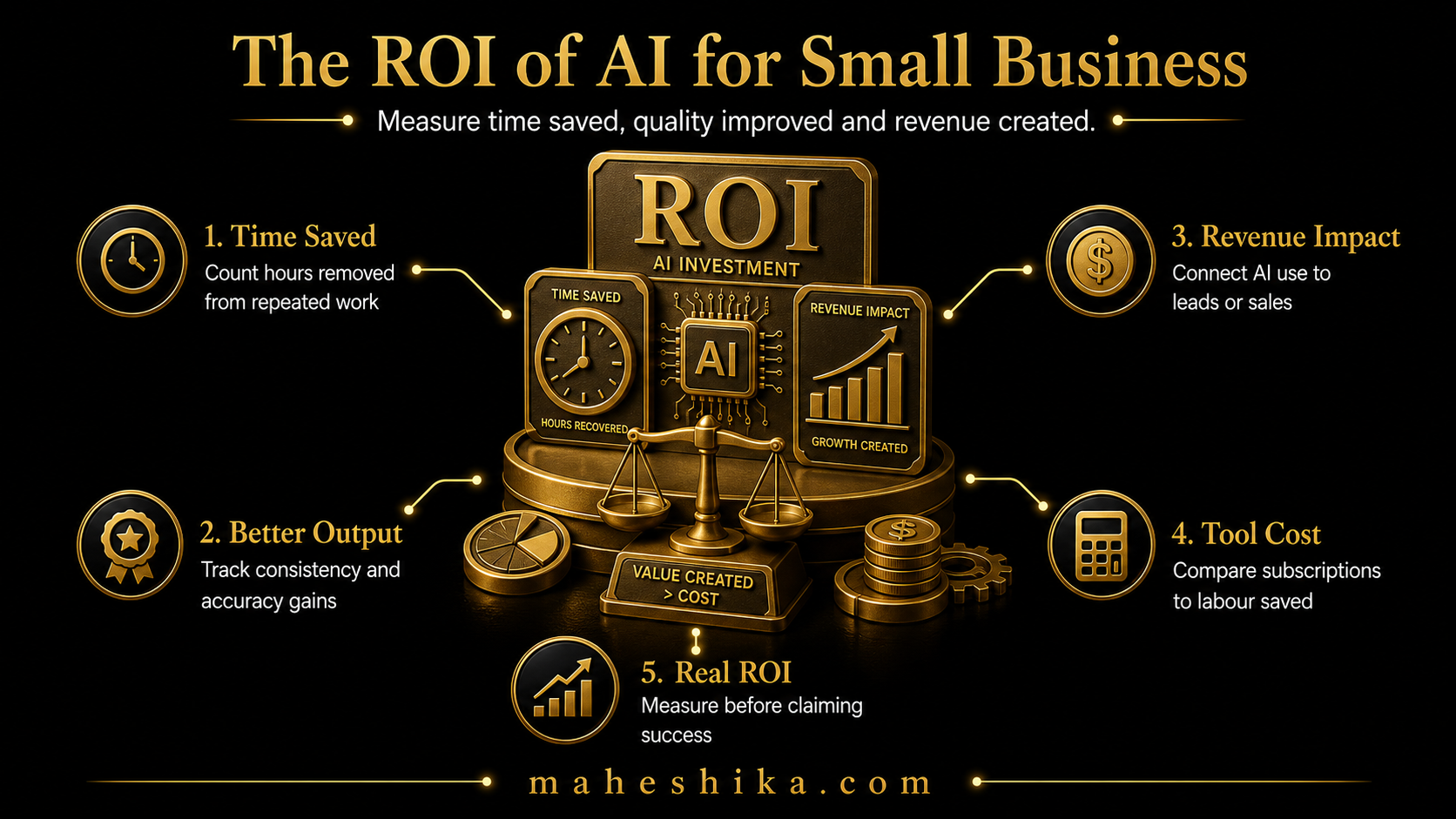
Time savings are the most immediate and measurable return. When a task that took three hours now takes 45 minutes, the return is calculable: roughly 2.25 hours reclaimed per instance. For a business owner whose time is their most constrained resource, this is significant regardless of whether those hours translate directly into revenue. They may translate into rest, strategic thinking, client relationships, or additional revenue-generating work. All of those have value.
Quality and consistency improvements are harder to measure but often more valuable over time. When your customer communications are consistently well-written rather than varying with how much energy you had that day, when your proposals go out within hours rather than days, when your content is published weekly rather than whenever you find the time: these improvements compound in ways that show up in client retention, conversion rates, and reputation. The mechanism is real; the attribution is just harder to isolate.
Where Small Businesses See the Fastest Return
Content production. This is the highest-frequency, highest-volume use case for most small businesses. Estimates suggest that AI assistance reduces content production time by 50 to 70 percent for tasks like blog posts, social media, and email newsletters. For a business owner spending four hours per week on content, that returns two to three hours per week, or roughly 100 to 150 hours per year. At any reasonable estimate of an owner's hourly value, that is a significant return even from free tools.
Customer service automation. For businesses that receive a consistent volume of routine enquiries, an AI chatbot handling 60 to 70 percent of questions without human intervention is achievable within the first three months of setup. The return depends on how many hours were previously spent on those enquiries. For businesses with active customer service demand, this can represent the largest single time saving from any AI implementation.
Proposal and document production. Compressing a four-hour proposal writing process to one hour, consistently, across every pitch: this is where AI delivers both time savings and quality improvement simultaneously. Faster proposals mean clients receive them while interest is high. Better-structured proposals convert at higher rates. The combined effect on revenue can be meaningful.
Related Reading
The Costs That Are Easy to Undercount
The most honest ROI calculation accounts for the full cost of implementation, not just the tool subscription.
Learning time. Every new tool has a learning curve. Budget realistically: a general-purpose AI assistant might take four to six hours to use competently. A customer service chatbot might take a full day of setup, testing, and refinement. Automation platforms can take a week of learning before you are building workflows confidently. These hours are real costs that most ROI calculations ignore.
Ongoing maintenance. AI systems are not set-and-forget. Chatbots need their knowledge bases updated when your services or policies change. Automations need reviewing when your processes change. Prompt templates need refining as you learn what works. Budget two to four hours per month for maintenance across an active AI stack.
Quality control. If AI-generated outputs require significant human review before they are usable, that review time is part of the cost. Good prompting reduces this, but it never reaches zero. A realistic estimate for a well-run AI content process is 15 to 20 minutes of editing per article. Include that in your calculation.
Free
Start free: what might your organisation not be seeing?
The Business X-Ray is an outside-in look at your business: what is visible, what may be happening underneath, and what cannot be known from the outside at all. Reviewed personally before it goes out.
Get the free Business X-RayHow to Calculate Your Own Return
Do not rely on industry averages. Run the numbers for your specific business. The formula is straightforward.
List the tasks you are considering using AI for. For each one, estimate the current time cost per week. After implementing AI, re-measure the actual time cost. Calculate the time saved per week and multiply by 52 for the annual figure. Assign a value to that time based on what you would do with it: revenue-generating work, delegation, or capacity you do not currently have.
Subtract the cost of the tools, the learning time valued at your hourly rate, and the ongoing maintenance time. What remains is your net return. For most small businesses that implement AI thoughtfully in two or three high-value use cases, the net return is positive within the first quarter.
The Return AI Cannot Calculate For You
So the honest answer to the ROI question is this: AI pays for itself, reliably, when you point it at one well-chosen problem instead of scattering it across everything at once. The businesses that struggle are the ones treating it as a general upgrade. The businesses that win are the ones treating it as a specific tool for a specific bottleneck, measured, then expanded from there.
But run that same content, proposal, and customer service automation across your whole industry and something else becomes visible. The AI writing your emails is the same AI writing everyone else's. The chatbot answering your customers is trained on the same patterns as your competitor's. Efficiency is spreading evenly across the market, which means it stops being what sets you apart. What used to distinguish a business, the founder's own judgement, own voice, own track record, is exactly the part no automation tool can produce or protect for you.
That is the return worth calculating next. Not another workflow, but the one asset that keeps your name, your thinking, and your results visible and unmistakably yours, no matter how identical the tools underneath become. A personal website under your own name, owned outright, doing the one job AI was never built to do: proving there is a specific, credible person behind the work.
If you have run the numbers on your AI stack and are ready to invest that same return in something that is yours alone, let us talk. I build exactly this, for professionals who want to be found for what they know, not just for what they automated.
This article is part of the AI for Small Business: The Complete Guide. For the practical steps to start measuring your own AI return, see the strategy article in the series.