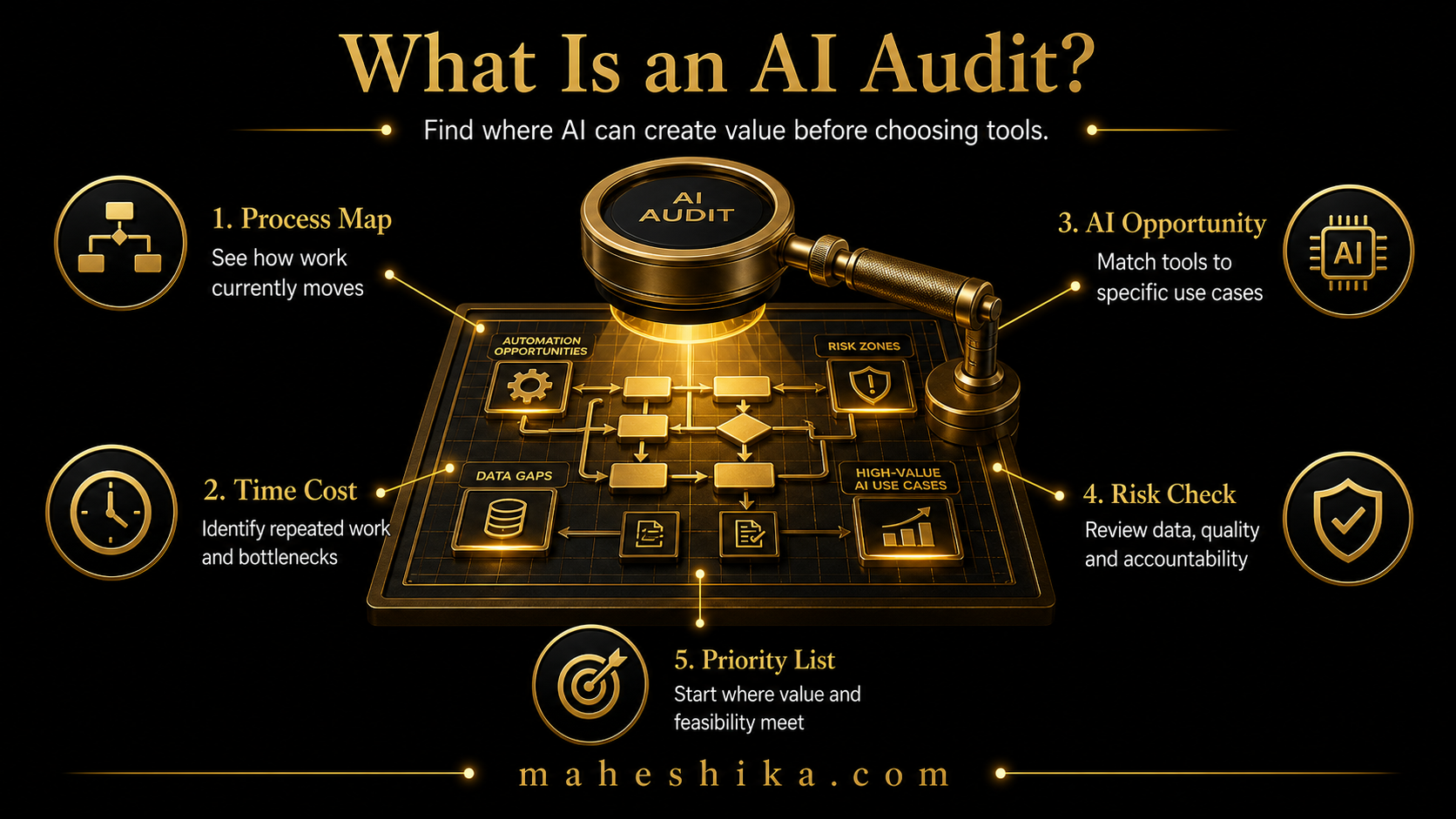
The term "AI audit" is being used to describe several different things, and the confusion is worth clearing up before you decide whether your business needs one. In some contexts it refers to a technical review of AI systems for bias, safety, or compliance: relevant for regulated industries and larger enterprises, but rarely the right starting point for a small business. In the more practical sense, an AI audit is a structured assessment of where AI could add value in your business, what is already in place, and what the gaps are. That is the version worth understanding.
Here is what a practical AI audit covers, when it is worth doing, and when you can do it yourself.
What an AI Audit Actually Examines
A practical AI audit for a small business looks at four areas.
Current AI usage. What AI tools are already in use, whether by you or your team? This includes obvious tools like AI writing assistants, but also AI features embedded in software you already use: the smart reply feature in your email client, the AI categorisation in your accounting software, the chatbot on a platform you are subscribed to. Many business owners discover they have more AI capability in their current stack than they realised, they just have not activated it.
Operational time costs. Where is time going in the business on tasks that follow a predictable pattern? The audit maps these tasks systematically: how frequent they are, how long they take, who performs them, and what the consequence of errors is. This is the foundation of any AI implementation plan.
Risk and quality considerations. Which tasks, if handled poorly by AI, would have significant consequences for your business or your clients? A misfiled document might be an inconvenience. An incorrect clause in a client agreement might be a legal problem. The audit identifies where human oversight is non-negotiable and where the risk of AI error is acceptable.
Readiness and constraints. Does your team have the skills to use AI tools? Are your existing systems compatible with the AI tools you might want to implement? Are there data privacy or contractual restrictions on what information can be processed by third-party AI systems? These constraints affect what is feasible in your specific situation.
When Does a Small Business Need a Formal Audit?
Most small businesses do not need a formal, externally-conducted AI audit. They need a structured conversation about their own operations, which they can have themselves with the right framework.
The situations where a more formal audit is worth the investment are specific. If your business operates in a regulated sector where AI use has compliance implications (financial services, healthcare, legal), a formal assessment is worth doing before implementation. If you have a team of more than ten people and AI will affect how multiple roles work, the process benefits from structure and external perspective. If you are considering a significant investment in AI infrastructure or custom development, an audit should happen before that investment is committed.
For most small businesses operating in non-regulated sectors with small teams, the DIY version of an AI audit is sufficient and can be completed in a half-day workshop with your team.
Related Reading
How to Run a DIY AI Audit in a Half Day
Set aside four hours. You need your own time, and if you have a team, at least one person who understands the day-to-day operations well.
Hour one: current state mapping. List every software tool you use in the business. For each one, check whether it has AI features you have not activated. Many do. Note what AI tools you are already using intentionally. You may find your current AI stack is more complete than you thought.
Hour two: time cost mapping. For each operational function in the business (sales, marketing, customer service, finance, project management, HR if relevant), list the five most time-consuming tasks. For each task, note: how often it happens, how long it takes, and whether it follows a consistent pattern. Tasks that are frequent, time-consuming, and pattern-based are your AI opportunities.
Hour three: prioritisation. Take your AI opportunities and rank them. Highest priority: frequent, time-consuming, pattern-based, and low-risk if handled incorrectly. Lowest priority: infrequent, quick to do manually, or high-risk if AI makes an error. Your top three priorities become your implementation roadmap.
Hour four: constraints check. For your top three priorities, identify any constraints. Data privacy: does this task involve client data you cannot share with a third-party tool? Skill: does anyone in the business have the ability to implement this, or will you need help? Cost: is there a budget requirement beyond free tools? Use this to refine your roadmap into a realistic plan.
At the end of four hours, you have everything an AI audit should produce: a clear picture of where you are, where the opportunities are, and what you are going to do first.
Free
Start free: what might your organisation not be seeing?
The Business X-Ray is an outside-in look at your business: what is visible, what may be happening underneath, and what cannot be known from the outside at all. Reviewed personally before it goes out.
Get the free Business X-RayThe Audit Answers One Question. It Raises Another.
So does your business need an AI audit? For most small businesses, no, not a formal one. What you need is the half-day version above, done honestly, followed by a 30-day commitment to your top priority. That is the whole answer. An audit is not a document to file away. It is the clarity that lets you stop guessing and start automating the tasks that are actually costing you time.
But run that audit and you notice something the framework itself does not fix. The AI tools you just mapped can now draft the email, write the proposal, answer the client query, in a voice that sounds competent and generic and interchangeable with every other business using the same tools. You automate the task. The client still has no reason to remember it was you who solved it. Efficiency and visibility are not the same thing, and only one of them keeps your name in the room.
The businesses that come through this well are not the ones with the most automated workflows. They are the ones whose owner has a place the AI cannot occupy for them: a personal website under their own name, where their thinking, their track record, and their judgement are on show. Owned outright, findable in a search, impossible to mistake for a generic answer. That is not a project for after the audit. It is the asset that makes everything the audit frees up actually count for something.
You do not have to figure out how to build that on your own. If you want it done properly, let us talk.
This article is part of the AI for Small Business: The Complete Guide. For the implementation framework that follows an audit, see the 90-day strategy article in the series.