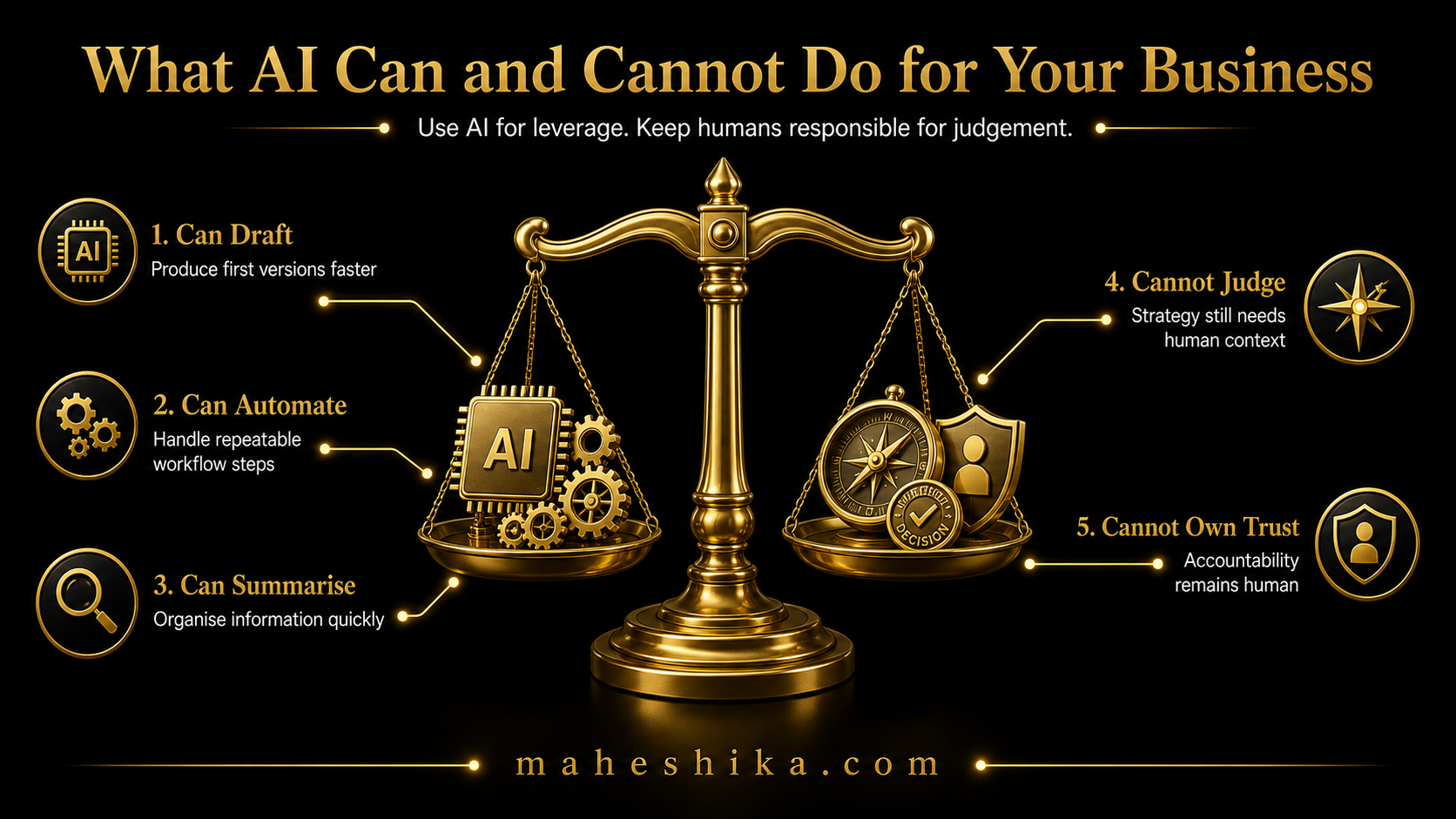
The AI conversation has two extremes, and both are wrong. One camp treats AI as a transformational force that will replace most knowledge work within the decade. The other dismisses it as an over-hyped autocomplete tool producing mediocre outputs. If you are running a small business and trying to make practical decisions, neither extreme is useful.
Here is an honest account of what AI genuinely delivers for small businesses right now, and where it still falls short. I have been using these tools daily for years and working with business owners implementing them. This is what I have actually observed.
What AI Does Well
First drafts, at speed. The single most valuable thing AI does for small business owners is compress the time between having an idea and having a usable draft. Whether that is a blog post, an email, a proposal, a job description, or a social media post, AI can produce something worth editing in seconds. The output is rarely perfect but it is almost always a better starting point than a blank page. For business owners who were writing from scratch, this is a significant time saving.
Handling volume. Tasks that are tedious because of their volume rather than their complexity are where AI shines. Answering the same five customer questions in slightly different ways, summarising 20 documents, creating variations of an email for different segments: AI handles repetition without fatigue and without variation in quality.
Summarisation and research. Pasting a long document into an AI tool and asking it to extract the three most important points, identify the risks, or produce a one-paragraph summary works well. Preparing for a client meeting by asking AI to brief you on their industry also works well. These tasks that previously required 45 minutes of reading now take five.
Brainstorming and structure. When you are stuck on how to approach a problem, an AI conversation is a useful thinking partner. It will generate more options than most human collaborators, without the social dynamics that often limit honest brainstorming. It will also produce frameworks, outlines, and structures for work you then complete yourself.
Where AI Falls Short
Accuracy on specific facts. AI can state things confidently that are incorrect. Numbers, dates, names, citations, and specific claims should always be verified independently before you use them professionally. This is not an occasional edge case; it is a consistent characteristic of how these models work. If a fact matters, check it.
Knowing your business. AI does not know your clients, your history, your specific positioning, or your market context unless you provide that information in your prompt. Generic prompts produce generic outputs. The more context you provide, the better the result. But that context has to come from you every time, or be stored in a system prompt you have set up. AI does not learn your business the way a long-term employee does.
Genuine creative originality. AI produces work that is competent and draws from patterns in its training. It does not produce ideas that have never existed before. For content that needs to be distinctive, surprising, or genuinely original, AI is a starting point that requires significant human direction and editing, not a finished output. Content that goes out unedited tends to sound like other AI-generated content, which is not a reputation worth building.
Relationship work. Client conversations, negotiation, difficult feedback, building trust over time: none of these are AI tasks. AI can help you prepare for these moments by drafting talking points or thinking through scenarios, but the moments themselves require you. The businesses that do best with AI are the ones that use it to handle the non-relational work so that the human has more time and energy for the relational work.
Related Reading
The Specific Limitations Worth Taking Seriously
Hallucination. The term used in the industry for when AI states false information confidently. It happens because AI predicts the most plausible next token, not because it accesses verified facts. The frequency varies by task: AI is less likely to hallucinate when drafting marketing copy than when asked to cite specific research. But it can happen in any domain. Treat AI output as a first draft from someone who is sometimes careless with facts.
Context limits. AI tools have a context window, the amount of text they can process at once. For most business tasks this is not a constraint. For very long documents or complex multi-step projects, it can be. If you are working with something large, check whether the tool you are using can actually hold all the relevant information at once.
Data privacy. Information you put into a third-party AI tool is processed by that tool's infrastructure. For most small business content tasks, this is not a concern. For legally sensitive documents, confidential client information, or proprietary data, check the data privacy terms before using any AI tool to process that information. Some tools offer private processing options; some do not.
Dependency risk. Building critical business processes on a single AI tool creates a dependency. Tools change, pricing changes, and services shut down. Design your AI workflows so that the human steps remain clear and the tool can be swapped if needed. Do not let any single tool become so embedded that losing it would be a crisis.
Free
Start free: what might your organisation not be seeing?
The Business X-Ray is an outside-in look at your business: what is visible, what may be happening underneath, and what cannot be known from the outside at all. Reviewed personally before it goes out.
Get the free Business X-RayThe One Thing AI Cannot Replicate
So the honest answer is not "AI will replace you" and it is not "AI changes nothing" either. It is quieter than that: AI raises the floor for everyone and takes the volume work off your desk, but it hands the real advantage to business owners who already knew what they were doing before the tools arrived. Use it to buy back time for judgement, relationships and expertise, and 2026 is genuinely good to you. Use it to skip past those things, and it will not save you.
Here is the realisation sitting underneath everything in this article. AI now produces confident, competent answers in a voice that sounds like everyone else's. Ask it the same question in a hundred different businesses and you get a hundred versions of the same answer. If your expertise only exists as things you say in meetings, or a bio on a page you do not own, it is invisible to the exact tools your clients now use to search.
What does not get erased by that is a personal website under your own name. Somewhere your thinking, your track record and your actual judgement live in one place, permanently, findable in a search, and unmistakably yours. Not a generic AI answer. Not a page you are renting from an employer or a platform. Owned outright, it is the one asset that keeps proving you know what you are doing, even when you are not in the room.
That is worth building properly. If you want it done right, by someone who has used these tools daily for years and knows exactly where the line between AI and human judgement sits, let us talk.
This article is part of the AI for Small Business: The Complete Guide. For practical implementation steps, see the full series.