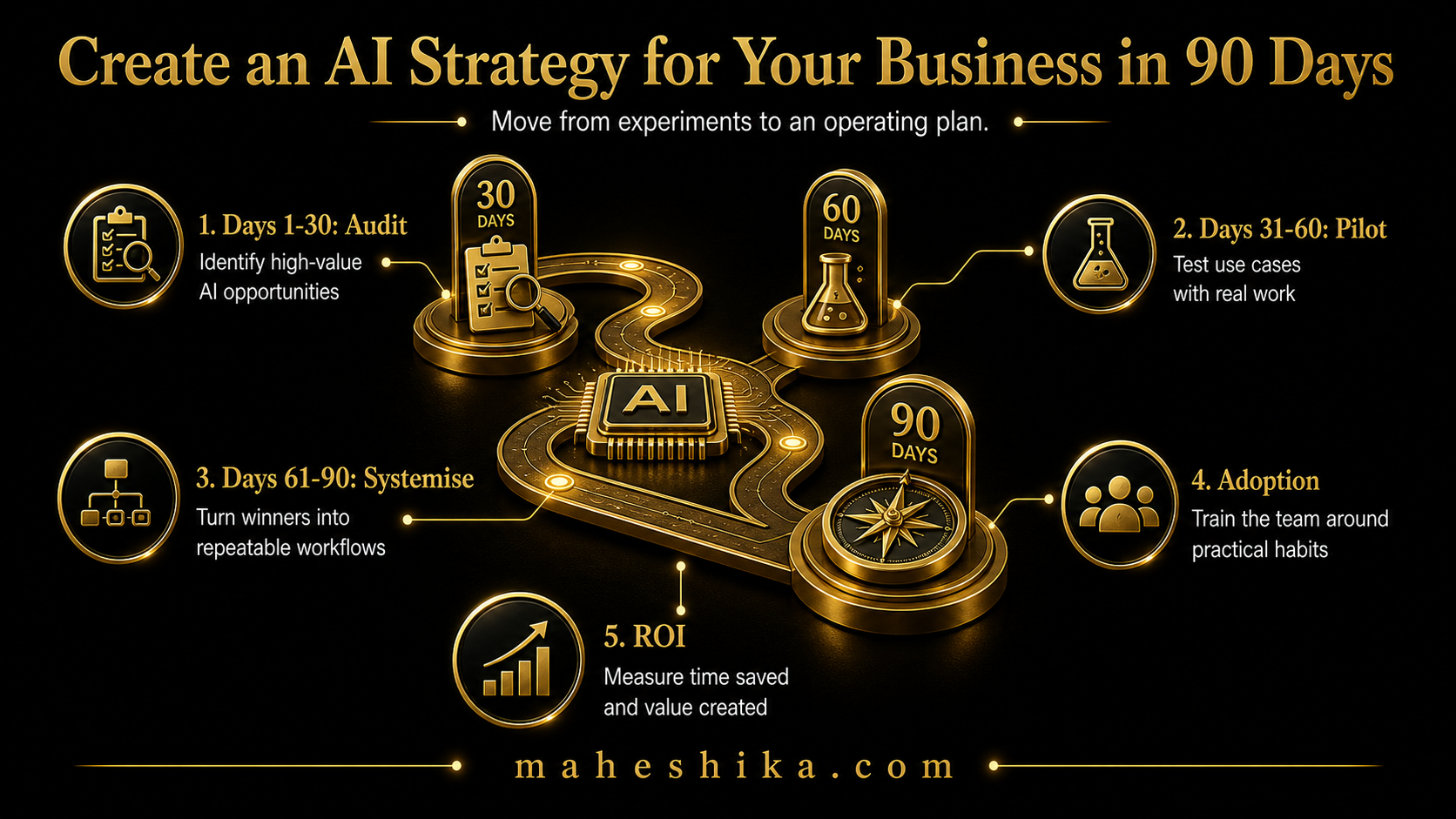
An AI strategy for a small business does not need to be a 40-page document. It needs to answer three questions clearly: where in my business is AI most likely to make a material difference, what will I implement first and how will I measure whether it works, and what is my plan for the 90 days after that. Everything else is detail.
The 90-day framing matters because it is long enough to see real results from a well-implemented AI process, and short enough to stay focused. Longer-term AI planning for small businesses tends to get ahead of reality; the tools change, the capabilities change, and a plan written for 18 months becomes obsolete. Plan in 90-day cycles, review and adjust at each cycle, and you will make better decisions with better information.
Before Day One: The Audit
Spend one week before you start your 90-day plan doing a proper audit of where your time goes. This is not about estimating; it is about actually tracking. For one full week, note every task you work on and how long it takes. Be specific: "writing content" is not specific enough. "Writing the weekly newsletter" is. "Responding to client enquiries" is too broad. "Answering the same three questions about our process" is actionable.
By the end of the week, you will have a clear picture of your time distribution. Sort your tasks into three categories: strategic work that requires your unique judgement, relationship work that requires your presence and personality, and operational work that follows a pattern and does not require your unique judgement. The third category is your AI implementation roadmap. Everything in it is a candidate.
Now prioritise that third category by two dimensions: frequency, how often does it happen per week, and time cost, how long does it take each time. High frequency, high time cost tasks are your first priority. Low frequency, low time cost tasks are not worth automating yet.
Days 1 to 30: First Implementation
Choose one task from the top of your priority list. Just one. Implement AI assistance for that task in the first 30 days. Your goal is not to have a finished, perfect system by day 30. Your goal is to have a working process that you are using consistently, with a clear view of whether it is delivering value.
For most small business owners, the right first task is content production: the weekly newsletter, the blog post, the LinkedIn update. It is high-frequency, time-consuming, and has a clear output quality metric. AI assistance for content also has a short feedback loop: you produce it, you publish it, you can evaluate it immediately.
By day 30, you should know: how long the AI-assisted process takes versus the manual process, whether the quality of output meets your standard after editing, and whether the habit is sustainable. If all three answers are positive, you have your first proven AI process. Document it: what tool, what prompt template, what editing steps, what the quality check looks like. That documentation is valuable for training and for your own consistency.
Related Reading
Days 31 to 60: Second Implementation and Process Building
With one working AI process in place, add a second. Choose the next task from your priority list. For most businesses, this is either customer service automation or administrative workflow automation, depending on which costs more time.
While implementing the second use case, also begin formalising what you have learned. Create a simple internal guide that documents how AI is being used in your business: which tools, which tasks, which prompts, and what quality standards apply. This guide serves two purposes: it makes the processes consistent when you are using them under time pressure, and it is the foundation for team training if you bring others into the AI implementation later.
By day 60, you should have two working AI processes, a documented approach, and a clearer view of where the next highest-value opportunity is.
Free
Start free: what might your organisation not be seeing?
The Business X-Ray is an outside-in look at your business: what is visible, what may be happening underneath, and what cannot be known from the outside at all. Reviewed personally before it goes out.
Get the free Business X-RayDays 61 to 90: Review, Refine, and Plan the Next Cycle
The final 30 days of your first 90-day cycle are for consolidation and review, not new implementations. Let the processes you have built run, observe them, and improve them based on what you have learned.
Review questions to answer at day 90: How much time have the two AI processes saved per week? Is the quality of output consistent, or are there recurring issues that need fixing? Are there tools or steps in the process that are not working as well as expected? What have you learned about prompting, about your business's specific AI needs, and about what matters most to your clients? What would the highest-value third implementation be?
The answers to these questions become the brief for your next 90-day cycle. You are not starting from scratch; you are building on a foundation that already works. Each cycle compounds the previous one. By the end of your third cycle, nine months from now, you will have a meaningfully AI-assisted business with documented processes, proven time savings, and a clear view of where to go next.
The Asset AI Cannot Automate for You
So that is what a 90-day AI strategy actually looks like. Not a vision document, not a technology wish list. One audit, one proven process, a second process, then a disciplined review that becomes the brief for the next cycle. Do three of those cycles and you have a business that runs measurably lighter than the one you started with, built on decisions you can defend rather than guesses you hoped would land.
But notice what that strategy does not touch. Every AI process you build makes your operations faster. None of it makes you more visible. As AI tools get better at producing content, answering questions, and doing the work that used to signal expertise, the businesses that stay ahead are not the ones with the most automation. They are the ones whose founder is unmistakably, findably the person behind the work, because everyone with the same tools starts to sound the same.
That is the part a 90-day plan will not build for you: a place under your own name where your strategy, your judgement, and your track record live in one spot, owned outright, not rented from a platform's algorithm or dependent on anyone else's feed. The businesses that automate the back office and never build that front door are easy to copy. The ones that do both are not.
You have the operational plan now. If you want the visibility to match it, that is a conversation, not a document, and I would be glad to have it with you.
This article is part of the AI for Small Business: The Complete Guide. For a diagnostic to identify your highest-priority AI opportunities, see the AI audit article in the series.