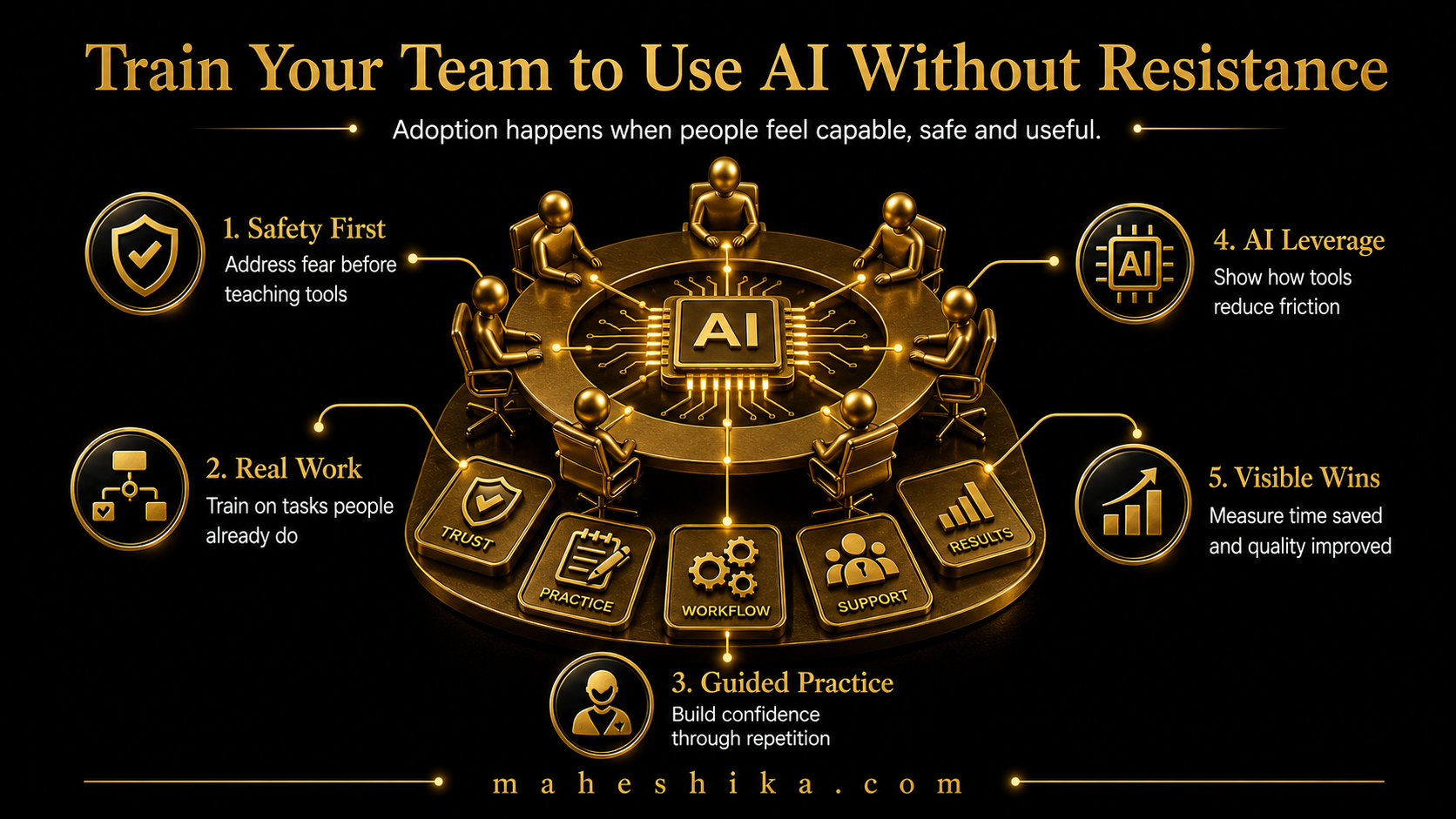
AI adoption fails in teams far more often because of how it was introduced than because of how it works. I have seen well-chosen tools gather dust because they were presented as mandates. I have seen mediocre tools used enthusiastically because the team felt ownership over the decision. The human dimension of AI implementation is at least as important as the technical one, and in small businesses, where every team member's attitude has an outsized impact, it matters most of all.
Here is how to approach it in a way that builds genuine adoption rather than surface compliance.
Understand Where the Resistance Actually Comes From
Resistance to AI in teams almost always has one of three sources, and they require different responses.
Job security anxiety. This is the most common and the most understandable. People who have spent years developing expertise in their role hear "AI can do that" as a direct threat to their value. Dismissing this concern does not make it go away. Addressing it honestly does. Be specific about what AI will be used for in your business: which tasks it will assist with, which roles it supports rather than replaces, and what you expect from your team as a result. Vagueness breeds fear. Specificity, even if uncomfortable, builds trust.
Skill anxiety. Some team members worry they will not be able to learn the new tools. This is especially common in people who are not naturally comfortable with technology. The solution is to start with the simplest possible use case, make the learning visible and collaborative, and make it safe to not know something. A team where admitting confusion is acceptable learns faster than one where people pretend to understand.
Scepticism about usefulness. Some people have tried AI tools on their own and found them underwhelming. This is a credibility problem, and the only fix is a compelling demonstration on a real task that matters to them. Showing someone what AI does for their specific work, with their specific context, converts sceptics more reliably than any amount of explanation.
Involve the Team Before the Decision Is Made
The most effective AI implementations I have seen in small businesses all have one thing in common: the team was involved in identifying where AI would help before the tools were selected. This is not about consensus management. It is about ownership.
Run a simple exercise with your team: ask each person to list the three tasks in their week that take the most time relative to the value they produce. Compile those lists. You will quickly identify where AI could have the highest impact across the team, and your team will feel that their experience informed the decision. That feeling changes everything about how they engage with the implementation.
Related Reading
A Training Approach That Actually Works
A two-hour training session on AI tools will be forgotten by Friday. What builds lasting capability is structured, repeated practice built into normal working rhythms.
Start with a single tool on a single task. Do not try to train your team on everything at once. Choose one tool and one use case, ideally the one that came from the team's own task audit. Spend one session introducing it, running it on a real example, and answering questions. Then ask each person to use it on one real task before the following week.
Share wins, not just instructions. Create a regular practice of sharing what is working. This can be as simple as five minutes at the start of a weekly meeting: who used AI this week, what did they use it for, and what was the result? Hearing colleagues describe real wins is more motivating than any training material.
Create a shared resource. A simple shared document with the prompts that work well for your business is enormously valuable. When someone finds a prompt that produces a consistently good result for a particular task, add it to the shared library. Over time, this becomes a genuine asset: your business's accumulated prompting knowledge, accessible to every team member.
Be patient with the learning curve. The first outputs someone gets from a new AI tool are almost never the best. This is especially true for people who are new to prompting. Expect a four to six week adjustment period before any team member is using a new tool productively. Factor this into your expectations and your communication.
Free
Start free: what might your organisation not be seeing?
The Business X-Ray is an outside-in look at your business: what is visible, what may be happening underneath, and what cannot be known from the outside at all. Reviewed personally before it goes out.
Get the free Business X-RaySetting Clear Standards Without Micromanaging
Once your team is using AI, two quality-related conversations become necessary. The first is about what AI-assisted work should meet as a standard before it leaves the business. The standard is exactly the same as for any other work: would you be comfortable with your best client reading this? If not, it needs more work regardless of how it was produced.
The second conversation is about accountability. AI assists; the person using it is responsible for the output. This is not a punitive principle; it is a professional one. Team members who understand they are responsible for reviewing and approving what they produce with AI develop better prompting habits and better editorial judgement. They also protect the business from the quality failures that come from treating AI output as final.
Where This Leadership Should Live
So resistance to AI is not solved with a mandate and a login. It dissolves when you name the real fear a person is carrying, hand the team the decision of where AI helps first, build practice into the rhythm of the week instead of a single training day, and hold the work to the same standard you always have. Do that consistently and adoption stops being a project you manage and becomes simply how the business now works.
But notice what you actually did to get there. You read a room correctly, built trust on purpose, and turned a team of sceptics into a team that uses AI well. That is a rare piece of judgement, and it is exactly the kind that becomes more valuable as the routine work itself gets automated. Right now, though, it lives entirely inside your business: in meeting notes, a shared prompt document, and the memory of a team that watched you handle it.
That is worth protecting, because AI can produce a competent-sounding article on managing AI adoption in thirty seconds, in a voice indistinguishable from a hundred other consultants. What it cannot produce is you: the specific judgement, the specific track record, the proof that you did this for real. If that proof only exists inside one company's Slack channel, it disappears the day you move on, the day the business changes hands, or the day nobody remembers who actually led it. The professionals who keep being sought out for judgement like this are the ones who put it somewhere they own: a personal website under their own name, where the thinking is written down, the results are shown, and the signature is unmistakably theirs.
That is worth building properly, and you do not have to work out how on your own. If you want this leadership to live somewhere it cannot disappear, let us talk.
This article is part of the AI for Small Business: The Complete Guide. For the strategic framework around implementation, see the 90-day strategy article in the series.