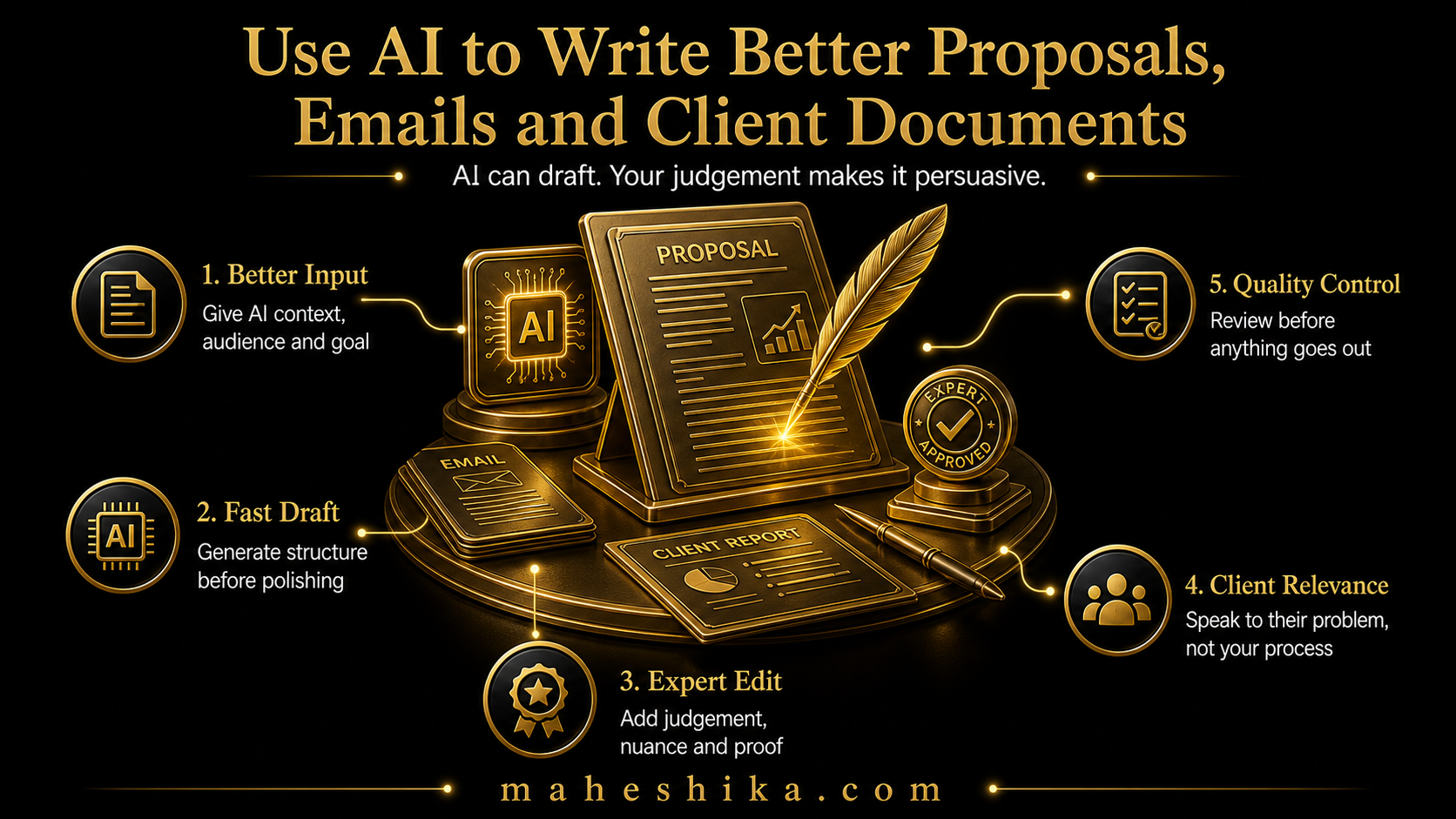
Client-facing documents are your business on paper. A proposal that is vague, poorly structured, or arrives three days late is communicating something about you even when you do not intend it to. A well-structured, specific, prompt proposal communicates competence and respect for the client's time. AI does not replace the thinking that goes into a good proposal. It does remove the friction that makes producing one quickly and consistently difficult.
Here is how to use AI effectively across the three most important writing tasks in most service businesses: proposals, client emails, and formal documents.
Proposals: The Framework That Works
The most common failure in AI-generated proposals is that the output is generic because the input was generic. "Write a proposal for a consulting engagement" produces a proposal-shaped document that could apply to any business, any client, and any problem. That is not useful.
The right approach starts with a brief that captures the specifics of the situation: the client's name and organisation, the problem they described in your discovery conversation, the outcome they said they were trying to achieve, any constraints they mentioned (budget, timeline, internal politics), and your specific proposed approach. Feed all of that into AI and ask for a structured proposal draft.
A workable proposal structure for most service businesses has five sections: context (demonstrating you understand their situation), objective (what success looks like), approach (how you will work together), deliverables and timeline, and investment. Ask AI to draft each section based on your brief. Review each one, add your specific examples and language, and remove anything that sounds generic. The whole process, from brief to final draft, should take under an hour.
Client Emails: The Most Underrated Use Case
The volume of professional email most business owners produce is significant, and a large portion of it follows predictable patterns. Follow-up after a meeting, response to a complaint, sending a deliverable, requesting information, declining a request with grace. Each of these has a shape that AI can produce quickly.
The key to good AI-assisted email is specificity and brevity. Tell AI: the email type, the recipient and your relationship with them, the specific content it needs to communicate, and the tone you want. Ask for a draft under 200 words. Edit for your voice and any specific details. Most client emails should take under five minutes to produce with this approach.
The emails worth taking more time on are the genuinely difficult ones: delivering bad news, navigating a misunderstanding, or making a difficult request. AI is useful here too, but as a thinking partner rather than a drafter. Ask AI to help you think through how to structure the communication, what to include, and what to leave out. Then write the email yourself, in your own words, because the human touch matters more in those moments than efficiency does.
Related Reading
Formal Documents: Policies, Reports, and Processes
Every business eventually needs documents that are not client-facing but are equally important: internal policies, process documentation, service agreements, onboarding guides. These take time to produce well, they are easy to deprioritise when operational demands are high, and they are exactly the kind of structured writing that AI handles well.
For process documents, the most effective approach is to describe the process verbally, either by typing it out in bullet points or by using a transcription tool during a recorded walkthrough. Feed that description to AI and ask it to produce a structured process document with clear steps, roles, and decision points. Review for accuracy and completeness. What previously took three hours of careful documentation takes 45 minutes.
For policies and agreements, use AI to produce a first draft based on your specific requirements. Never use AI-generated legal documents without review by a qualified professional, but a well-drafted first version significantly reduces the time and therefore the cost of that professional review.
Free
Start free: what might your organisation not be seeing?
The Business X-Ray is an outside-in look at your business: what is visible, what may be happening underneath, and what cannot be known from the outside at all. Reviewed personally before it goes out.
Get the free Business X-RayThe One Document AI Cannot Draft For You
So the honest answer to "can AI write my proposals and client documents" is yes, and it should, for everything that has a repeatable shape: the drafts, the follow-ups, the process documents. What it cannot do is the fifteen minutes of judgement that makes a document specifically right for this client, at this moment, in your voice. That review is not the boring bit you rush through before sending. It is the actual value you are paid for.
Here is the harder truth sitting underneath all of this. If AI can produce a competent proposal for anyone, in any voice, from a few prompts, then a well-written document is no longer proof of much. It used to signal that you were careful, capable, worth the fee. Now it mostly signals that you know how to prompt. The thing that actually proves you are the right person for the job is the same thing AI cannot generate: a body of visible, verifiable work that only you could have produced, sitting somewhere a client can check before they ever ask you for a proposal.
Right now, most of that proof lives in sent folders and closed deals that nobody outside your client list will ever see. That is not a system, it is a filing cabinet. A personal website under your own name changes what a prospective client finds when they check you out before the call: not a generic bio, but your thinking, your case studies, your actual work, sitting in one place that is unmistakably yours and impossible to mistake for anyone else's AI-assisted draft.
That is what a Signature does, and you do not have to build it alone or work out the structure yourself. If you want the same clarity applied to how you are seen as you already give to the documents you send, let us talk.
This article is part of the AI for Small Business: The Complete Guide. For a broader view of AI in your sales process, see the sales article in the series.