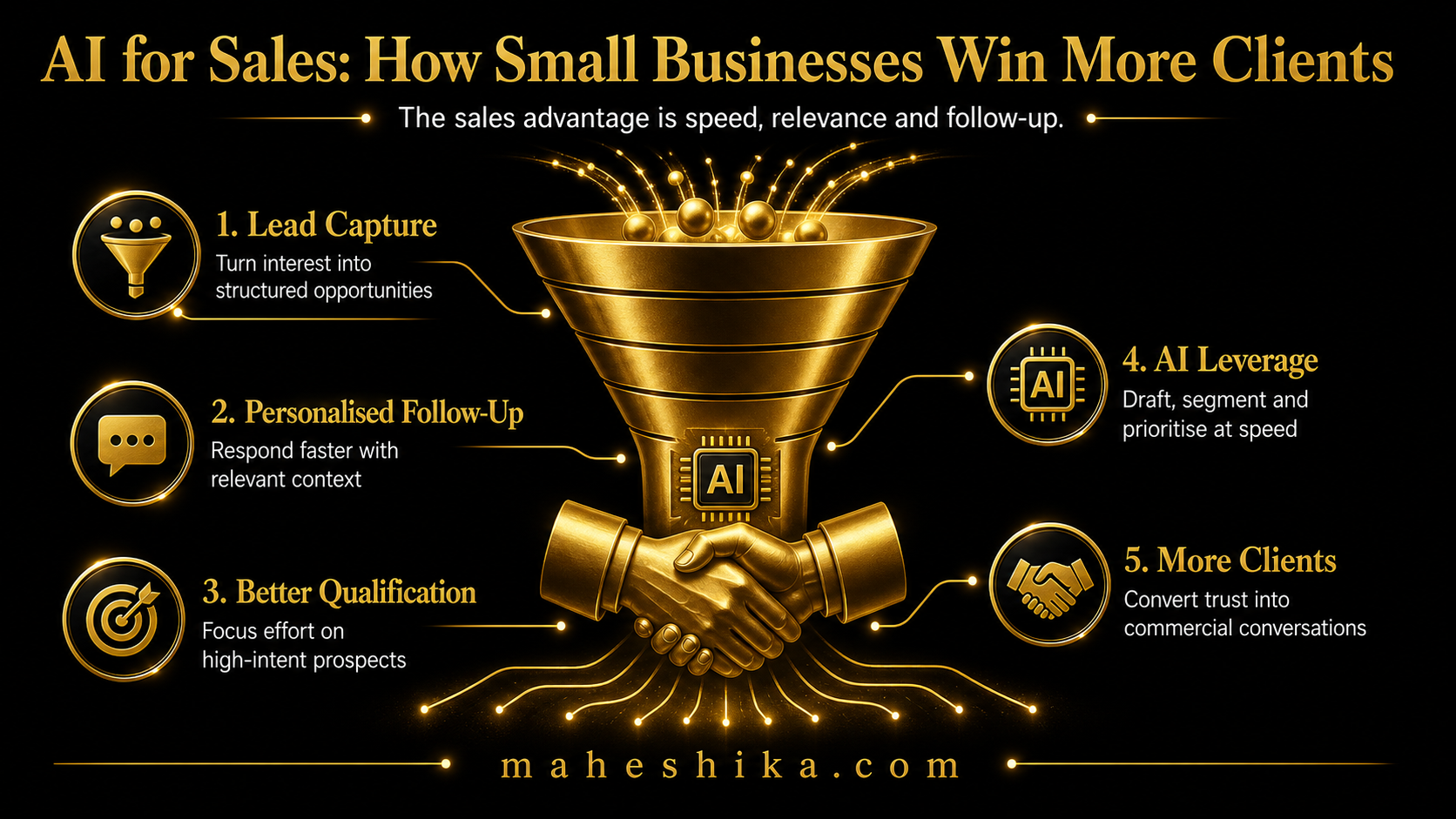
Sales is the one area where small business owners most consistently leave money on the table, not because they lack the capability, but because the process breaks down in predictable, fixable ways. Slow follow-up. Proposals that take too long to produce. Inconsistent outreach. Lost leads that fell through because nobody followed up at the right moment. AI addresses all of these, and the businesses paying attention to this are winning more clients with the same sales effort.
This is not about replacing the relationship side of sales. The conversation, the understanding of what a client actually needs, the trust that gets built over a call: those are human and they stay human. What AI replaces is the administrative friction around those conversations that slows everything down.
Faster Response to Enquiries
Speed is one of the most underappreciated factors in sales conversion. When someone enquires about your services, the window of peak interest is short. A response within minutes is meaningfully more likely to convert than a response the following day. For most small businesses, a same-day response is achievable but a sub-hour response is not, unless the process is automated.
An AI-powered enquiry workflow can acknowledge the enquiry immediately with a personalised, contextually relevant response, gather additional information through a conversational form, and route the lead to you with a suggested response already drafted based on what they shared. By the time you see the notification, the groundwork for the sales conversation is already laid.
The difference in conversion rates between businesses with this kind of responsiveness and those without is significant. Enquiries are not opportunities; they are moments of interest that expire. AI keeps those moments alive.
Research Before Client Conversations
One of the fastest ways to build credibility in a first sales conversation is to demonstrate that you understand the prospect's business before they have explained it to you. This used to require an hour of research. With AI, it takes ten minutes.
Before a discovery call, ask AI to brief you on: the prospect's industry and the main challenges facing it, any recent news about their specific company or sector, likely questions they will have about services like yours, and potential objections you should be prepared to address. You arrive at the conversation informed and prepared, which signals competence immediately.
This is particularly valuable for small business owners whose time for preparation is limited. Ten minutes of well-directed AI research can replicate the preparation quality that a larger team would take an hour to produce.
Related Reading
Proposals That Move Faster
The time between a positive sales conversation and a proposal in the client's inbox is where deals most often go cold. Life intervenes, other priorities compete, and what felt like a certain next step quietly fades. Compressing that timeline from days to hours changes the economics of your sales process.
With a strong proposal template and AI assistance, the process of producing a first draft from the notes of a discovery call can take under an hour. You provide the context: what the client needs, what you are proposing, the relevant terms and pricing. AI produces a structured draft you review and edit. The final document goes out the same day as the conversation, when interest is highest.
The psychological impact of a fast, polished proposal is real. It signals organisation, capability, and respect for the client's time. Those signals affect the buying decision.
Free
Start free: what might your organisation not be seeing?
The Business X-Ray is an outside-in look at your business: what is visible, what may be happening underneath, and what cannot be known from the outside at all. Reviewed personally before it goes out.
Get the free Business X-RayFollow-Up Without the Mental Load
Most small business owners are poor at follow-up, not because they do not understand its importance but because they are already managing too many things. AI-powered follow-up automation removes the mental load entirely.
A well-designed follow-up sequence sends the right message at the right time based on where the prospect is in the process, without you having to remember to do it. Sent a proposal three days ago and no response: an automatic follow-up goes out. Had a discovery call but no proposal sent yet: a reminder appears in your task list. Lead went quiet two weeks ago: a re-engagement email is queued.
None of this replaces the personal follow-up for high-value opportunities. But it ensures that the standard process happens reliably, without things falling through because you were focused on something else. Consistency in follow-up, more than any individual message, is what closes the deals that would otherwise be lost.
The Advantage AI Cannot Automate For You
So the answer is not that AI closes deals for you. It is that AI removes the friction that used to cost you deals: the slow reply, the unprepared call, the proposal that sits in a draft folder for four days, the follow-up that quietly never happens. Fix those four points and the same selling effort you already make converts more of it. That is the whole shift. Not more selling, cleaner selling.
But there is a quieter problem sitting underneath all of it. Every small business you compete with now has access to the same AI tools you just read about. The same fast replies, the same sharp research, the same same-day proposals. Responsiveness stops being your edge and becomes the baseline everyone meets. So before a prospect ever replies to your outreach, before they book the call at all, they do the one thing AI cannot do for you: they search your name.
What they find in that search decides more than any follow-up sequence ever will. If the only thing under your name is a LinkedIn profile and a scattering of mentions, you are asking a stranger to trust you on thin evidence, in a market where AI can generate a convincing-sounding expert in seconds. The business that wins the client is not the one that replied fastest today. It is the one whose name leads somewhere real: a home of their own, where the work, the thinking, and the proof are already sitting there before the enquiry even lands.
That home is not another task bolted onto your sales process. It is the foundation the whole process stands on. If you would like help building yours properly, let us talk.
This article is part of the AI for Small Business: The Complete Guide. For more on writing proposals with AI, see the dedicated article in the series.