This is the last article in a series of one hundred. I wrote every one of them with a specific person in mind. Not a persona. Not a demographic. A person: the one who has given years to an organisation, who has built real expertise, who has done genuinely important work, and who is now standing at a threshold, looking at what might be possible, wondering whether it is too late, whether they have what it takes, whether now is the right moment.
This article is for you.
The job well done is not the job that earns the most applause. It is the job that you can look back on and know, without needing anyone else's confirmation, that it was done with full commitment and genuine skill.
I wrote a book with that title. Not because I had something tidy to say about career satisfaction, but because I had spent 18 years watching what happens when genuinely capable people give everything to work that belongs to someone else, and then wonder, at the moment of transition, whether they were ever really seen. The job was well done. The question is what comes next.
What I Actually Believe
I believe that expertise is the most durable form of professional capital. More durable than titles, more durable than the organisations that once held them, more durable than networks that were built inside a structure that no longer exists. If you have spent 15 or 20 years becoming genuinely good at something that matters, that knowledge is yours. It does not belong to your former employer. It did not end when the role did. It is the thing that remains when everything else is stripped away.
I believe that the expert economy, the growing market for independent, specialised, high-value professional knowledge, is real and is accelerating. Not as a buzzword. As an economic reality. The organisations that used to employ senior experts full-time are finding it more efficient to access that expertise on demand. The professionals who understand this and position themselves correctly are capturing enormous value. The ones who are waiting for the employment market to return to what it was are missing a window that is genuinely significant.
I believe that AI has changed the landscape for independent professionals in a way that is not incremental but structural. The barriers to building a professional independent business, visibility, operational infrastructure, positioning, content, all of them have compressed dramatically. A single person with genuine expertise can now build a professional platform, produce high-quality content, deliver excellent client work, and operate a serious business without a team, without significant capital, and without the years of patient brand-building that used to be the only route. I do this myself, every day. It is not theoretical.
And I believe that the question of whether to build something that is yours is not primarily a financial question, though the financial case is strong. It is a question about how you want to use the expertise you have spent a career building. About whether the next decade of your professional life should be structured around someone else's agenda or your own.
What This Work Actually Requires
I want to be honest with you here, because I have no interest in making this sound easier than it is.
Building an independent business requires you to think differently about yourself. Not more highly. Differently. The identity shift from employee to owner is real and it takes time. You will have days, particularly in the first six months, where the absence of external structure feels less like freedom and more like freefall. That is normal. It is not a sign that you made the wrong decision. It is a sign that you are doing the actual work of transition rather than just its surface layer.
It requires you to be visible in a way that corporate employment did not ask of you. You will need to write. To speak. To share your thinking in public and be associated with a clear point of view. If that feels uncomfortable, I understand. It felt uncomfortable to me too. But visibility is not vanity. For an independent expert, visibility is how the right people find you. There is no other mechanism. The organisation is no longer introducing you to the room. You have to walk into it yourself.
It requires you to price your expertise at its actual market value, which is almost certainly higher than the figure your first instinct offers. The reluctance to charge properly is one of the most consistent patterns I see in senior professionals going independent, and it causes more practical problems than almost any other mistake. You are not a junior freelancer. You are a senior expert with a track record. Price accordingly from the beginning.
And it requires patience with the compound curve. The first client is the hardest. The second is easier. By the time you have five real engagements behind you, something has shifted. You have evidence that this works. You have case studies. You have language for what you do that was tested in the real world rather than developed in isolation. The trajectory bends upward, but you have to stay on the path long enough to reach the bend.
Related Reading
What the Business Looks Like When It Works
When an independent expert business is working well, it has a quality that is very different from employment and from the early, effortful stages of building it. It has alignment. The work you are doing reflects what you genuinely know and care about. The clients you are serving are the ones you chose, because they are working on problems you find genuinely interesting and because they respect the value you bring. The income reflects the actual worth of your expertise, not the salary band someone assigned to you based on a grade structure that had nothing to do with your market value.
You have a body of work accumulating under your name. Articles you wrote. A book, perhaps. A speaking profile. A reputation in your field that is yours, not borrowed from an employer's brand. When someone searches your name, they find a coherent picture of what you know, what you believe, and what you do. That picture did not exist before you built it. You built it.
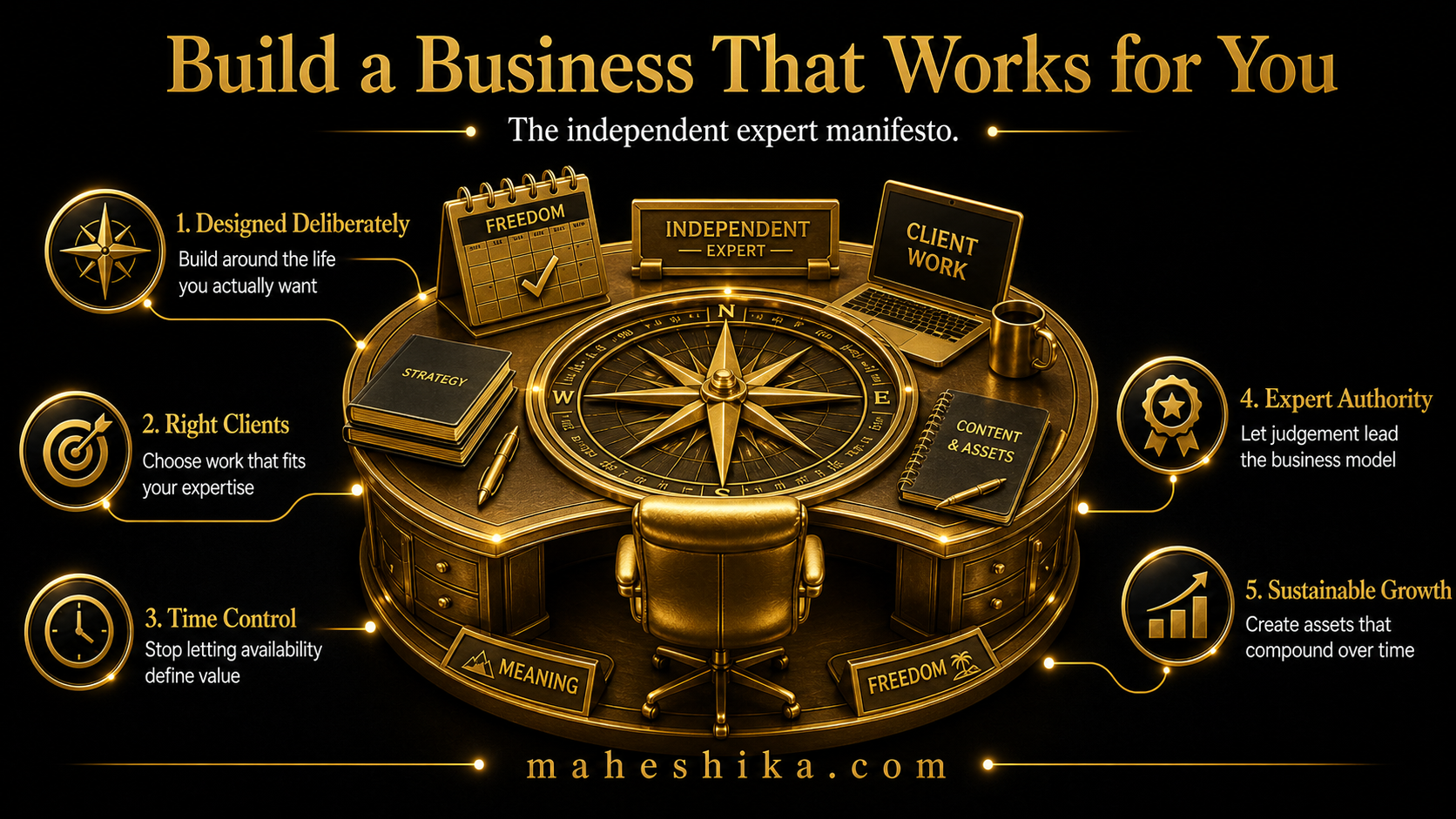
The business works for you, rather than you working for the business, because you designed it that way. The clients, the engagements, the pace, the focus: all of it reflects deliberate choices rather than the accumulated demands of other people's priorities. That is not a small thing. For most people who have spent their careers inside organisations, it is an entirely new experience of professional life. And it is available.
Free Tool
Start free: where do you actually stand?
Two free tools give you an honest answer in minutes. The AI Risk Score shows how exposed your role is. The Expertise Ownership Score shows how findable and owned your expertise is.
AI Risk Score Expertise Ownership ScoreThe Question You Are Actually Asking
If you have read this far, you are not asking whether an independent business is possible in the abstract. You already know it is possible. Other people are doing it. You can see it. The question you are asking is whether it is possible for you, specifically. Whether your expertise is specific enough, valuable enough, distinct enough. Whether you have what it takes to do this without the safety net of a salary and a structure. Whether it is too late, or whether you have waited too long, or whether the risk is too high given your circumstances.
These are not academic questions. They are the actual questions, and they deserve a real answer rather than generic reassurance.
The answer, in my experience working with the people who ask them, is almost always the same: the expertise is there. The capability is there. The track record is there. What is usually missing is not the ability to do this, but the clarity about how to position it, the structure to build it, and the specific next step to take. Those are solvable problems. They are not character flaws or capability gaps. They are just problems, and problems have solutions.
The Job Well Done
I spent 18 years doing a job well done inside organisations that were not mine. I am grateful for those years. They built the expertise, the network, the understanding of how commercial ecosystems actually function, and the judgement that now forms the foundation of everything I do independently. I do not regret them.
But I am more grateful for the decision to take that expertise and build something that is mine. To write under my own name. To consult on my own terms. To build AI-powered platforms because I find them genuinely interesting and because they serve the people I work with. To speak on stages about things I actually believe rather than things the organisation needed me to say. To produce one hundred articles about the topics I care most about and give them to anyone who wants to read them.
This is what the job well done looks like when you are working for yourself. Not for a metric. Not for a grade. Not for an appraisal cycle. For the work itself, and for the people the work serves.
That is what I want for you.
The Foundation Under Everything I Have Written
So here is the answer, after one hundred articles: a business that works for you is not a personality trait or a stroke of luck. It is a structure you build, deliberately, around expertise you already have. The professionals who make this transition well are not braver than everyone else. They simply stop waiting for permission and start building the thing that makes their knowledge visible, priced properly, and theirs.
But there is one realisation this whole manifesto has been circling, and I want to say it plainly. The organisation that once made you visible is no longer doing that job, or will not be for much longer. And increasingly, when someone searches for the kind of expertise you have, what they find first is an AI-generated answer written in nobody's voice, standing in for yours. If you have not claimed a place of your own, that is the answer they get instead of you.
A personal website under your own name changes that. Not a job title. Not a platform profile you have rented. Not a directory listing. A home where your thinking, your work, and your name live together, owned outright, findable by anyone searching for what you know. It is not a nice extra to a job well done. It is the one asset that keeps doing the work of being found, long after any employer's structure would have stopped.
That is the actual next step behind everything I have written in this series, and you do not have to work out how to build it alone. If you are ready to put your name on something that is finally yours, let us talk.