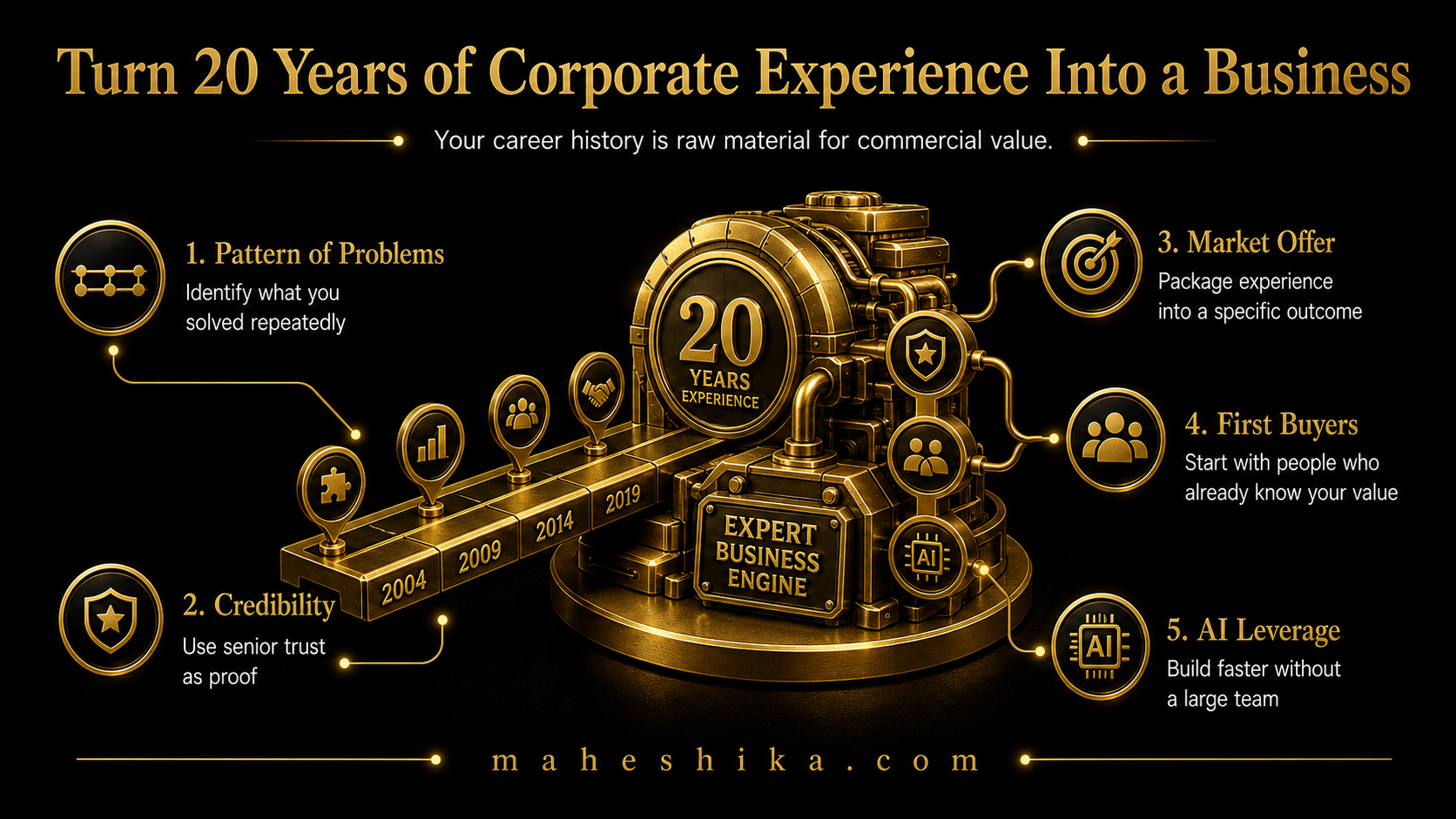
Twenty years of corporate experience is not a CV entry. It is a body of knowledge, a set of hard-won judgements, a network of professional relationships, and a track record of outcomes that most people in the market could not replicate if they tried. The question is not whether it has value. The question is how to unlock that value outside the structure of an employer who has, until now, been the container for all of it.
That translation, from employee expertise to independent business, is the most important professional work you will ever do. And it is more achievable than the conventional narrative around entrepreneurship suggests.
What Corporate Life Actually Gives You
Two decades inside large organisations builds things that cannot be taught in a classroom or acquired through a business school programme. You have managed complexity: commercial, political, human, operational. You have operated at the intersection of strategy and execution, where most of the real decisions happen. You have built relationships with the kinds of clients, partners, and stakeholders who pay serious money for serious outcomes.
You also have something less tangible but equally valuable: pattern recognition. You have seen enough situations that you know, often quickly, what is actually going on and what actually needs to happen. That is not experience. That is expertise. And expertise is what independent businesses are built on.
The challenge is that corporate life also builds habits that work against independence. The habit of waiting for sign-off. The habit of attributing success to the team or the brand rather than to your own contribution. The habit of measuring your worth through salary bands rather than market value. These habits are understandable. They are also the ones that need to change.
The Extraction Problem: Getting Your Expertise Out
The first practical challenge is extraction: articulating what you actually know, in terms that make sense outside the specific context of your former employer. This is harder than it sounds. Most experienced professionals describe their expertise in the language of their organisation: internal frameworks, proprietary methodologies, functional titles. None of that translates directly to the market.
The extraction process involves asking better questions. Not "what did I do?" but "what did I make possible?" Not "what was my role?" but "what problems did I solve?" Not "what were my responsibilities?" but "what outcomes would not have happened without my involvement?" The answers to these questions are the raw material of your independent positioning.
Start with a simple audit. List the ten most significant contributions you made in the last five years. For each one, identify: the problem that existed before you engaged, what you specifically did, and the outcome that resulted. You now have ten case studies. These are not just content for your website. They are the evidence base for every conversation you will have with a prospective client.
Related Reading
What to Carry Forward, and What to Leave Behind
Not everything from your corporate career translates. Some of it needs to stay behind, not because it was bad, but because it belongs to a different context.
Carry forward: your subject matter expertise, your professional relationships, your track record, your understanding of how organisations make decisions, and your ability to communicate at senior level. These are assets. Price them accordingly.
Leave behind: the internal politics, the approval processes, the identity that was tied to a specific title or brand, and the assumption that your next move needs to look like your last one. Independence is not a continuation of employment by other means. It is a genuinely different structure, and it requires a genuinely different orientation.
One thing worth examining carefully is your professional identity. If you have spent 20 years being "the Head of Commercial at X" or "the VP of Strategy at Y," that identity has a lot of weight. The transition to independence asks you to build a new identity: not around a job title or an employer, but around your expertise, your point of view, and the clients you serve. That shift takes time. Give it the time it needs.
Free Tool
Start free: where do you actually stand?
Two free tools give you an honest answer in minutes. The AI Risk Score shows how exposed your role is. The Expertise Ownership Score shows how findable and owned your expertise is.
AI Risk Score Expertise Ownership ScoreThe Business Structure That Fits Expertise
An independent business built on expertise does not need to be complicated. The core model has three components: consulting (where you apply your expertise directly to client problems for a fee), speaking and facilitation (where you share your expertise with audiences and groups), and intellectual property (books, frameworks, programmes, or digital products that embody your thinking).
These three components work together. Consulting gives you immediate revenue and deepens your expertise through client work. Speaking builds your reputation and extends your reach. Intellectual property creates assets that attract clients and generate income without your direct time investment. Most independent experts start with consulting and add the others as they build. That sequencing makes sense.
What does not make sense is waiting until you have all three before you start. Start with what you can sell now. Your expertise, applied directly to a problem someone is willing to pay to solve. Everything else can follow.
The Income Transition: Making the Numbers Work
The practical concern for most senior professionals considering independence is income. Corporate salaries at senior levels are substantial, and the transition to building your own business involves a period of uncertainty. This is real, and it deserves a direct answer.
The consulting rates available to genuinely senior professionals are substantially higher than most people assume. Day rates for experienced commercial, strategic, or technical consultants in competitive markets are meaningful. A single retained consulting engagement can replace a significant proportion of a previous salary. The maths works, but only if you price your expertise at its actual market value, which is almost always higher than your first instinct suggests.
The transition is more comfortable when you begin it before you leave. Building your positioning, testing your offer with conversations, and identifying your first two or three prospective clients while still employed reduces the gap between your last salary and your first consulting income. Not everyone has that luxury. But those who do should use it.
The Asset That Makes the Translation Permanent
So the translation from employee to independent expert is not one dramatic leap. It is extraction, naming what you actually know in terms the market understands, structure built in the right order, and pricing your expertise at what it is genuinely worth, which is almost always higher than your first instinct. Get those three right and the numbers work.
But here is what the corporate structure did for you without you ever noticing: it made you visible. The title on the door, the logo in your email signature, the org chart, all of it told the market who you were before anyone had to ask. Walk away from that structure and the visibility walks away with it. Twenty years of expertise, and suddenly nowhere for anyone to find it.
That gap matters more now than it ever has. AI can answer almost any question today, in a voice that sounds like everyone else who asked it. The professionals who still get chosen, still get the call, still command the day rate, are the ones with a place of their own: a personal website under their own name, where the ten case studies you just built have a permanent home, where your thinking is on the record, where your signature is unmistakable. Owned outright. Findable in a search. Impossible to flatten into a generic answer.
That is the one move worth making before any of the others. You do not have to work it out alone. If you want help building it properly, by someone who has made this exact transition herself, let us talk.