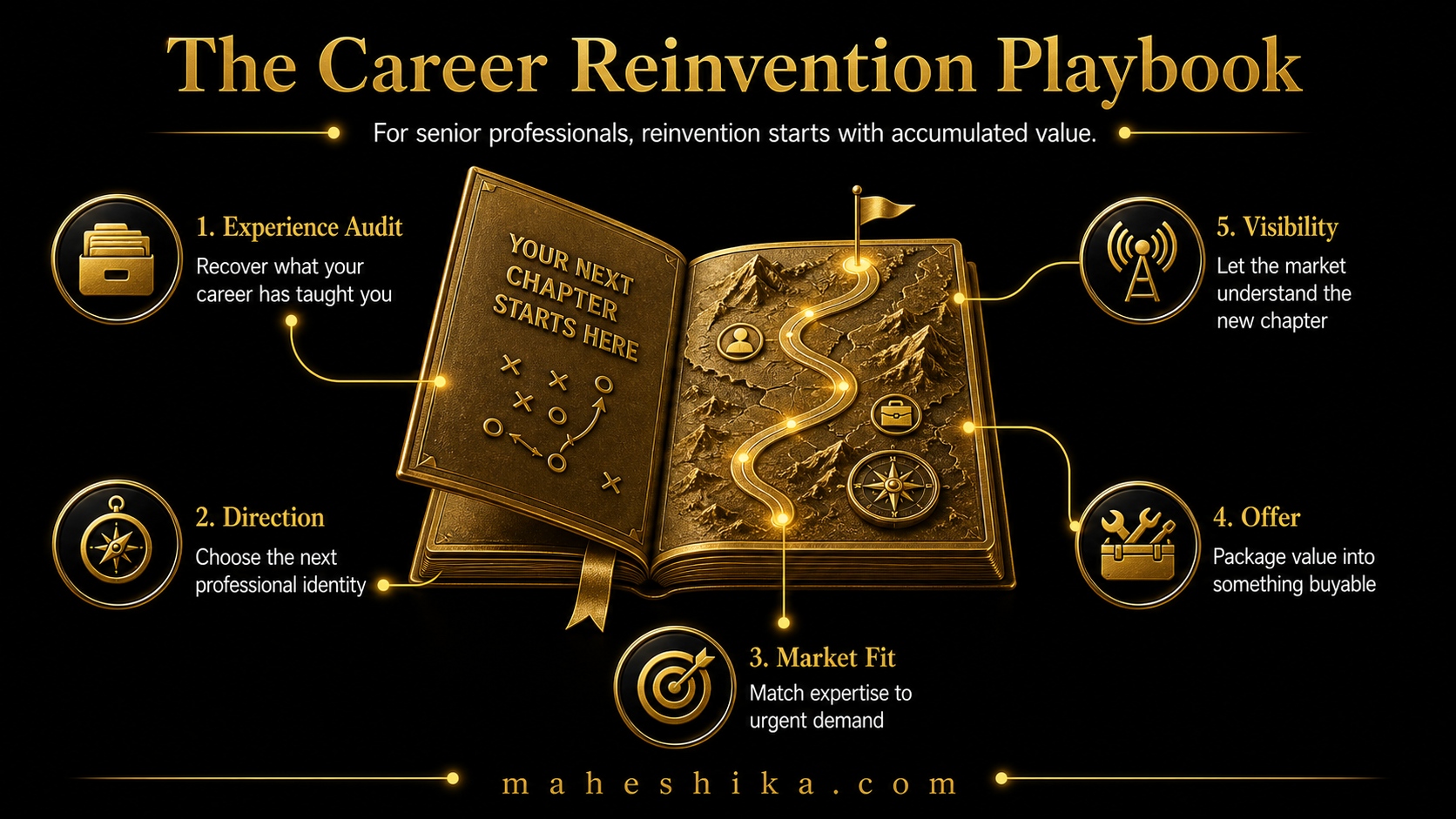
Most career reinvention advice is written for people in their twenties. It assumes you are starting from scratch, have little to lose, and possess infinite energy for hustle. If you are a senior professional with 15 or 20 years of real experience behind you, most of that advice is not only useless: it is actively misleading. You are not starting from scratch. You are starting from somewhere extraordinary. The work is not to build from zero. The work is to recognise what you already have, and translate it into something that works on your terms.
This is that playbook.
Step 1: Assess, Honestly and Completely
The first step is an audit, not a pivot. Before you decide what to do next, you need an accurate picture of what you are actually bringing to the table. This is harder than it sounds, because most experienced professionals systematically undervalue their own expertise. You have done things so many times that they feel ordinary. They are not ordinary. They are rare.
Write down the last five significant outcomes you drove. Not your job titles. Not your responsibilities. The outcomes: the commercial results, the problems you solved, the things that would not have happened without you. Now ask yourself who would pay to achieve those same outcomes. That list is your starting market. The overlap between what you do well, what you enjoy, and what the market will pay for generously is where your independent business lives.
Assess your situation honestly too. Do you have financial runway? Six to twelve months is sensible. Do you have relationships in your industry that are genuinely warm? Do you have a point of view that is distinct, or are you still defaulting to the language of the organisation you left? These answers shape your timeline and your first moves.
Step 2: Position Around a Specific Problem
Positioning is the work that most senior professionals avoid, because it requires saying no to things. After years of being valued for breadth, being asked to narrow down feels like shrinking. It is not shrinking. It is focusing. And focused expertise commands dramatically higher fees than broad availability.
The most effective positioning for a senior professional follows a simple formula: you help a specific type of client achieve a specific outcome, using the specific experience that makes you credible. Not "I help companies improve their commercial performance." Something closer to: "I help mid-market SaaS companies entering EMEA build commercial frameworks that actually convert, based on 15 years of doing exactly that at enterprise level."
Your positioning does not need to be permanent. It needs to be clear enough to be actionable. You can refine it as you work. The mistake is launching without any positioning at all and waiting for the market to tell you what to offer. The market will not tell you. You have to lead.
Related Reading
Step 3: Package Your Expertise Into Offers
Positioning tells the market what you do. Packaging tells them how to buy it. This step is where most senior professionals either stall or significantly underprice themselves, and both outcomes are avoidable.
There are three core ways to package senior expertise: consulting engagements, speaking and facilitation, and intellectual property (books, frameworks, programmes). Each has a different economics and a different role in your business. Consulting gives you immediate income and deep client relationships. Speaking builds your reputation and reach. Books and programmes create authority and attract inbound clients even when you are not actively selling.
Start with consulting, because it generates revenue quickly and sharpens your thinking faster than anything else. But package it deliberately. Define what a client engagement looks like: what you deliver, over what timeframe, at what investment. Having a structured offer is not about being inflexible. It is about signalling that you are serious and experienced, not someone still figuring out what they are selling.
Your first offer does not need to be perfect. It needs to be good enough to take to the market, get a response, and improve from there.
Free Tool
Start free: where do you actually stand?
Two free tools give you an honest answer in minutes. The AI Risk Score shows how exposed your role is. The Expertise Ownership Score shows how findable and owned your expertise is.
AI Risk Score Expertise Ownership ScoreStep 4: Launch With Precision, Not Volume
The conventional wisdom about launching an independent business involves posting constantly on LinkedIn, cold emailing hundreds of strangers, and waiting for the algorithm to deliver. That approach can work. It is also exhausting, and it is not the only way. For senior professionals with real networks and genuine track records, the more effective launch is precision-based: identify the 20 people who know your work, respect your judgement, and sit inside the world you want to serve. Have real conversations with them. Tell them specifically what you are now doing and what kind of client you are looking for. Ask one question: who do you know who might benefit from this?
Your first clients will almost certainly come from your existing network. Not because you sent a mass announcement, but because you had a direct, specific conversation with the right person at the right moment. This is not networking in the transactional sense. It is honest communication between people who already have context and trust.
At the same time, begin building your digital presence. Not to replace conversation, but to provide a place for people to land when they are curious about you. A clean, well-positioned website. A LinkedIn profile that speaks to your ideal client rather than your former employer. A piece of writing that demonstrates how you think. These assets compound over time. Start them early, even if they are not perfect.
The Mindset Shift That Makes All of This Work
The playbook above is practical and sequenced. But every step of it depends on a prior shift: from employee thinking to owner thinking. An employee delivers what is asked. An owner decides what is worth doing, designs the thing, prices it, and stands behind it completely. That shift is not automatic. It takes deliberate practice, and for many experienced professionals, it takes longer than they expect.
The clearest sign that you have not yet made the shift is that you are still waiting for permission. Waiting for someone to validate your positioning before you commit to it. Waiting until your website is perfect before reaching out to potential clients. Waiting until you feel ready, which is a state that never quite arrives.
You already have the experience. You already have the judgement. The reinvention is not about becoming a different person. It is about applying who you already are to a context that is finally yours.
The One Asset That Makes the Reinvention Permanent
So the playbook is not four dramatic decisions. It is an honest audit, a clear position, a packaged offer, and a precise launch, done in that order, without waiting for permission that will never arrive. That sequence is what separates the professionals who reinvent well from the ones who circle the idea for years.
But there is a quieter risk sitting underneath the whole playbook, and it is the one most people do not see until it is too late. When you leave the organisation, you also leave the thing that made you findable. The title, the company page, the internal directory that told the market who you were and what you knew. Twenty years of judgement and results suddenly live nowhere anyone outside your contacts can see them. And in a market where AI now answers most questions in a voice that sounds like everyone else, the professionals who stay visible are the ones who have somewhere of their own to be found.
A personal website under your own name. Somewhere your positioning is stated plainly, your track record is shown, and your signature on the work is unmistakable. Owned outright, not rented from an employer or a platform, and impossible to flatten into a generic answer. That is not a finishing touch on the reinvention. It is the asset that keeps the whole playbook working long after the first burst of conversations has faded.
You do not have to build that asset alone, and you do not have to leave it for later. If you want it built properly, by someone who has made this exact move, let us talk.