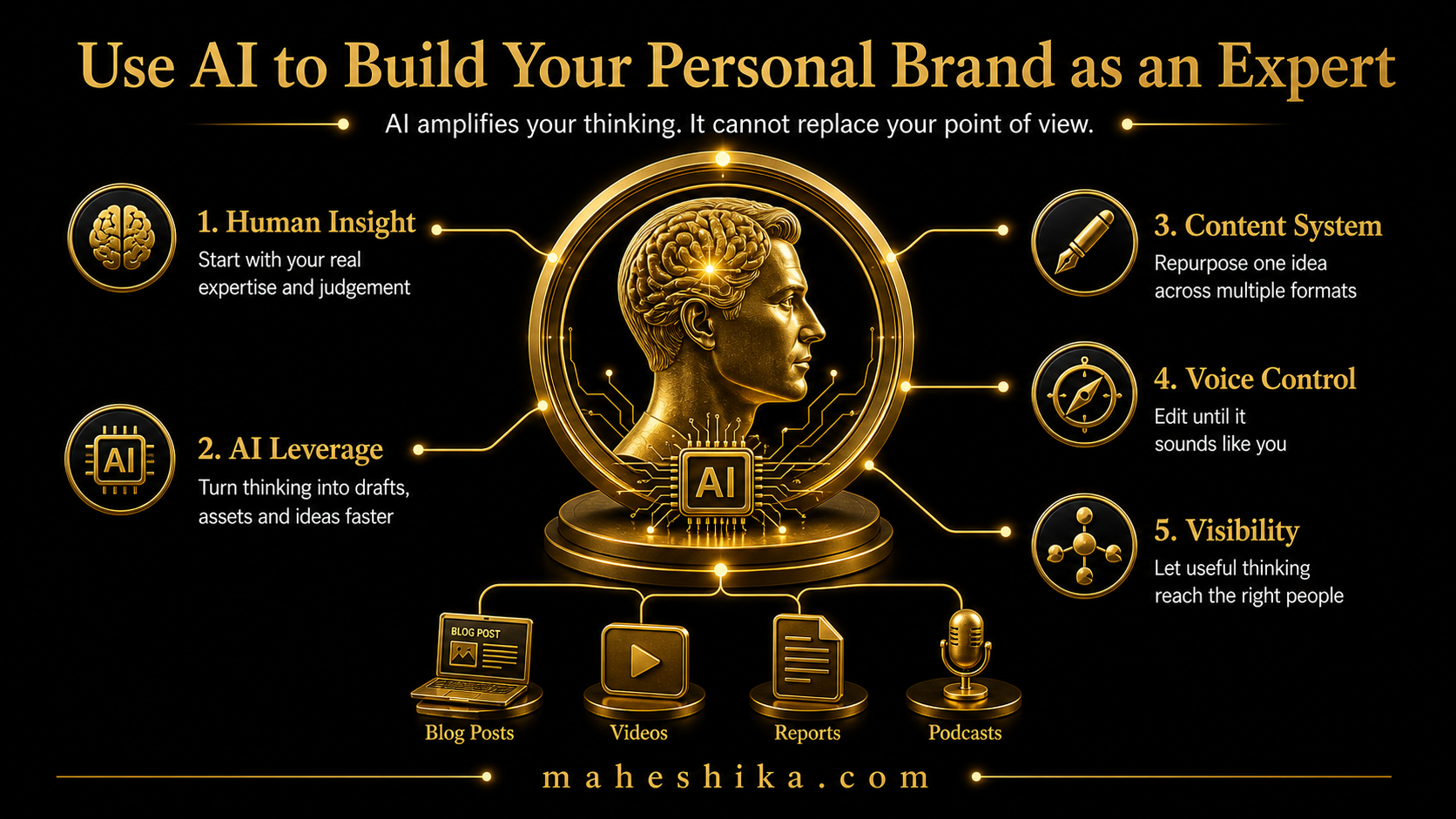
The objection I hear most often when I talk about using AI to build a personal brand is some version of: "But won't it sound fake?" It is a fair question. Personal brands are built on authenticity, on the sense that a real person with real views is speaking directly to you. If an AI is generating the words, where does the authentic human go?
Here is my honest answer, as someone who uses AI every single day in my own work: AI does not replace your voice. It amplifies it. The distinction matters more than almost anything else in understanding how to use these tools well.
The Real Bottleneck in Building a Personal Brand
For most experienced professionals, the problem with building a personal brand is not a shortage of ideas. It is a shortage of time and structure. You have the knowledge. You have the point of view. You have years of observations and frameworks and hard-won judgements that would genuinely help people if they were expressed clearly. The bottleneck is the translation: getting what is in your head into a form that works on a platform, reaches the right people, and builds up over time into a recognisable body of thought.
That translation work is exactly where AI is useful. Not as a replacement for your thinking, but as an accelerant for getting your thinking into the world more efficiently and more consistently.
Where AI Genuinely Helps
Let me be specific, because the generic advice to "use AI for content" is not especially useful.
Content ideation. I use AI to generate content angles from a single core idea. If I have a view on, say, why senior professionals undervalue their consulting rates, I can prompt an AI to give me ten different ways to explore that idea: the counterintuitive take, the personal story angle, the practical framework version, the research-backed argument. I then choose the angle that fits the moment and the platform. The thinking is mine. The range of expression is wider than I would reach alone.
First drafts from rough notes. I often speak faster than I write. I record a voice note with my thinking on a topic, transcribe it, and give it to Claude with a clear prompt about tone and format. What comes back is a structured draft that already sounds approximately like me, because it was built from my words. Editing a rough draft takes far less time than writing from nothing.
Repurposing at scale. One piece of substantive thinking, say a long article or a conference talk, contains multiple LinkedIn posts, an email to your list, a short video script, and a carousel. AI can extract and adapt these quickly. The expertise was created once. The distribution is multiplied.
SEO and structure. AI is good at thinking through search intent, identifying the questions your ideal clients are actually asking, and structuring content to address them effectively. This is not creativity. It is architecture. Let AI handle the architecture so you can concentrate on the substance.
Related Reading
Where AI Cannot Help, and Where It Can Harm
AI cannot give you a point of view. It cannot tell you what you believe, what you have experienced, or what you stand for. If you use AI without any of your own thinking as input, you will produce content that is technically competent, broadly inoffensive, and completely forgettable. Personal brands are not built on content that is broadly inoffensive. They are built on content that makes the right people feel that someone finally said exactly what they were thinking.
The harm is subtle. If you let AI define the content rather than produce it, your output starts to converge toward the mean: the same angles, the same advice, the same framing as everyone else using the same tools. The way to avoid this is to ensure that every piece of AI-assisted content begins with your original thinking. Your experience. Your observation. Your disagreement with the received wisdom. The AI handles the expression. You supply the substance.
Free Tool
Start free: where do you actually stand?
Two free tools give you an honest answer in minutes. The AI Risk Score shows how exposed your role is. The Expertise Ownership Score shows how findable and owned your expertise is.
AI Risk Score Expertise Ownership ScoreA Practical Workflow for the Time-Poor Expert
Here is the workflow I use and recommend. On Monday, spend 20 minutes identifying three things you believe, observed, or would push back on this week. These are your content seeds. They come from you, not from a prompt. Then use AI to expand each seed into a working draft: a LinkedIn post, an article outline, a short video script. Spend another 20 minutes editing each one so it genuinely sounds like you. Publish across the week.
That is roughly an hour a week to maintain a consistent, substantive presence that reflects your actual expertise. Not perfect. Not volume for volume's sake. But enough to be visible, recognisable, and credible to the people you most want to reach.
The professionals who are building the most effective personal brands right now are not the ones posting most frequently. They are the ones whose content is most distinctly theirs, most consistently useful, and most clearly positioned for a specific audience. AI helps you sustain that without burning out.
The One Asset AI Cannot Write For You
So no, using AI to build your personal brand does not make it fake. It makes it possible. AI amplifies the range and the reach. You still supply the belief, the experience, and the disagreement with the received wisdom that make the content worth reading in the first place. Handled this way, an hour a week is enough to build a body of thought that is unmistakably yours.
But there is a question underneath this one that most people never ask: yours, published where? A LinkedIn post is borrowed space. A platform can change its algorithm, bury your reach, or simply stop existing in its current form. And the more AI writes in a voice that sounds competent and interchangeable, the more a platform post that could have come from anyone starts to disappear into the noise, however sharp your thinking was.
What does not disappear is a home. A personal website under your own name, where every piece of that AI-assisted thinking actually lives, in one place, building into a body of work that a search engine can find and a client can point to as proof. Owned outright. Not rented from a feed. That is the difference between content that amplifies your voice for a week and an asset that keeps making the case for you long after you have moved on to the next idea.
You do not have to work out how to build that on your own. If you want your AI-assisted thinking to live somewhere it compounds instead of scrolling away, let us talk.