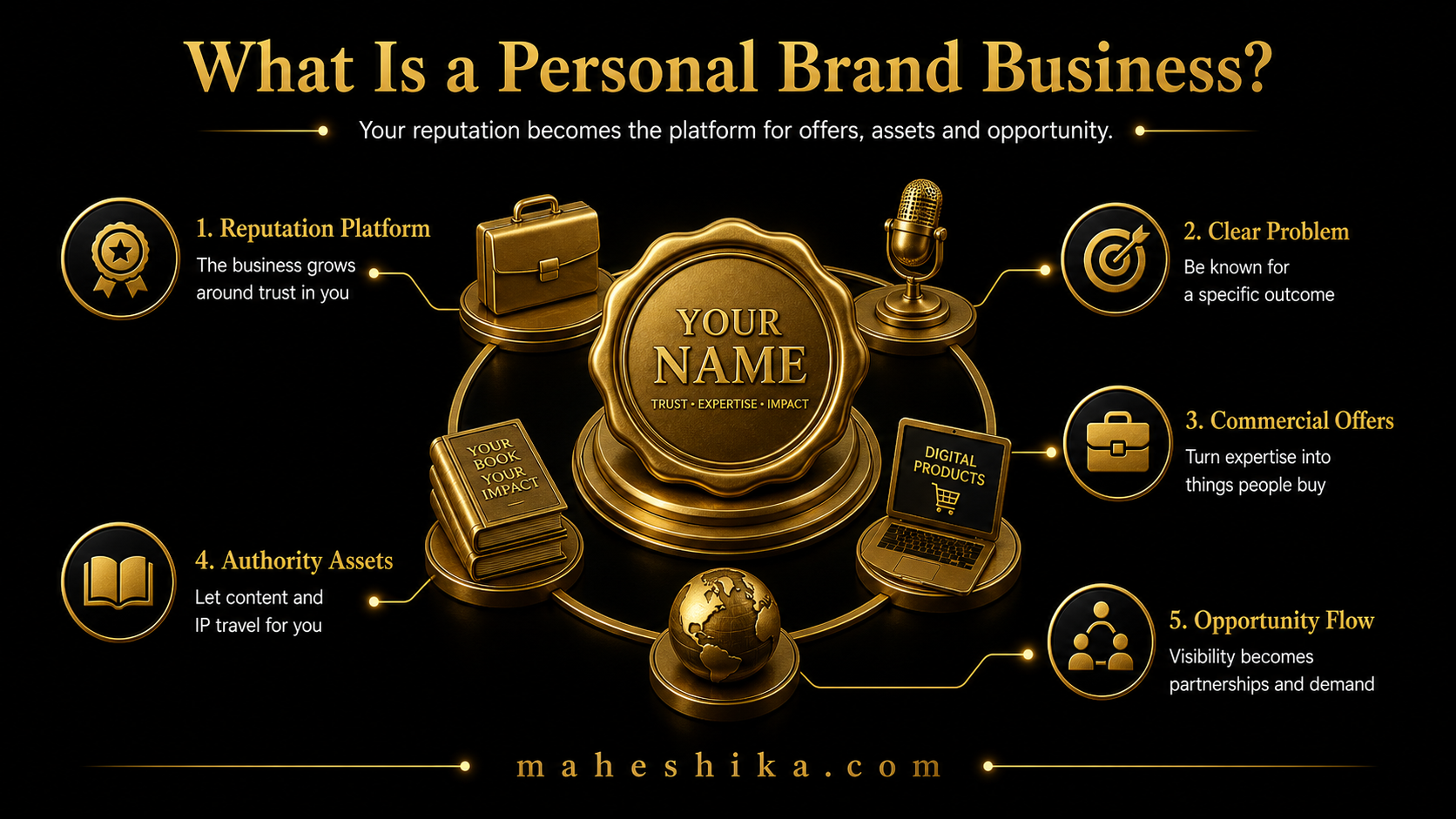
The phrase "personal brand" gets used in a lot of different ways, and not all of them are helpful. It appears in career advice about polishing your LinkedIn profile. It appears in influencer culture, usually attached to content strategies designed to manufacture likability at scale. And it appears in the context of genuine expertise-led businesses where a person's name, reputation, and body of work are the primary commercial assets.
That last version is the one worth understanding, because it is a real and serious business model. It is also the one most relevant to experienced professionals considering independence.
A Clear Definition
A personal brand business is a business where the primary commercial asset is the reputation, expertise, and identity of a specific individual. The individual is not interchangeable. Clients, audience members, and buyers engage because of who that person is and what they specifically know or believe. You cannot sell the business by replacing the person at the centre of it.
This is distinct from a consultancy that happens to be named after its founder but could operate without them. It is distinct from a product business where the founder's name is on the packaging but the product stands alone. A personal brand business is, at its core, a business built around a person's knowledge and point of view.
The commercial expressions of this model include consulting engagements, speaking and keynotes, books and intellectual property, group programmes, advisory relationships, and digital products. What they have in common is that people buy them because they want access to a specific person's thinking, not just the category of service.
The Genuine Advantages
A personal brand business has structural advantages that other business models do not.
Premium pricing. When clients buy you specifically, rather than a commodity service, price sensitivity is lower. A client who wants your particular perspective on their commercial strategy is not cross-shopping you against three other consultants on a framework comparison. They want you. That dynamic changes the pricing conversation entirely.
Inbound lead flow over time. A strong personal brand generates inbound interest, people who find you through your writing, speaking, or reputation and reach out directly. This is categorically different from outbound business development, which is expensive, time-consuming, and often demoralising. The personal brand does the reaching out on your behalf, continuously, even when you are not actively selling.
Compound value. Every piece of content you publish, every talk you give, every article that circulates adds to the body of work associated with your name. Unlike most business investments, this one does not depreciate. It compounds. A book written five years ago is still introducing new people to your thinking today.
Alignment. You are building something that reflects your actual expertise, your actual values, and your actual point of view. That alignment is more sustaining over the long term than working within someone else's structure and someone else's agenda.
Related Reading
The Real Limitations to Consider
Honest advice requires acknowledging the limitations too.
A personal brand business is not scalable in the traditional venture sense. You cannot hand it off to a management team and exit. The asset is you, which means it has natural limits in terms of how large it can grow without structural changes like licensing your methodology, training others to deliver it, or building a programme-based model that reduces dependency on your direct time.
It also requires consistent visibility. You need to be willing to share your thinking publicly, to have a point of view and express it, and to show up in your industry as a recognisable voice. For some people this is energising. For others it is genuinely uncomfortable, and that discomfort is worth factoring in honestly before committing to the model.
Finally, reputation is fragile. A personal brand business is dependent on your credibility, which means that how you conduct yourself matters across every interaction: client work, public communications, professional relationships. There is less institutional protection than in corporate employment. Your reputation is yours to build and yours to protect.
Free Tool
Start free: where do you actually stand?
Two free tools give you an honest answer in minutes. The AI Risk Score shows how exposed your role is. The Expertise Ownership Score shows how findable and owned your expertise is.
AI Risk Score Expertise Ownership ScoreWhere This Answer Actually Lives
So here is the honest test, distilled. A personal brand business is right for you if you have genuine expertise in a defined area, a point of view that is actually yours rather than borrowed from the mainstream, and a willingness to be visible. If those three are present, this is not just a viable model, it is the one that lets everything you have built finally compound instead of resetting each time you change employer. If one of them is missing, that is useful information too, and there is no shame in choosing a different structure.
But knowing you are the right fit only matters if you also know where that brand is meant to live. Right now, most of what you have built, your reputation, your track record, your point of view, sits scattered across a LinkedIn feed you do not own, a company bio that disappears the day you leave, and search results that AI is increasingly summarising in a voice that sounds like everyone else's. When a title can vanish overnight and an algorithm can answer a client's question without ever naming you, decades of hard-earned expertise stop being findable unless you have given them a home.
That home is a personal website under your own name. Not a profile you are renting from a platform, but a place you own outright: your thinking, your work, your signature, unmistakably yours and impossible for an algorithm to flatten into a generic answer. In a personal brand business, it is the one asset nothing and no one can take from you.
If you have decided this model is right for you, or you are close and want to think it through properly with someone who has built exactly this, let us talk.