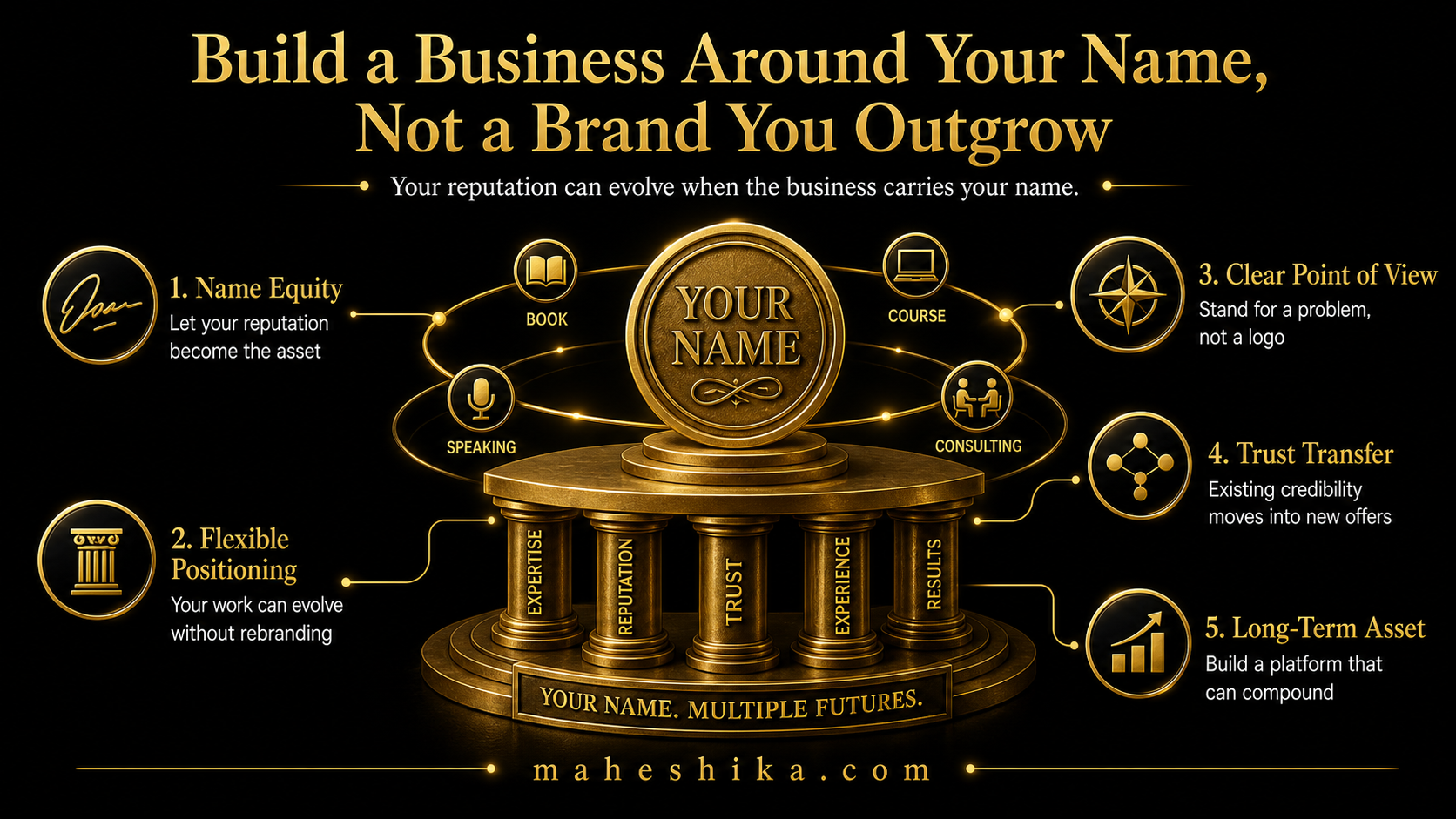
When most people consider going independent, one of the first decisions they face is what to call the business. The temptation is to invent a name. Something that sounds professional. Something that signals the category: "Strategic Consulting Partners" or "Apex Advisory Group" or "Clarity Solutions." Something that creates, in theory, a brand that is larger than one person and could eventually be sold or scaled.
I want to make the case that for most senior professionals building an expertise-led independent business, this is the wrong choice. And I want to explain exactly why building under your own name is both smarter and more durable.
The Problem With Invented Business Names
The logic behind inventing a business name is understandable. It feels more professional. It creates a separation between you and the entity. It signals that this is a real business, not just a freelancer operating under their own name. And if you want to sell the business someday, you need a brand that is not just you.
The problem is that for expertise-led businesses, the invented name creates a brand you will almost certainly outgrow, and often one that actively obscures the very thing your clients are buying: you. When someone hires you as an independent consultant, they are hiring your judgement, your experience, and your specific way of seeing a problem. "Apex Advisory Group" tells them nothing about any of that. Your name, when it is associated with a clear body of work and a recognised expertise, tells them everything.
There is also a compounding problem. Every piece of content you produce, every talk you give, every article that circulates builds equity in a name. If that name is your own, the equity accrues to you permanently and travels with you across every evolution your business takes. If it is an invented brand, you are building equity in a container that may no longer fit you in five years.
Your Name as a Commercial Asset
The most powerful personal brands in any professional field are built around names, not invented entities. This is not accidental. A name is the most direct signal of accountability. When someone puts their name on their work, on their website, on their books and speaking engagements, they are taking full responsibility for it. That signal matters to high-value clients.
Think about the advisors, authors, and consultants in your own field whose work you respect. The ones who command the highest fees and the most interesting mandates are almost always known by their names. The name is the brand, because the expertise is the product and the expertise is inseparable from the person.
Building your business under your own name is also a positioning decision. It signals confidence. It says: I am not hiding behind a corporate-sounding entity. I am the expert. My track record is what you are buying. Clients who are serious enough to pay senior consulting rates appreciate that clarity.
Related Reading
What Building Under Your Name Actually Requires
Committing to your own name as the business means committing to a few things that invented brands allow you to avoid.
It requires a clear and well-articulated expertise. If your business is your name, your name needs to be associated with something specific and valuable. Not "consulting" in the abstract. A defined area where you have genuine depth and a distinctive point of view. That definition is the work that comes before the website, before the LinkedIn profile, before any of the external expression.
It requires a body of work. Your name builds authority through what you produce: writing, speaking, frameworks, books, case studies. The more consistent and substantive that body of work, the more weight your name carries in the market. This does not happen overnight, but it does happen reliably if you build it intentionally.
It requires willingness to be visible. Building under your own name means being findable, recognisable, and associated with a clear expertise in your field. If that visibility feels uncomfortable, it is worth examining why, because the discomfort is usually more about old identity than genuine risk.
Free Tool
Start free: where do you actually stand?
Two free tools give you an honest answer in minutes. The AI Risk Score shows how exposed your role is. The Expertise Ownership Score shows how findable and owned your expertise is.
AI Risk Score Expertise Ownership ScoreWhat to Do If You Already Have an Invented Brand
If you have already built some equity in an invented brand name, this is not necessarily a reason to abandon it entirely. You can run the two in parallel: an entity that holds contracts and issues invoices, and your personal name as the public-facing brand that does all the positioning work. Many successful independent professionals do exactly this. The entity is administrative. The brand is personal.
The key is to ensure that your name is the thing that is visible and searchable, not the entity name. Your website, your LinkedIn, your book covers, your speaking profile: all of these should lead with your name, not the consultancy wrapper. The wrapper is a legal and financial convenience. The name is the asset.
The One Asset You Never Outgrow
So the answer is not "Apex Advisory Group." It is your name, held up as the thing you built your work around from the start. Thirty years from now, the asset that remains is the reputation attached to your name, not the consultancy name you chose in the first year or the logo you once commissioned. Build every piece of work, every talk, every client relationship toward that one name, and you are building something that outlasts any structure you put around it.
Here is the part that is easy to miss until it happens to you. An invented brand can be recoloured, merged, sold on, or quietly wound down, and none of it touches you personally. Your own name cannot be taken that way, but it also will not build itself. If you never give it a home, a search for your name turns up a scattered LinkedIn profile and whatever the algorithm decides to surface that week, and every year of expertise you have built sits with no address of its own.
That is the real cost of skipping this step: not a wrong choice, an invisible one. Your name is already the most valuable asset in your business. The only question is whether it points somewhere, or nowhere. In a market where AI can generate a plausible answer to almost anything, a name with no home is easy to overlook and easy to forget. A name with a home, one place online that is unmistakably yours, is the one thing that stays findable, stays credible, and stays entirely under your control.
That home is what I build. If you are ready to give your name the address it deserves, let us talk.