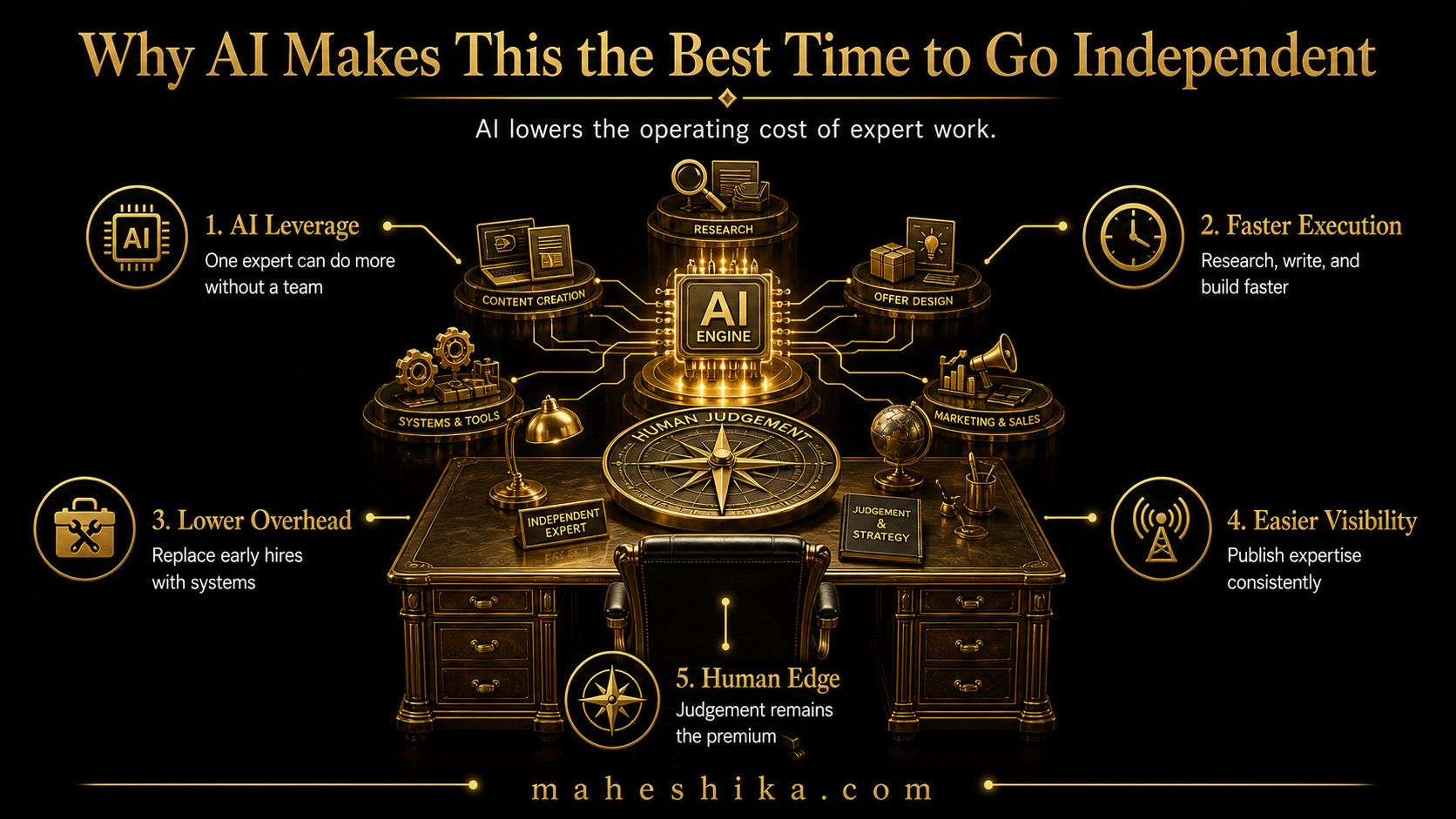
I want to make a specific claim and back it up properly: right now, in 2026, is the most favourable moment in professional history to build an independent expert business. Not because the desire to work independently is new, it has always existed. And not because expertise has suddenly become more valuable, genuinely rare expertise has always commanded premium rates. But because the three structural barriers that previously made independence difficult for most experienced professionals have been compressed to a fraction of their former size, and AI is the primary reason why.
Barrier One: Visibility and Reach
Building a professional reputation outside of an employer used to require either years of patient networking, a significant marketing budget, or the luck of being attached to the right institution at the right time. An independent consultant, however excellent, was largely invisible beyond their immediate network unless they had written a book or built a media profile over many years.
AI has changed the visibility equation fundamentally. A single experienced professional can now produce high-quality articles, social content, email communications, and video scripts consistently, without a content team, without a marketing budget, and without spending the majority of their working week on content creation. The thinking is yours. The velocity is AI-assisted. The result is a compounding body of work that builds visibility and credibility in your field, continuously.
This matters because visibility drives inbound. And inbound, where prospective clients find you rather than you pursuing them, is the most efficient and sustainable source of consulting enquiries. Before AI, building inbound at meaningful scale as an individual required either years of effort or significant investment. Now it is achievable within months for someone who engages with it deliberately.
Barrier Two: Operational Infrastructure
Running a professional independent business always required operational infrastructure: a website, a client management system, proposal templates, engagement documentation, research tools, and often a support person to manage the administrative overhead. All of this cost money, time, or both. It was a meaningful overhead that most people going independent significantly underestimated.
AI has removed most of this cost. A capable AI model can draft contracts, prepare proposals, structure research, write briefing documents, and manage a significant proportion of the administrative work of running a small business. A professional website that previously required a developer and a designer can now be built by someone with no technical background, using AI assistance, in a fraction of the time and cost.
The operational barrier to looking and functioning like a serious independent professional has essentially collapsed. This is not trivial. It removes a category of friction that previously deterred many capable people from making the move.
Related Reading
Barrier Three: Market Access and Positioning
Positioning an independent business well used to require either branding and marketing expertise, expensive consultants to help develop it, or years of trial and error in the market. Getting the language right, finding the message that resonates with the right clients, building a clear and compelling professional presence: these were skills that took time and money to develop or acquire.
AI accelerates this learning cycle significantly. You can test positioning language rapidly, develop multiple versions of your messaging, and iterate based on real market feedback far faster than was previously possible. The gap between "I have left my job and need to figure out my offer" and "I have a clear, well-positioned offering I am confident taking to market" has compressed from years to months for people who engage seriously with the process.
Free Tool
Start free: where do you actually stand?
Two free tools give you an honest answer in minutes. The AI Risk Score shows how exposed your role is. The Expertise Ownership Score shows how findable and owned your expertise is.
AI Risk Score Expertise Ownership ScoreThe Demand Side Has Also Shifted
While AI has lowered the supply-side barriers to going independent, the demand side has also moved in favour of independent experts. Organisations are restructuring. Headcount is being scrutinised. Many companies that previously employed senior leaders full-time now find it more efficient to access that expertise on a retained or project basis. The market for independent senior expertise is growing, not shrinking.
At the same time, AI is automating the more routine elements of professional work, which means the premium is shifting further toward the genuinely rare: deep expertise, contextual judgement, senior-level relationships, and the ability to navigate complex organisational situations. These are things that experienced professionals have in abundance, and things that AI makes more commercially accessible by removing the operational overhead that previously diluted how much time experts could spend on the work that is actually rare.
What This Means Practically
If you are an experienced professional who has considered independence but concluded the barriers were too high, it is worth revisiting that conclusion with the current landscape in mind. The cost of building a professional presence has collapsed. The time required to reach a visible and credible market position has compressed. The operational overhead of running a small expert business is lower than it has ever been.
What has not changed is the requirement for genuine expertise and the willingness to do the strategic work of positioning, offer design, and client development. AI is an accelerant, not a substitute for those things. But for someone who has the expertise, the moment has never been more favourable.
The One Barrier AI Cannot Remove For You
So here is the direct answer to the question this article set out to settle: yes, 2026 is the most favourable moment in professional history to go independent. The visibility barrier has collapsed, the operational barrier has collapsed, and the positioning barrier has compressed from years to months. If you have genuine expertise, the structural excuses that once made independence feel too risky no longer hold up.
But timing removes barriers, it does not build the thing that actually protects you once you are through them. AI can write your content, draft your proposals, and shorten your positioning cycle, and it can do exactly the same for every other professional making this move alongside you. When AI can answer almost any question in a voice that sounds like everyone else, the professionals who still get remembered are the ones who are not relying on borrowed ground: a LinkedIn algorithm, a directory listing, a former employer's domain, to be found.
What secures your place is where that expertise lives. A personal website under your own name, owned outright, is the one asset in this whole equation that nobody can deprecate, de-rank, or reshuffle out from under you. It is where your thinking, your proof, and your signature sit permanently: findable in a search, impossible to mistake for a generic answer. Everything else in this article compresses the time it takes to build the business. This is what makes the business unmistakably yours once it is built.
If you have done the work of getting your expertise ready to go independent, the next move is making sure it has a proper home. I build that home for experienced professionals who are ready to be found under their own name. Let us talk.